
Finding a few little dark pellets inside a cabinet is one of those moments when you really hope you’re looking at spilled food.
Sometimes you are.
Sometimes you’re looking at mouse droppings.
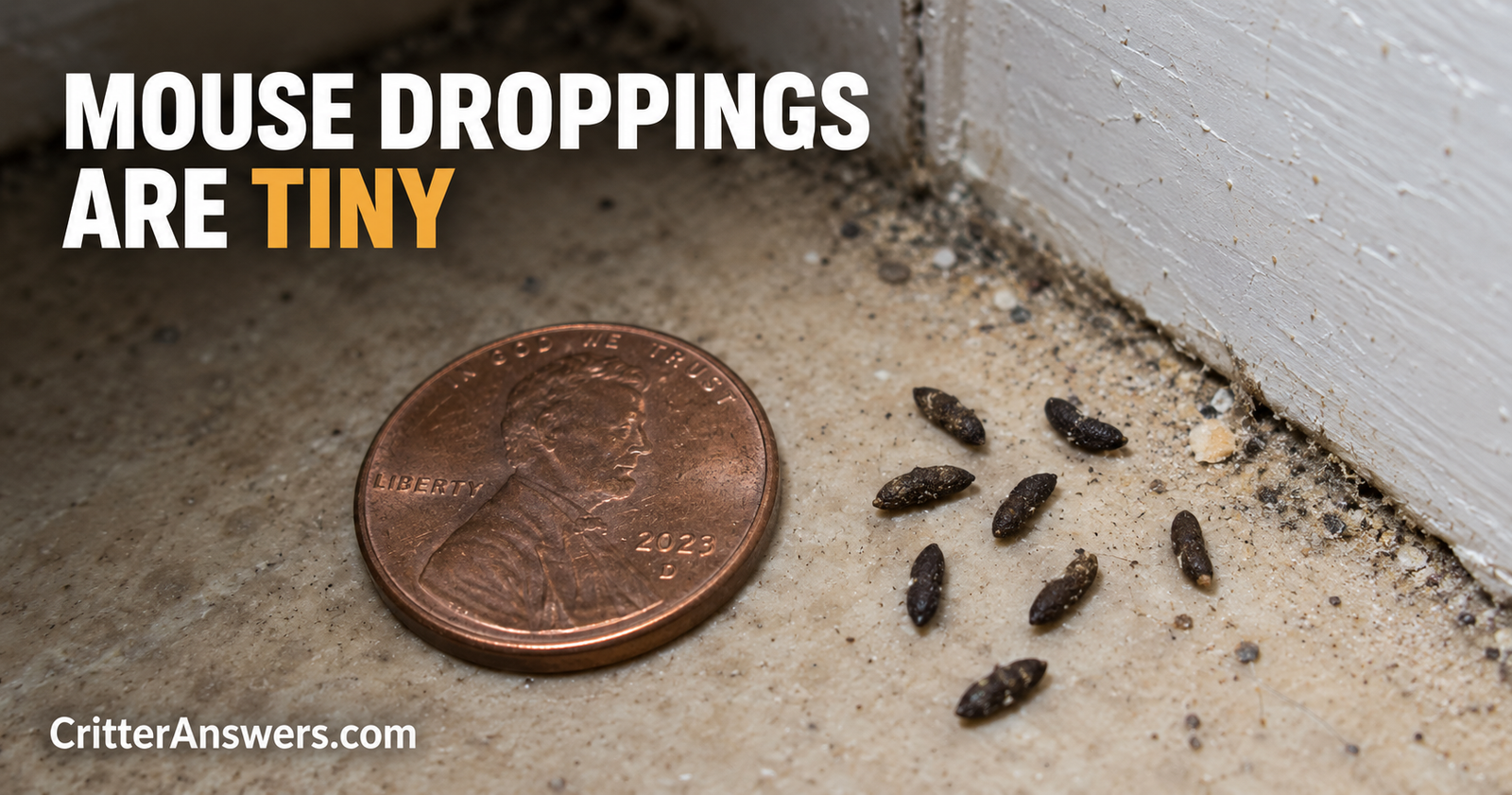
Mouse droppings are small, dark pellets that are generally elongated rather than round. They can have tapered or pointed ends and are much smaller than typical rat droppings.
Where you find them matters too.
Mouse droppings commonly show up inside cabinets and drawers, behind appliances, beneath sinks, in pantries, along walls, and around stored food.
And while the droppings themselves are an important clue, I don’t like identifying mice from one mysterious black speck.
I want to look at size, shape, location, quantity, and the other evidence around it.
What Mouse Droppings Look Like at a Glance
If you’re trying to decide whether something is mouse poop, look for these general characteristics:
- Small size
- Dark coloration
- Elongated pellet shape
- Often tapered or pointed at an end
- Usually found in multiple pieces rather than one isolated dropping
- Frequently concentrated around food, shelter, or mouse travel routes
CDC specifically notes that rodent droppings can be found anywhere rodents have gained access and commonly turn up in cabinets, drawers, and other hidden locations.
MU Extension also identifies droppings as one of the main signs of house-mouse activity.
So if you’re finding little dark pellets inside a kitchen cabinet, you have a clue worth investigating.
How Big Are Mouse Droppings?
Mouse droppings are small.
That’s one of the easiest ways to separate a likely house-mouse dropping from the much larger droppings of an adult rat.
A typical house-mouse dropping is roughly 1/8 to 1/4 inch long.
That puts many of them somewhere around the size people loosely compare to a grain of rice, although I don’t love relying on food comparisons alone.
Actual measurements are better.
If you’re unsure, put a ruler beside the droppings and take a photograph.
Don’t pick them up to measure them.
A photo beside a ruler gives you scale without unnecessary handling.

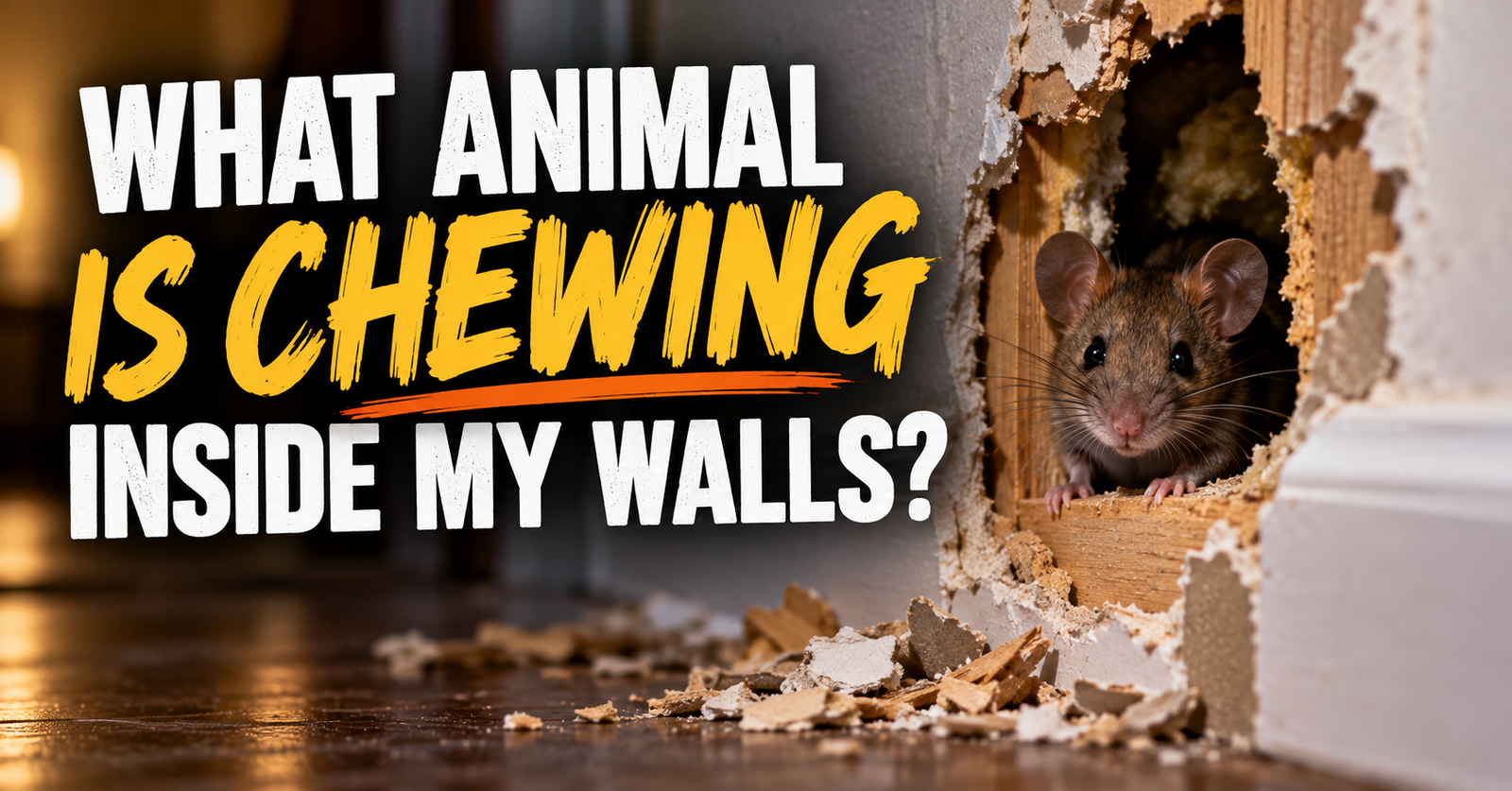

Are Mouse Droppings Pointed?
They can be.
CDC describes rodent droppings as pointed at one end and notes that they can contain hair.
With house mice, think of a small elongated pellet rather than a perfectly round ball.
But I wouldn’t reject the possibility of mice because every dropping doesn’t look identical to a textbook illustration.
Droppings can vary somewhat in appearance.
That’s why size and shape should be combined with location and other mouse evidence.
What Color Is Mouse Poop?
People often expect a perfect color chart:
Black means this.
Brown means that.
Gray means something else.
Real life isn’t that tidy.
Mouse droppings can appear dark brown to nearly black, and older material may look different after sitting in the environment.
I would not try to determine the exact age of mouse droppings based solely on whether they look black, brown, gray, shiny, or dull.
That’s not a reliable enough way to decide whether mice are still active in your house.
There’s a better method.

Can You Tell If Mouse Droppings Are Fresh?
Not reliably enough just by looking at them.
You’ll see advice online claiming that shiny black droppings are fresh while dull gray droppings are old.
There may be visible differences as droppings dry and age, but environmental conditions affect appearance too.
CDC specifically cautions that it can be difficult to determine whether a rodent population is currently active just by examining droppings.
So I wouldn’t bet the house on the color.
Instead:
Safely clean the existing droppings.
Then monitor the area.
If new droppings appear, you know you have current rodent activity.
That’s far more useful than trying to guess whether a dropping is three hours old or three weeks old.
Never Sweep or Vacuum Mouse Droppings Dry
Before we go any farther, this is the most important safety point in the article.
Do not sweep or vacuum dry mouse droppings.
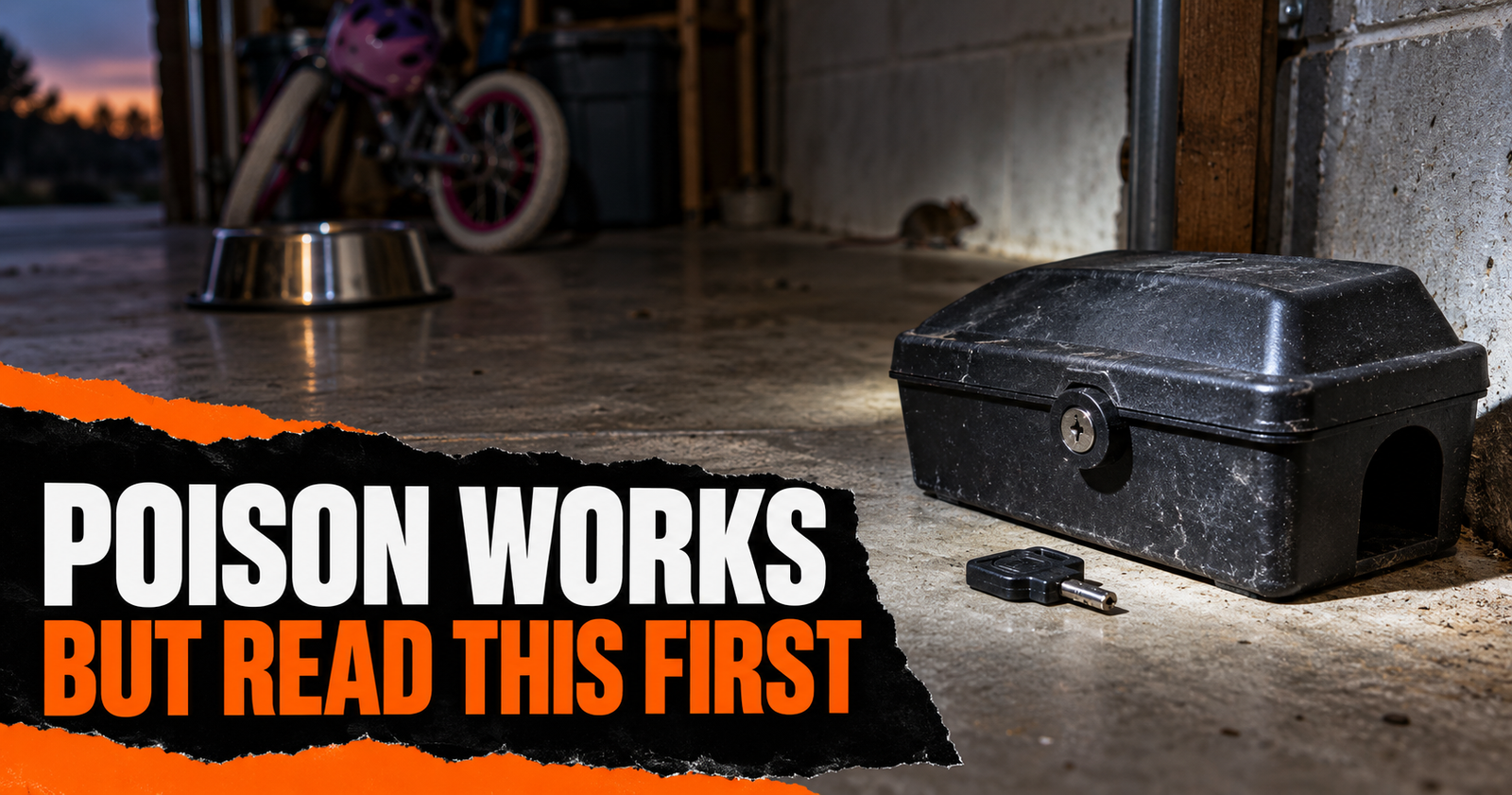
CDC warns that vacuuming or sweeping rodent urine, droppings, or nesting materials can put contaminated particles into the air. Rodents can carry diseases that spread through contact with their waste or contaminated air. For broader context on identifying unknown waste and deciding when professional help is appropriate, see FAQ guidance on animal waste safety.
If you’ve just discovered droppings, leave them alone until you’re prepared to clean them correctly.
I’ll walk through that process below.
Where Are Mouse Droppings Usually Found?
Where you find the droppings can be nearly as useful as what they look like.
House mice spend a lot of time near food, shelter, nesting areas, and established travel routes.
So I would inspect:
- Kitchen cabinets
- Kitchen drawers
- Behind the refrigerator
- Behind the stove
- Under sinks
- Pantries
- Along walls
- Closets
- Basements
- Garages
- Attics
- Crawl spaces
- Utility rooms
- Around pet food
- Around bird seed or livestock feed
- Inside or behind stored boxes

UC IPM specifically recommends looking for droppings, fresh gnaw marks, and tracks to identify where house mice are active. Those signs are most useful when combined rather than used for identifying an animal from a single clue.
Don’t just clean the droppings and forget where you found them.
Their location is information.
Mouse Droppings in a Kitchen Cabinet
This is one of the classic places to find them.
Cabinets give mice:
Darkness.
Shelter.
Travel routes.
And sometimes food.
If you find suspected mouse droppings in a cabinet, remove food and cookware from the area before cleaning.
Discard food that rodents have accessed or contaminated.
Then inspect the cabinet carefully.
Look in the back corners.
Check where shelves meet walls.
Look around plumbing if the cabinet is beneath a sink.
Check for gnawing.
And look for holes or gaps.
Remember that mice can squeeze through openings only about 1/4 inch wide — roughly pencil-width.
The droppings may lead you directly toward the route they’re using.

Mouse Droppings in a Drawer
This one gets people’s attention quickly.
You open the silverware drawer and find little dark pellets.
CDC specifically lists drawers among the places where rodent droppings are commonly found.
If that happens, don’t simply remove the visible droppings and put the forks back.
Empty the drawer.
Clean and disinfect the drawer properly.
Clean potentially contaminated items appropriately.
Then inspect behind and underneath the drawer if accessible.
A mouse may be moving through the cabinet cavity behind it.
Mouse Droppings Under the Kitchen Sink
If I find droppings beneath the sink, I immediately look at the plumbing penetrations.
Where do the pipes enter the wall?
Where does the drain line go?
Is there extra space around those openings?

We recently covered this in our guide to how mice are getting into your house.
A mouse can use an exterior opening to enter the structure and then travel through wall or cabinet cavities before emerging around plumbing.
The hole beneath the sink may therefore be an interior travel route rather than the original exterior entrance.
Follow the evidence in both directions.
Mouse Droppings Behind the Refrigerator
This is another place I wouldn’t be surprised to find them.
Behind a refrigerator is usually:
Dark.
Warm.
Protected.
Rarely disturbed.
Close to food.
And potentially full of crumbs nobody knew were there.
If you can safely move the refrigerator without damaging the appliance, flooring, electrical cord, or water line, inspect behind it.
Look along the wall.
Check corners.
Look for gnawing and nesting material.
And after safely cleaning the existing droppings, this can be an excellent place to monitor for new activity.
Mouse Droppings Behind the Stove
Same idea.
Except now you may also have years of crumbs and food debris.
If it’s safe to move the stove, inspect behind and underneath it.
Don’t disconnect gas or electrical appliances unless you know what you’re doing.
You don’t need to create a dangerous situation to investigate a mouse.
If the appliance can’t be safely moved, work around what you can access or get appropriate help.
Mouse Droppings in the Pantry
This one needs immediate attention because food may have been contaminated.
Look closely at:
Boxes.
Bags.
Lower shelves.
Corners.
Pet treats.
Cereal.
Rice.
Pasta.
Baking supplies.
Snack foods.
If rodents have chewed into or contaminated food, discard it.
Then move vulnerable dry foods into sturdy containers with secure lids.
The pantry isn’t just where you’re finding evidence.
It may be one of the reasons mice keep returning to that part of the house.
Mouse Droppings Around Pet Food
Dog and cat food count as mouse food.
So does bird seed.
So does chicken feed.
If you find droppings around bags of feed, inspect the bags themselves.
Look for tiny chewed openings.
Then look beneath them.
A bag may appear fine from the front while spilled food underneath is feeding mice every night.
Store bulk food and feed in durable containers with tight-fitting lids.
Mouse Droppings in the Garage
A garage can support a mouse problem without you ever seeing a mouse in the kitchen.
Look around:
Stored pet food.
Bird seed.
Grass seed.
Livestock feed.
Cardboard.
Workbench drawers.
Storage shelves.
Garage-door edges.
Wall perimeters.
An attached garage is particularly important because it can become the first stop between outdoors and your living space.
If you find mouse droppings there, don’t ignore them simply because they’re “not technically in the house.”
Figure out where the mice are entering the garage and whether they can move farther inside.
Mouse Droppings in an Attic
Droppings in an attic need a little more caution because mice aren’t the only animals that can leave small dark droppings overhead.
Bats can create confusing evidence too.
Other rodents may also use attics.
So don’t automatically identify every dark attic pellet as mouse poop.
Look at:
Size.
Shape.
Distribution.
Gnawing.
Nesting material.
Sounds.
Tracks.
And other evidence.
UC IPM recommends using multiple clues—including droppings, tracks, and damage—when identifying wildlife pests rather than relying on one sign alone.
What Do Mouse Droppings Look Like Compared With Rat Droppings?
Size is one of the biggest differences.
House-mouse droppings are small.
Rat droppings are substantially larger.
UC IPM’s rodent identification material shows house-mouse droppings alongside roof-rat and Norway-rat droppings with a ruler, and the size difference is obvious.
That’s why a ruler photograph can be so helpful.
If what you’re finding is much larger than typical mouse droppings, don’t keep forcing the mouse identification.
You may be dealing with rats.
Mouse Poop vs. Rat Poop
Here’s the simple version:
Mouse droppings: small, narrow, elongated pellets.
Rat droppings: noticeably larger and thicker.
Rat species can also differ from one another, so I wouldn’t try to identify the exact rat species from one dropping without additional evidence.
UC IPM notes that house mice and rats can sometimes be confused, especially when a young rat is involved.
If the size looks questionable, investigate before choosing traps.
A trap sized for a house mouse and a control plan for a larger rat aren’t necessarily interchangeable.
Mouse Droppings vs. Cockroach Droppings
This is another common source of confusion.
Cockroach droppings can look like tiny dark specks, pepper-like material, or small cylindrical droppings depending on the roach species.
Mouse droppings are generally larger and more distinct as individual elongated pellets.
But again, don’t identify from poop alone if the evidence isn’t clear.
Ask what else you’re seeing.
Mouse clues:
Gnaw marks.
Shredded nesting material.
Small rodent tracks.
Mouse sightings.
Light nighttime scurrying.
Cockroach clues:
Actual roaches.
Shed skins.
Egg cases.
Roach activity in cracks and crevices.
Multiple types of evidence make the answer much stronger.
Mouse Droppings vs. Bat Droppings
This comparison matters especially in attics.
Bat droppings, or guano, can look somewhat similar to mouse droppings at first glance.
Location is an important clue.
Bat guano often accumulates beneath a roosting location.
Mouse droppings are more likely to be scattered along mouse travel, feeding, and nesting areas.
I would not recommend crushing unidentified droppings between your fingers to identify them.
That’s unnecessary exposure to animal waste.
Use location, size, distribution, and other evidence instead.
If the situation remains unclear, a wildlife or pest professional can inspect it.
Mouse Droppings vs. Food or Seeds
Yes, this happens.
A dark seed or little piece of food can look remarkably suspicious when you already think mice are in the house.
Don’t panic over one pellet.
Look for repetition.
If you find twenty objects that are nearly identical in size and shape scattered along the back of a kitchen cabinet, that’s more suspicious than one mystery speck beside a spice jar.
Look for other evidence too.
A nearby chewed cereal box changes the picture.
Do Mouse Droppings Smell?
A few mouse droppings may not produce an odor you notice.
Larger or long-established mouse infestations can produce a characteristic musky odor.
UC IPM and MU Extension both identify musky odor as a sign associated with house-mouse infestations.
But don’t attempt to identify mouse poop by intentionally smelling it up close.
You don’t need your nose inches away from rodent waste.
If the entire cabinet or enclosed area has an unusual musky odor and you’re finding small rodent droppings and gnawing, that’s useful supporting evidence.
Does One Mouse Leave a Lot of Droppings?
Mice eat and move around frequently, so droppings can accumulate.
But I wouldn’t try to calculate the number of mice in your house by dividing the number of droppings by some supposed universal “poops per mouse per day” formula.
That’s not a reliable population survey.
You don’t know:
How long the droppings have been accumulating.
Whether multiple mice used the area.
Whether you’re seeing all the droppings.
Whether some have already been cleaned.
Instead, use the distribution and recurrence of the evidence.
A few droppings in one old box tell a different story from new droppings appearing every night throughout several rooms.
Does a Lot of Mouse Poop Mean a Lot of Mice?
Not necessarily.
A large accumulation may mean several mice.
It may also mean the area hasn’t been disturbed or cleaned for a long time.
That’s why the better question is:
Are new droppings continuing to appear?
Safely clean the old evidence.
Then monitor.
If droppings return quickly in several locations, you have clear ongoing activity that needs to be addressed.
We’ll get much deeper into estimating the extent of an infestation in our upcoming article on how many mice may be in your house if you see one.
Does Finding Mouse Poop Mean Mice Are Still There?
Not automatically.
Old droppings can remain after the mouse is gone.
This is where I really don’t want you relying on appearance alone.
CDC says it can be difficult to determine active rodent presence just from examining droppings and recommends safely cleaning the area and checking whether droppings reappear.
That’s a simple test I trust much more.
If you clean everything correctly on Monday and find new mouse droppings Tuesday morning, you’ve learned something important.
How to Tell Where the Mouse Is Traveling
Don’t think of droppings only as something gross that needs to be cleaned.
Before cleanup, notice the pattern.
Where are most of them?
Along one wall?
Behind one appliance?
Inside one cabinet?
Near one plumbing opening?
Beside the dog food?
That concentration can help reveal the mouse’s travel route.
Photograph the area if necessary before cleaning.
Then use that information when placing traps.
Finding Droppings Can Tell You Where to Put Traps
Once you’ve confirmed mouse activity, put traps where the mice actually travel.
UC IPM recommends placing traps in secluded areas along walls, behind objects, in dark corners, and where droppings have been found.
That makes sense.
The mouse has already given you a map.
Use it.
For a house with evidence in several locations, I like having enough traps to cover those active routes instead of depending on one trap for the whole building.
The Victor Metal Pedal Mouse Traps 12-Pack fits that job well because it gives you multiple traditional snap traps to distribute among confirmed activity areas.

Check the Victor Metal Pedal Mouse Traps 12-Pack on Amazon
Keep traps inaccessible to children and pets, follow the product instructions, and don’t randomly scatter all twelve.
Put them where the evidence tells you mice are moving.
What If You Don’t Want an Exposed Snap Trap?
Some people would rather use an enclosed trap.
That’s where our other saved option makes sense.
The OWLTRA OW-2 Indoor Electric Mouse Trap 2-Pack is an enclosed electronic option intended for indoor mouse control.

Check the OWLTRA OW-2 Indoor Electric Mouse Trap 2-Pack on Amazon
You don’t need both types.
Choose the trapping method that works for your household and place traps in areas with confirmed activity.
And even with an enclosed trap, keep it inaccessible to children and pets and follow the manufacturer’s instructions.
How to Clean Mouse Droppings Safely
Now let’s deal with the droppings themselves.
CDC’s current guidance is straightforward.
First, do not vacuum or sweep them dry.
Put on rubber or plastic gloves.
Spray the droppings and surrounding contaminated area with an appropriate household disinfectant labeled as a disinfectant, or use a properly prepared bleach solution according to CDC guidance.
Get the material very wet.
Let the disinfectant sit for the required contact time. CDC’s general instructions specify five minutes or the time stated on the disinfectant label.
Then wipe the droppings up with paper towels.
Put the waste into a covered garbage container that is regularly emptied.
Clean and disinfect the surrounding hard surfaces.
Wash your gloved hands before removing the gloves.
Then wash your bare hands thoroughly with soap and warm water.
Why You Shouldn’t Vacuum Dry Mouse Poop
This deserves repeating because vacuuming feels like the obvious solution.
You see ten little pellets.
Grab vacuum.
Gone in three seconds.
Except CDC specifically advises against it.
Vacuuming or sweeping dry rodent waste can disturb contaminated material and put particles into the air.
Wet it first.
Disinfect it.
Then remove it.
That’s not much harder, and it’s the safer approach.
What About Mouse Droppings on Carpet?
CDC gives different guidance for porous materials than for hard surfaces.
After rodent waste has been properly disinfected and removed, CDC recommends shampooing rugs and upholstered furniture with an appropriate commercial disinfectant or using a commercial-grade steam cleaner or shampooer.
Don’t start by running your normal vacuum over visible dry droppings.
Deal with the rodent waste first.
Then clean the carpet appropriately.
What About Droppings on Clothes or Bedding?
If potentially contaminated clothing, bedding, or stuffed items can be laundered, CDC recommends washing them with hot water and detergent and machine drying on high heat or allowing them to dry in sunlight.
Again, don’t shake contaminated material around unnecessarily before cleaning it.
Handle it carefully.
Mouse Droppings in Food Cabinets Need More Than a Quick Wipe
If mice have been inside a cabinet where you store food, inspect everything.
Discard food that rodents have accessed or contaminated.
Clean and disinfect the cabinet.
Check packages for gnawing.
Then start moving vulnerable foods into sturdy containers with secure lids.
And don’t stop there.
Find out how the mice reached the cabinet.
Cleaning mouse poop without fixing the mouse problem guarantees you’ll probably be cleaning mouse poop again.
Heavy Mouse Contamination Is a Different Job
A few droppings behind the stove are one thing.
An attic covered with rodent waste, nests, dead rodents, and contaminated insulation is another.
CDC recommends additional precautions for heavy rodent infestations.
That’s where I’d seriously consider professional help.
Especially if the contamination involves:
Large amounts of waste.
HVAC systems.
Extensive insulation.
Hard-to-access areas.
Or conditions you can’t safely clean yourself.
Don’t treat a heavily contaminated attic like a kitchen drawer.
What Should You Do After You Find Mouse Droppings?
Finding the poop isn’t the end of the investigation.
It’s the beginning.
I would do four things:
1. Document where you found it.
That tells you where mice are active.
2. Clean it safely.
Don’t sweep or vacuum dry waste.
3. Put traps along the active routes.
Use the evidence to guide placement.
4. Find the entry points.
Otherwise another mouse can replace the one you catch.
If you’re ready to tackle the whole infestation, our complete guide to getting rid of mice in your house for good walks through the removal, exclusion, sanitation, and monitoring process together.
Keep Checking the Area After Cleanup
This is one of the simplest ways to determine whether the problem is ongoing.
After you’ve safely cleaned the droppings, check the same locations regularly.
Cabinet clean Monday night.
New droppings Tuesday morning?
Active rodents.
Nothing returns?
Keep monitoring.
Don’t rely only on whether you hear noises.
The physical evidence can tell you much more.
Look for Gnaw Marks Too
CDC identifies both droppings and gnaw marks as major signs of rodent presence.
So if new droppings keep appearing, look nearby for:
Chewed food packages.
Gnawed cardboard.
Damaged wood or plastic.
Enlarged openings.
The combination helps confirm that you’re dealing with rodents rather than some unrelated debris.
Look for Nesting Material
House mice make nests from finely shredded paper and other fibrous material in sheltered areas.
UC IPM and MU Extension both identify these nests as another sign of mouse activity.
If you find droppings inside a storage box and then discover a little nest of shredded paper in the back, the picture is becoming much clearer.
Don’t handle suspected rodent nesting material dry.
It should be cleaned using appropriate rodent-waste precautions too.
Follow the Droppings Back Toward the Entry Route
Once you know mice are active, start looking for openings.
A mouse can squeeze through an opening only around 1/4 inch wide.
That means the route may be much smaller than you’re expecting.
Check:
Under sinks.
Around plumbing.
Behind appliances.
Along foundations.
Around doors.
At garage-door corners.
Around utility penetrations.
Near vents.
In crawl spaces.
And around the roofline when upper-level activity is involved.
Our mouse entry-point guide walks through those locations one by one.
Don’t Let the Droppings Become the Entire Mouse Strategy
It’s easy to get fixated on cleaning.
Clean cabinet.
Mouse poops again.
Clean cabinet again.
Mouse poops again.
At that point you’re not solving the problem.
You’re providing janitorial service for a mouse.
The droppings are evidence.
Use them.
They tell you where to investigate, where to trap, and where to start looking for access.
A Quick Mouse Dropping Identification Checklist
When you find mysterious dark pellets, ask:
How big are they?
House-mouse droppings are small, generally around 1/8 to 1/4 inch long.
What shape are they?
Look for small elongated pellets, sometimes tapered or pointed.
Where are they?
Cabinets, drawers, pantries, behind appliances, garages, and other protected mouse areas make sense.
Are there several?
A repeated pattern is more useful than one mysterious speck.
Are there gnaw marks nearby?
That strengthens the rodent identification.
Is there nesting material?
Finely shredded paper or fibers in a sheltered spot supports mouse activity.
Do new droppings appear after safe cleanup?
That’s strong evidence of current rodent activity.
Are they much larger than expected?
Consider rats or another animal instead of assuming mouse.
Mouse Poop Is Gross, but It’s Also Useful Evidence
Nobody wants to find mouse droppings in a kitchen cabinet.
But once they’re there, don’t waste the clue.
Look at their size.
Look at their shape.
Look at where they’re concentrated.
Look for gnawing.
Look for nesting material.
Then safely clean the area and see whether new droppings return.
If they do, you aren’t looking at some forgotten evidence from years ago.
You have an active problem to solve.
Use the droppings to figure out where the mice are traveling, put traps along those routes, and find the tiny openings they’re using to enter the house.
That’s far more useful than simply wiping up the poop and hoping you never see it again.
About the author: Caleb Rourke researches how mice and other rodents get into homes, where they hide, and the practical steps homeowners can use to identify and prevent them. He writes straightforward rodent-control guides for Critter Answers.