
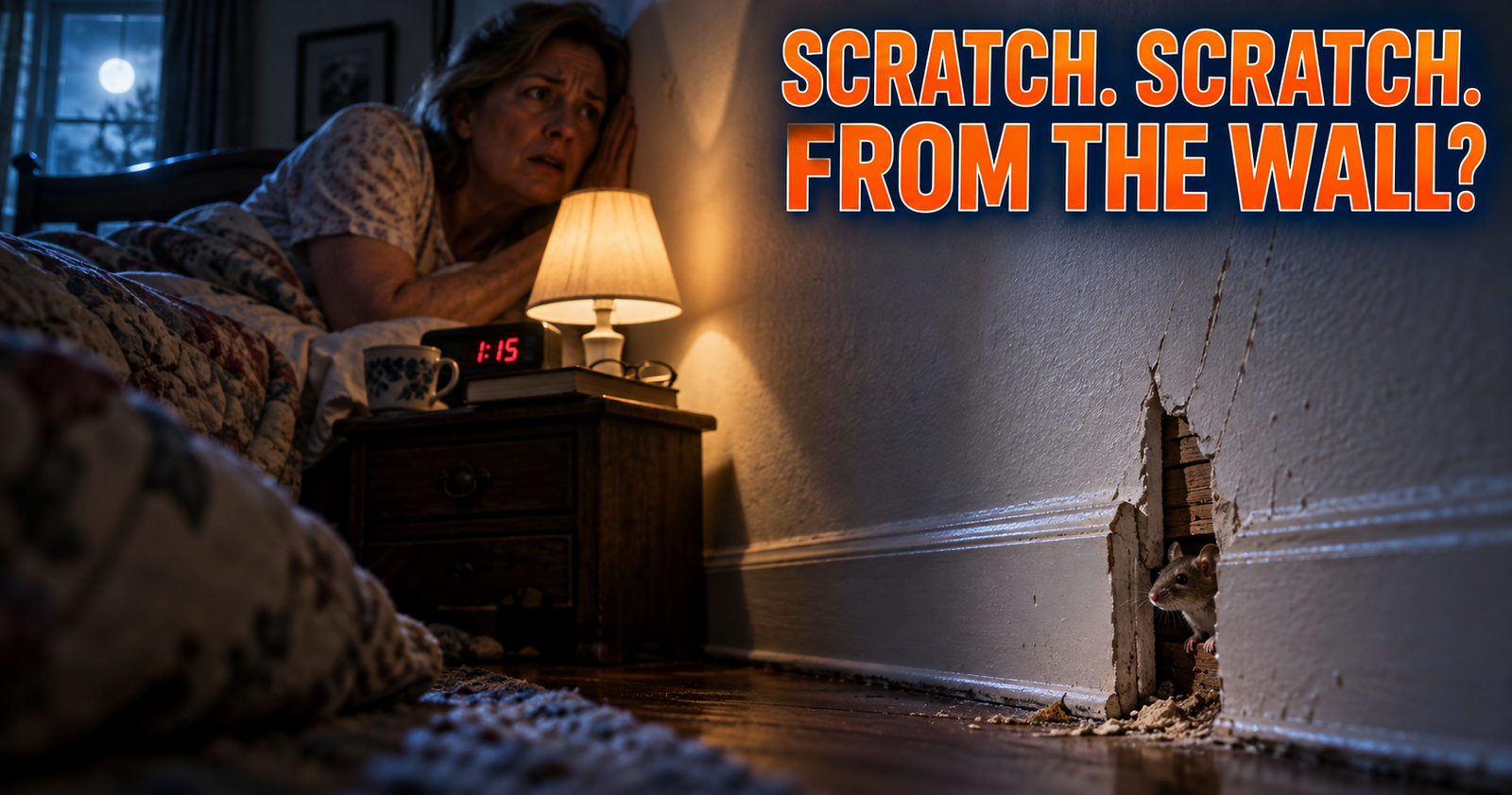
You turn everything off for the night, the house finally gets quiet, and then you hear it.
Scratch.
A few seconds later, something seems to scurry inside the wall.
Then silence.
If this keeps happening at night, mice are definitely one of the animals I’d investigate.
House mice are most active at night, and wall cavities give them protected routes through a house. But I wouldn’t identify mice from scratching sounds alone. Squirrels, bats, rats, insects, and other animals can sometimes create noises that homeowners describe in surprisingly similar ways. For a more careful process, use the clues together when identifying what critter is inside your house.
The better approach is to combine what you hear, when you hear it, where the sound occurs, and what physical evidence you can find nearby.
If you hear light scratching or rapid scurrying primarily at night and also find small mouse droppings, gnaw marks, nesting material, or mouse-sized entry openings nearby, the case for mice becomes much stronger.
What Do Mice in Walls Sound Like?
There’s no single mouse sound that every homeowner will hear exactly the same way.
Walls and ceilings can amplify movement.
Different insulation and building materials can change the sound.
And what one person calls scratching, another person may describe as rustling.
Common descriptions include:
- Light scratching
- Quick scurrying
- Tiny footsteps
- Rustling
- Gnawing or chewing
- Occasional squeaking
- Short bursts of movement followed by silence
The pattern is more useful to me than trying to judge the animal’s exact size from volume.
A surprisingly loud sound can still come from a small animal when it’s moving inside a hollow wall.
Why Do I Hear the Scratching Mostly at Night?
This is one reason mice are such a reasonable suspect.
MU Extension notes that house mice are most active at night.
During the day, people are also moving around the house.
Doors close.
Televisions run.
Kids play.
Appliances operate.
Traffic passes.
At night, the house becomes quiet enough that tiny movements behind drywall suddenly sound much more obvious.
So some of what you’re noticing isn’t necessarily that the animal only moves at night.
It’s that mice are naturally more active then and you’re much more likely to hear them.



Does Scratching at Night Definitely Mean Mice?
No.
And this distinction matters.
If all you know is:
“Something scratches inside my wall at night.”
you don’t have enough information yet to confidently say it’s a mouse.

Our broader guide to what animal may be scratching in your walls at night covers the other possibilities.
For mice specifically, I want supporting clues.
Look for These Signs Near the Noisy Wall
Once you’ve identified where the noise seems strongest, inspect the accessible areas around it.
Look for:
- Small droppings
- Gnaw marks
- Chewed food packages
- Shredded nesting material
- Small openings
- Tracks in dusty areas
- A musky rodent odor
- Actual mouse sightings
MU Extension identifies droppings, fresh gnawing, tracks, nests made from shredded fibrous material, and a characteristic musky odor as signs of house-mouse activity.
One of those signs helps.
Several together are much better.

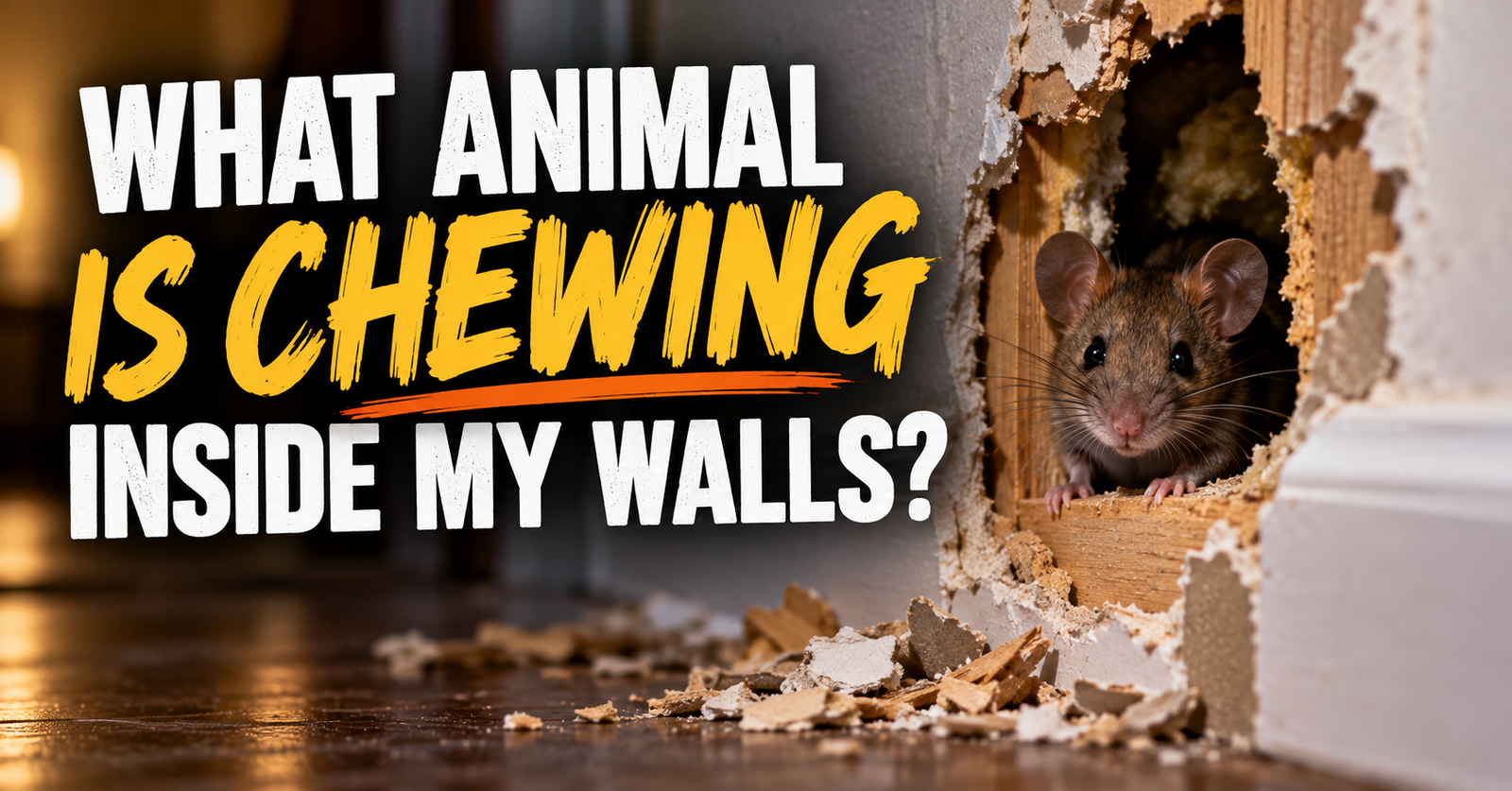

Mouse Droppings Can Confirm You’re on the Right Track
Droppings are one of the first things I’d look for.
Check around the wall where you’re hearing activity.
Then inspect nearby:
Cabinets.
Drawers.
Closets.
Pantries.
Behind appliances.
Under sinks.
Basements.
Garages.
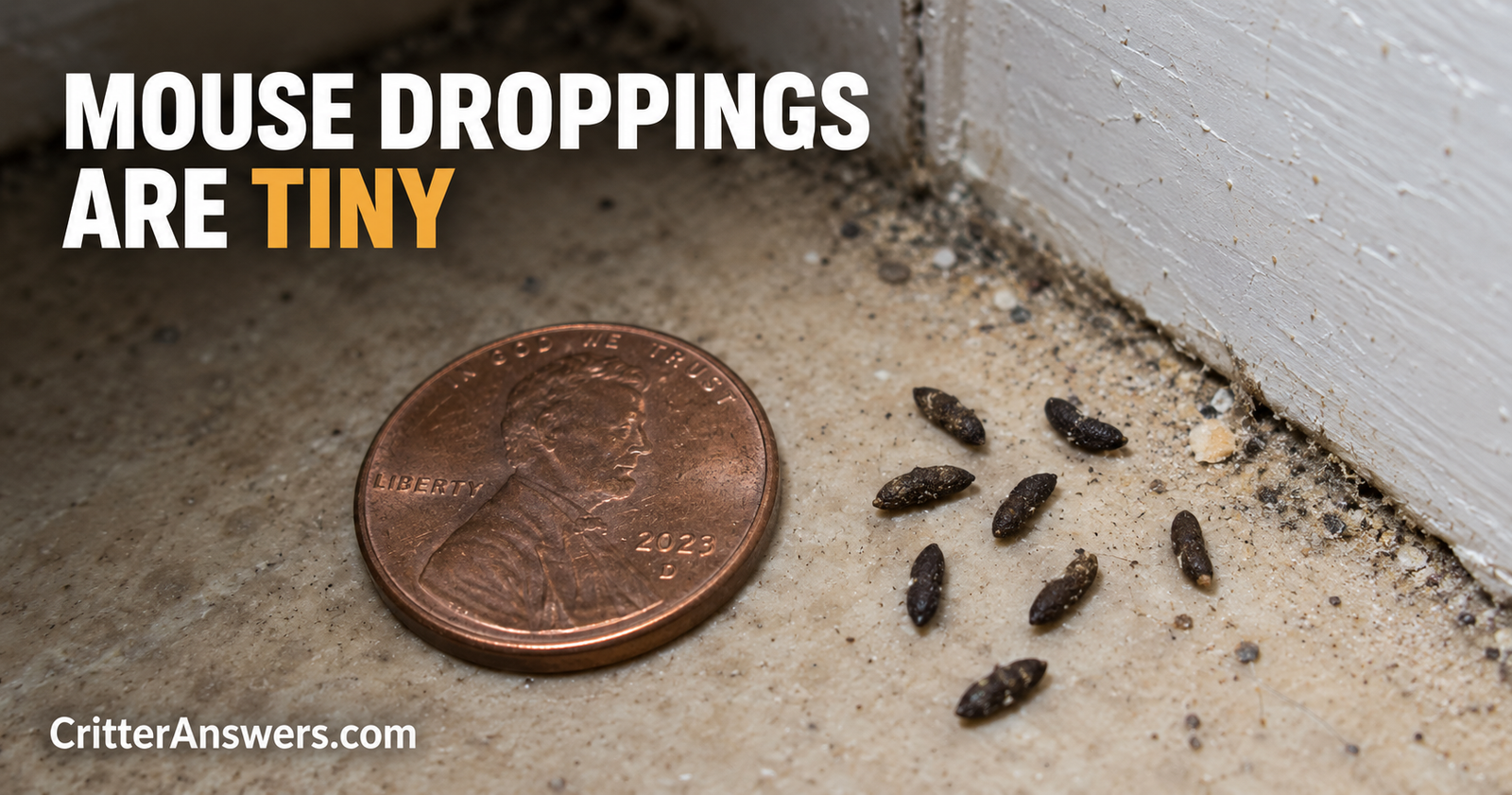
House-mouse droppings are small, dark, elongated pellets. If you’re unsure what you’ve found, our mouse-dropping identification guide goes much deeper into size, shape, location, look-alikes, and safe cleanup.
If the scratching wall leads directly into a cabinet containing mouse droppings, that’s a much stronger clue than the noise alone.
Follow the Wall Instead of Following the Sound
This is one of the most useful things you can do.
Suppose the scratching seems to be inside a kitchen wall.
What’s along that wall?
A sink?
Stove?
Refrigerator?
Pantry?
Utility penetration?
Exterior wall?
Now look at the other side.
Maybe it’s a garage.
Maybe it’s a bathroom.
Maybe it’s outside.
Then look above and below the noisy section.
The mouse isn’t magically appearing in the middle of the wall.
There’s a route.
Finding that route is much more useful than standing with your ear against the drywall.
How Do Mice Get Inside Walls?
Wall cavities aren’t sealed boxes.
Houses contain countless penetrations for:
Plumbing.
Electrical wiring.
HVAC.
Gas lines.
Cable.
Drain lines.
Other utilities.
A mouse can enter the structure through one opening and then use gaps around these building components to move through concealed spaces.
And mice don’t need much room.
CDC says a mouse can fit through a hole about 1/4 inch wide, roughly the width of a pencil.

That’s why our guide to the places mice use to get into houses focuses so heavily on tiny structural gaps.
Check Under the Sink Near the Noisy Wall
If plumbing runs through the wall, this is one of my first stops.
Open the cabinet.
Remove enough stuff that you can actually see the back.
Use a flashlight.
Inspect where every pipe enters the wall or floor.
Do you see an oversized opening?
Droppings?
Gnawing?
Shredded material?
That little plumbing penetration may be an access point from the wall cavity into the cabinet.
It doesn’t necessarily mean that’s how the mouse originally entered the house from outdoors, but it may reveal how it’s moving through the structure.



Check Behind the Refrigerator and Stove
These areas deserve attention because mice like protected travel routes and hiding areas.
CDC specifically recommends putting traps behind stoves and refrigerators when rodent evidence indicates those areas are active.
If the wall noise is coming from the kitchen, inspect both appliances if you can do so safely.
Look for droppings along the baseboard.
Check for food debris.
Look for holes.
Inspect nearby cabinets.
A mouse traveling through a wall may emerge behind an appliance where you almost never disturb it.
The Mouse May Not Actually Live Inside the Wall
This is another important distinction.
You hear a mouse inside a wall, so naturally you imagine its nest sitting directly behind the drywall.
Maybe.
But not necessarily.
The wall may simply be the highway.
Its nesting area could be:
Behind an appliance.
Inside a cabinet void.
In an attic.
In a basement.
Inside stored materials.
In a garage.
Somewhere else nearby.
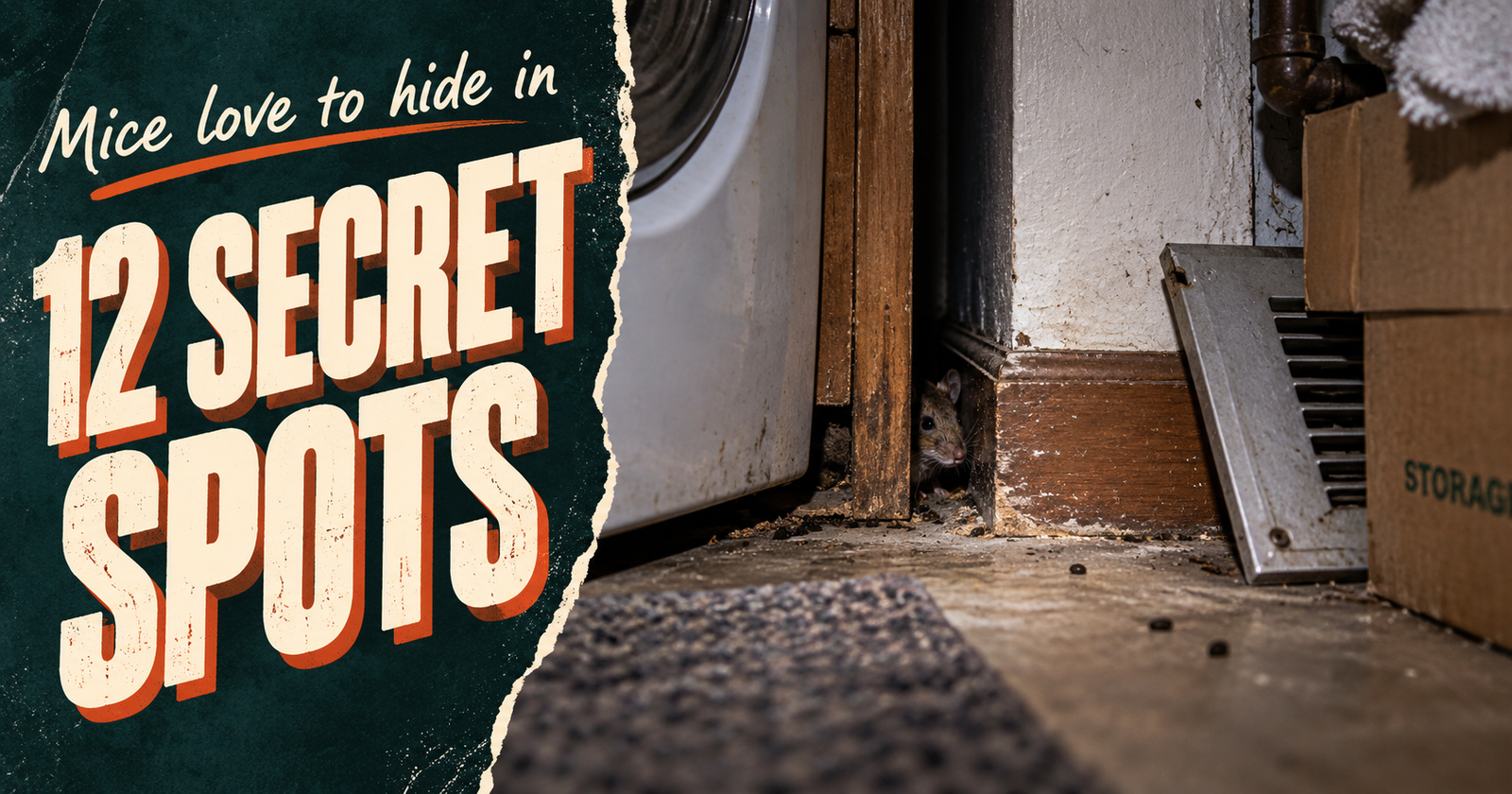
Our guide to 12 places mice commonly hide around a house can help you expand the search without randomly tearing things apart.
Listen for Where the Mouse Goes
If the noise happens repeatedly, pay attention to movement.
Does the sound:
Travel upward?
Move horizontally?
Disappear behind the refrigerator?
Seem to reach the ceiling?
Stay in one small section?
Move toward the pantry?
You don’t need to map every footstep.
You’re trying to identify the active zone.
That tells you where to start looking for accessible travel routes and where traps are most likely to work.
Scratching Low in the Wall Can Give You Clues
If the activity consistently sounds close to floor level, inspect nearby baseboards, cabinets, appliance spaces, and utility openings.
Mice commonly travel close to walls and objects because those routes give them cover.
CDC recommends positioning traps against walls for exactly that reason.
Look at what connects to the noisy area rather than obsessing over the exact spot where you heard one scratch.
What If the Noise Is High in the Wall?
Don’t rule out mice.
House mice are excellent climbers. MU Extension notes that they can climb rough vertical surfaces, move along cables or ropes, and jump about 12 inches from the floor onto a flat surface.
They aren’t limited to running around at baseboard level.
High wall activity should make you investigate:
The attic.
Upper cabinets.
Utility chases.
Soffits.
Eaves.
Roofline openings.
Upper-level plumbing.
A mouse can enter high, or it can enter low and climb.
What If I Hear Scratching in the Ceiling?
The investigation becomes similar.
First determine what’s above the ceiling.
Attic?
Second floor?
Roof cavity?
Another room?
Then look for physical mouse evidence in accessible areas.
If you have an attic, inspect it carefully for droppings and nesting material.
Don’t assume every ceiling noise is mice, though.
An attic opens the possibility of other animals, including animals substantially larger than a mouse.
Mice vs. Squirrels in a Wall
Timing can provide a useful clue.
House mice are particularly active at night.
Tree squirrels are generally active during daylight hours.
That doesn’t give you a perfect identification from your clock, but it’s useful.
If you hear heavier running and activity repeatedly during daylight hours, I’d expand the investigation beyond mice.
If you hear light, quick movement after the house becomes quiet at night and find mouse droppings downstairs, mice become much more convincing.
Mice vs. Rats in Walls
Rats are rodents too, so the sounds can overlap.
I’d look closely at the physical evidence.
Rat droppings are considerably larger than house-mouse droppings.
Gnawing and tracks may also be larger.
Movement can sound heavier.
But sound alone isn’t enough to confidently separate them.
If you find droppings, measure them without handling them and compare the other evidence before choosing traps.
CDC specifically recommends selecting the correct size snap trap for the rodent you’re dealing with.
Could It Be a Bat in the Wall?
Potentially, depending on the location and other evidence.
Bats can occupy wall and attic spaces, and their activity may be noticed around dusk or nighttime.
But bat management is a different problem from mouse trapping.
If you actually see a bat, find guano beneath an upper roosting area, or have evidence pointing toward bats rather than mice, don’t simply start treating the problem as a mouse infestation.
Identify the animal first.
Can Mice Chew Through Drywall?
Mice are capable gnawers, but they usually don’t need to chew through the middle of a perfectly intact sheet of drywall to move around a house.
Construction already gives them plenty of edges, penetrations, gaps, and cavities.
I’d first look around:
Pipes.
Cabinet openings.
Baseboards.
Utility penetrations.
Existing holes.
Damaged areas.
Those routes are more useful to investigate than assuming the mouse is tunneling straight through solid walls.
Why Does the Scratching Stop When I Walk Over?
Because you’ve changed the environment.
Mice have good hearing and are sensitive to movement around them.
If you’re lying silently in bed and then suddenly walk toward the wall, the animal may stop moving.
That doesn’t mean you imagined it.
But it also doesn’t prove the animal is a mouse.
Use the sound to locate the area, then use physical evidence to identify what’s actually there.
Should I Bang on the Wall to Make the Mice Leave?
You can probably scare a mouse into becoming quiet or moving temporarily.
That isn’t control.
MU Extension notes that mice may initially be frightened by unfamiliar noises but can become accustomed to repeated sounds. It also says there is little evidence that sound devices will drive established mice or rats from buildings.
You need to remove the mice and prevent more from entering.
Turning your wall into a drum every night doesn’t accomplish that.
What About Ultrasonic Mouse Repellers?
I wouldn’t build my mouse-control strategy around them.
MU Extension says ultrasonic sound has very limited usefulness for rodent control because it is directional, doesn’t penetrate behind objects well, and loses intensity with distance. It also says there’s little evidence that sound will drive established mice or rats from buildings.
A wall cavity is exactly the sort of hidden location where I’d rather rely on physical control.
Find the routes.
Trap the mice.
Seal the entrances.
Remove food and shelter.
Those steps address the actual problem.
Don’t Put Poison Into the Wall Just Because You Hear a Mouse
This is one shortcut I’d think very carefully about.
If a poisoned mouse dies somewhere inaccessible inside a wall, you may end up with a dead-animal odor you can’t easily reach.
MU Extension specifically notes that one advantage of trapping indoors is being able to dispose of the carcass rather than potentially dealing with dead-mouse odors associated with poisoning inside buildings.
CDC currently recommends traditional snap traps for reducing rodent populations around the home and says poison or bait stations should be reserved for infestations that persist.
For an ordinary indoor mouse problem, trapping gives you much more control over where the mouse ends up.
Don’t Seal an Interior Hole and Assume the Mouse Problem Is Fixed
Suppose you find mice coming through a gap beneath the sink.
You fill the hole.
Great.
But where did they originally enter the structure?
If the exterior opening remains, mice can still get into:
Wall cavities.
The basement.
The attic.
The garage.
Other rooms.
You want to identify and seal the outside access points, not merely close one doorway between a wall cavity and your kitchen.
CDC recommends checking both inside and outside the house and sealing gaps and holes that allow rodents to enter.
How Do You Get Mice Out of Walls?
The phrase makes it sound like you need to reach into the wall and physically pull them out.
Usually, you don’t.
The practical strategy is:
Find where they’re emerging.
Place traps along their accessible travel routes.
Find and seal exterior entry points.
Remove accessible food and shelter.
Continue monitoring until the activity stops.
You’re intercepting mice when they leave the inaccessible cavity.
That’s usually much more practical than opening walls.
Put Traps Where Mice Come Out
This is where all that listening and investigating pays off.
CDC recommends placing traps in areas where you’ve found:
Droppings.
Nesting material.
Gnawed food.
Gnaw marks.
Or other evidence.
It also recommends locations such as behind stoves and refrigerators, in cabinets and drawers, and near attics, basements and crawl spaces where rodents may be entering.
That’s much better than putting one mouse trap in the middle of the kitchen and hoping for the best.
Put the Trap Against the Wall
CDC recommends placing a snap trap on the floor against the wall with the baited end toward the wall so the trap forms a T with it. Rodents tend to travel next to walls and objects for protection.
That’s exactly the behavior we’re trying to exploit.
If a mouse emerges from a cabinet opening and follows the baseboard behind the refrigerator every night, that’s where I want the trap.
Not six feet away in the middle of the room.
One Trap May Not Be Enough
If you have evidence in several places, use enough traps to cover the active routes.
MU Extension recommends a decisive trapping effort and says traps generally shouldn’t be spaced more than about 10 feet apart in areas where mice are active because house mice usually don’t venture far from shelter and food.
This is where the Victor Metal Pedal Mouse Traps 12-Pack becomes especially useful.
Instead of relying on one trap to cover an entire house, you can target several confirmed mouse routes.

Check the Victor Metal Pedal Mouse Traps 12-Pack on Amazon
Use only as many as your situation calls for, follow the manufacturer’s instructions, and keep traps inaccessible to children and pets.
An Enclosed Electric Trap Is Another Option
If you’d rather not use an exposed traditional snap trap, the OWLTRA OW-2 Indoor Electric Mouse Trap 2-Pack is an enclosed electronic option for indoor mouse control.

Check the OWLTRA OW-2 Indoor Electric Mouse Trap 2-Pack on Amazon
You don’t need to buy both trap types.
Whichever style you choose, placement matters enormously.
A fancy trap sitting where mice never travel isn’t going to outperform a properly placed basic trap along an active mouse route.
Don’t Put a Trap Inside the Wall Unless You Can Retrieve It
This seems obvious once you say it, but it’s worth saying.
Don’t drop a trap into an inaccessible wall cavity where you can’t check or retrieve it.
CDC recommends checking traps daily and promptly disposing of captured rodents.
Put traps at accessible points where mice emerge from concealed areas.
Behind an appliance may be inconvenient.
Inside a cabinet may require moving things.
But you can still reach the trap.
That’s what matters.
What If the Mice Won’t Come Out of the Wall?
If mice are living inside a wall, they still need resources.
They need food.
They need water.
They move.
The goal is to intercept those movements.
Look harder at the evidence.
Where are droppings appearing?
Where is food being damaged?
Where does the sound travel?
Where are utility openings?
Where have you actually seen a mouse?
Those clues reveal the accessible portions of the route.
Find the Exterior Entry Point at the Same Time
Catching the mice inside is only half the job.
CDC says mice can squeeze through an opening about 1/4 inch wide and recommends inspecting around doors, windows, foundations, utilities, vents, attics, crawl spaces, eaves, soffits, and other potential access points.
If you don’t close those openings, the wall can simply become a mouse highway again.
Trap and exclude.
Not one or the other.
Check the Garage If It Shares the Noisy Wall
This is an easy connection to overlook.
Suppose you hear mice inside the kitchen wall.
What’s on the other side?
Attached garage.
Now inspect the garage.
Look around:
The overhead door.
Pet food.
Bird seed.
Storage boxes.
Utility penetrations.
The wall shared with the house.
You may discover that mice enter the garage first and then move through a small opening into the wall.
Check the Basement or Crawl Space Below It
Same idea.
If the noisy wall sits above a basement or crawl space, inspect underneath.
Look at plumbing and utility penetrations.
Check foundation edges.
Look for droppings.
Inspect insulation.
The mouse may be moving vertically through the house.
Finding evidence directly below the noisy wall can help connect the route.
Check the Attic Above It
If the wall continues into an attic, look there too.
Inspect accessible areas for:
Droppings.
Nesting material.
Gnawing.
Tracks.
Possible openings around eaves and soffits.
House mice can climb, so don’t assume the activity has to remain near floor level.
A mouse route can involve several levels of the house.
Remove the Reasons Mice Keep Coming Out
While you’re trapping, reduce the food and shelter supporting them.
CDC recommends removing food, water and shelter that support rodents.
That means paying attention to:
Pantry food.
Pet food.
Bird seed.
Livestock feed.
Garbage.
Crumbs behind appliances.
Clutter.
Cardboard.
Stored materials.
If mice have a buffet ten feet from their wall cavity, you’re making life very easy for them.
How Long Until the Scratching Stops?
Don’t use one quiet night as proof that the problem is gone.
Keep checking traps and looking for fresh evidence.
CDC says trapping should continue until rodents are gone; its guidance uses a week without captures and without new rodent signs as an indicator that the infestation has likely been eliminated.
So I want more than silence.
I want:
No captures.
No new droppings.
No new gnawing.
No sightings.
No continued wall activity.
That’s a much stronger endpoint.
What If the Scratching Continues but You Catch No Mice?
Reconsider the identification.
This is important.
If you repeatedly hear something inside the wall but:
Never catch a mouse.
Never find mouse droppings.
Never find gnawing.
Never see a mouse.
Never find a mouse-sized entry route.
then don’t keep forcing the mouse explanation.
It may be another animal.
The sound itself isn’t enough.
Go back to the evidence and identify the animal before escalating control.
When I’d Consider Calling a Professional
I’d consider professional help when:
- The wall activity continues despite properly placed traps
- You can’t identify the animal
- Several parts of the house are affected
- You can’t locate the entry points
- The infestation appears extensive
- Significant contamination is present
- The activity is in inaccessible structural areas
- You aren’t comfortable handling the problem
A good inspection should do more than throw bait around.
You want someone to identify what is there, where it’s traveling, and how it’s entering.
My Wall-Scratching Checklist
If you’re lying in bed listening to scratching again tonight, here’s what I’d do the next day.
Identify the noisy wall.
Figure out what’s on both sides, above it, and below it.
Look for droppings.
Check cabinets, appliances, closets, basement areas, and other protected locations nearby.
Look for gnawing and nesting material.
Those strengthen the mouse identification.
Inspect plumbing and utilities.
Look for mouse-sized openings into the wall.
Inspect outside.
Remember that a mouse can use an opening about pencil-width.
Trap accessible travel routes.
Put traps where physical evidence says mice are moving.
Remove food and shelter.
Especially pantry food, pet food, bird seed, feed, garbage, crumbs and clutter.
Monitor.
Don’t declare victory after one quiet night.
The Noise Is a Clue, Not the Whole Answer
Hearing scratching inside a wall at night is unsettling because you know something is there but can’t see it.
Don’t let that push you into random fixes.
Don’t cut holes everywhere.
Don’t bang on the wall every night.
Don’t assume an ultrasonic device will solve it.
And don’t start plugging random interior openings without investigating where the animal entered the structure.
Use the noise as a starting point.
Then look for mouse droppings, gnaw marks, nesting material and tiny access openings.
Follow the wall.
Check what’s above and below it.
Find where the mice emerge.
Trap those routes.
Then seal the exterior openings that allowed them inside.

If the evidence confirms mice and you want the entire process in one place, follow our guide to getting rid of mice in your house for good.
The goal isn’t just to make tonight’s scratching stop.
It’s to make sure you aren’t lying in bed listening to the same scratching again next month.
About the author: Caleb Rourke researches how mice and other rodents get into homes, where they hide, and the practical steps homeowners can use to identify and prevent them. He writes straightforward rodent-control guides for Critter Answers.