

You walk into the kitchen late at night, flip on the light, and a mouse shoots across the floor.
Your first thought probably isn’t:
“Well, that’s nice.”
It’s more likely:
“If I saw one mouse, how many more are hiding in my house?”
Here’s the answer I wish were as simple as the internet makes it sound:
Seeing one mouse does not tell you exactly how many mice are in your house.
It could be one.
There could be several.
Or you could have an established mouse population tucked into parts of the house you rarely see.
What I wouldn’t do is tell you that seeing one mouse automatically means there are five, ten, twenty, or some other magic number hiding nearby.
There’s no reliable formula like that.
Instead, I would look at where you saw the mouse, how often you’re seeing them, how much fresh evidence you’re finding, how many areas of the house are affected, and what happens when you start trapping.
Those clues can tell you much more than the sighting itself.
Does Seeing One Mouse Mean There Are More?
It can, but it doesn’t prove it.
A single mouse can enter a house.
That happens.
Especially when outdoor conditions change and a mouse finds one of the tiny openings around a building.
But house mice also reproduce rapidly when they have dependable food and shelter, so I wouldn’t dismiss a mouse sighting as an isolated visitor without investigating.
The right response is somewhere between:
“It’s only one. I’ll ignore it.”
and
“There must be 50 mice living behind my refrigerator.”
You don’t know yet.
So gather evidence.
Why One Mouse Can Turn Into a Bigger Problem
House mice have impressive reproductive potential.
MU Extension reports that a female house mouse can produce five to ten litters in a year, commonly with five or six young per litter. Young mice can reach reproductive maturity in only a matter of weeks.
That doesn’t mean every mouse entering your house immediately produces dozens of mice.
It does explain why ignoring an established mouse problem is a bad idea.
If mice have:
Food.
Shelter.
Access to the building.
And places to nest.
a small problem has the potential to become a much larger one.
That’s why I take even one confirmed indoor mouse seriously.



First Ask Where You Saw the Mouse
The location of the sighting matters.
A mouse that darts into an attached garage through an open garage door isn’t exactly the same situation as a mouse running from beneath your kitchen stove after you’ve already found droppings in three cabinets.
Ask yourself:
Where did I see it?
Kitchen?
Pantry?
Living room?
Garage?
Basement?
Bedroom?
Attic?
Then ask:
What evidence is around that location?
That’s where the real investigation begins.
One Mouse With No Other Signs
This is the best-case scenario.
You saw one mouse once.
You’ve searched the surrounding area and found:
No droppings.
No gnaw marks.
No nesting material.
No damaged food.
No repeated nighttime sounds.
No second sighting.
No trap activity.
That still deserves attention, but it doesn’t prove you have a large infestation.
I’d inspect the building for possible entry points, set appropriate traps in likely travel areas, and monitor closely.
If nothing else happens, you may genuinely have caught the problem early.
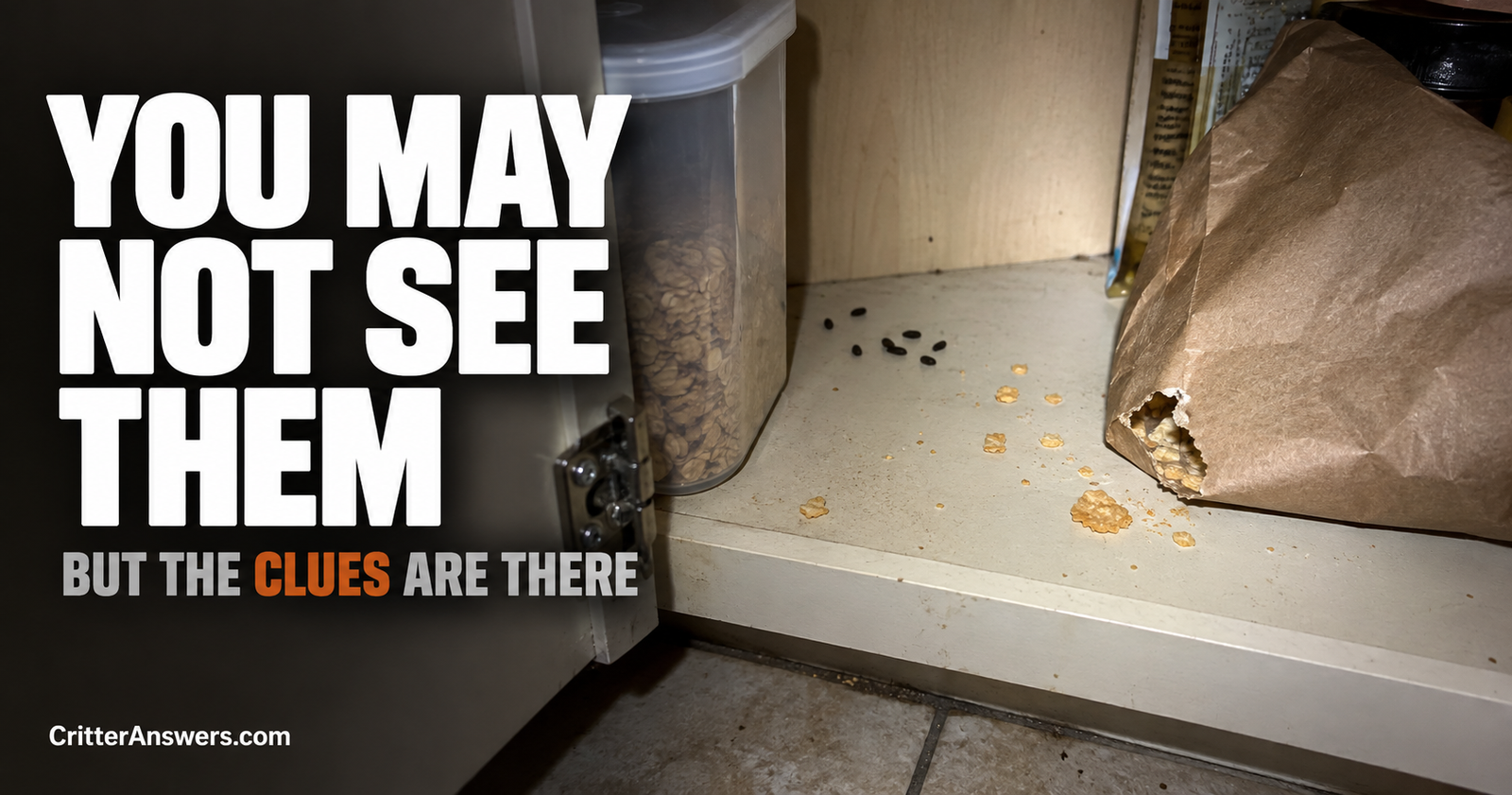


One Mouse Plus Droppings Is More Concerning
Now the situation changes.
You saw one mouse and then found droppings:
Behind the refrigerator.
Inside a cabinet.
Under the sink.
In the pantry.
Along a basement wall.
Or in several locations.
That tells you the mouse has been using the house rather than simply giving you a one-second sighting.
The amount and distribution of droppings can also help reveal how widespread the activity is.
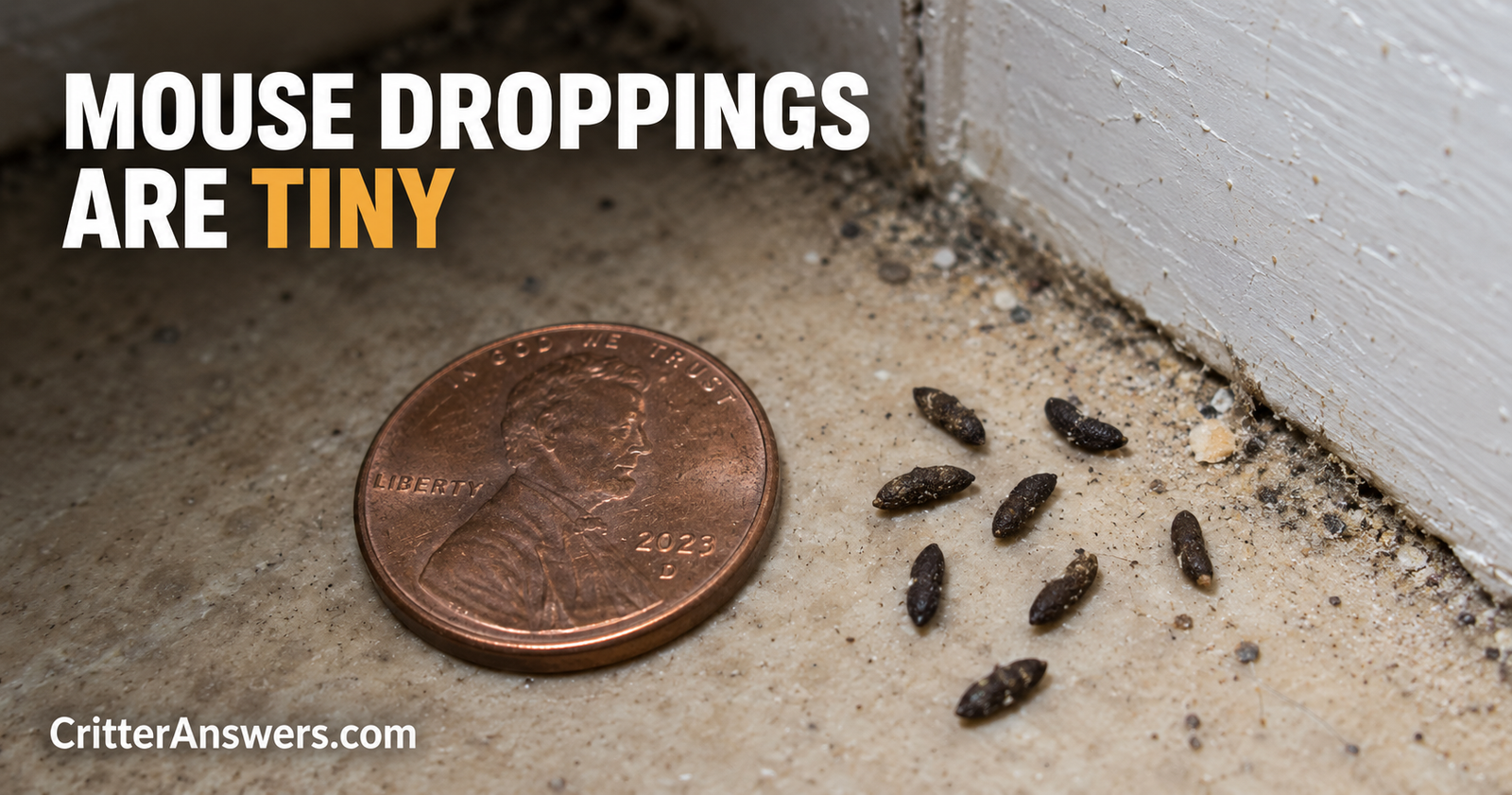
Our guide to identifying mouse droppings explains what they look like, where they’re commonly found, and how to clean them safely.
Don’t Count Droppings and Try to Calculate the Number of Mice
This sounds logical.
If one mouse produces X droppings per day and I found Y droppings, then I have Z mice.
Unfortunately, your house isn’t a controlled laboratory.
You don’t know exactly:
How long those droppings have been accumulating.
Whether they’ve been partially cleaned before.
How many locations the mouse uses.
Whether several mice are sharing one area.
Whether one mouse repeatedly used the same route.
So I wouldn’t turn mouse poop into a math equation.
The recurrence and distribution of droppings are more useful than the raw number.
Clean the Old Evidence and Watch for New Evidence
This is one of the smartest ways to determine whether mice are currently active.
CDC notes that it can be difficult to determine current rodent activity simply by looking at existing droppings. After proper cleanup, the appearance of new droppings indicates ongoing activity.
That’s much more useful.
If you safely clean one cabinet and nothing returns, keep monitoring.
If you clean four areas and fresh droppings start appearing again in all four, you have a stronger indication that the problem is established.
Just remember not to sweep or vacuum dry rodent waste. Follow appropriate rodent-cleanup precautions.
Evidence in Several Rooms Is a Bigger Warning Sign
This is one of the clues I’d take seriously.
Suppose you find:
Droppings behind the kitchen stove.
More droppings in the pantry.
Gnawing in a basement storage area.
And mouse activity in the garage.
That doesn’t automatically tell you there are four mice.
One mouse can move around.
But widespread evidence tells you the problem isn’t confined to one tiny spot.
That’s enough reason to expand your inspection and trapping effort.



Several Mouse Sightings Matter Too
Seeing the same mouse three times and seeing three different mice can look identical from your perspective.
You probably aren’t going to recognize individual house mice.
But repeated sightings tell you something important:
Mouse activity is continuing.
If you see a mouse tonight, another tomorrow, and another three days later, stop treating the first sighting as a random event.
Whether it’s one extremely busy mouse or several doesn’t change the immediate strategy much.
You need to trap the active mice and find their entry points.
What If I See Two Mice at the Same Time?
Now you know one thing for certain.
There is more than one mouse.
That sounds obvious, but it’s actually useful because you’ve eliminated the possibility that every sighting involved one individual.
At that point, I would assume the house deserves a thorough inspection rather than waiting to see whether they disappear.
Look for droppings.
Look for nests.
Look for food damage.
Set enough traps.
And start checking for openings.
Does Seeing a Baby Mouse Mean There Are More?
This would make me investigate carefully.
A very young mouse didn’t materialize inside your house by itself.
If you’re confident that what you’re seeing is a juvenile house mouse, there may be a nearby breeding population or nesting area.
Look in sheltered locations.
House mice build nests from shredded paper and other fibrous material.
Potential nesting areas include:
Behind boxes.
Inside stored belongings.
Cabinet voids.
Garages.
Attics.
Basements.
Wall cavities.
Behind appliances.
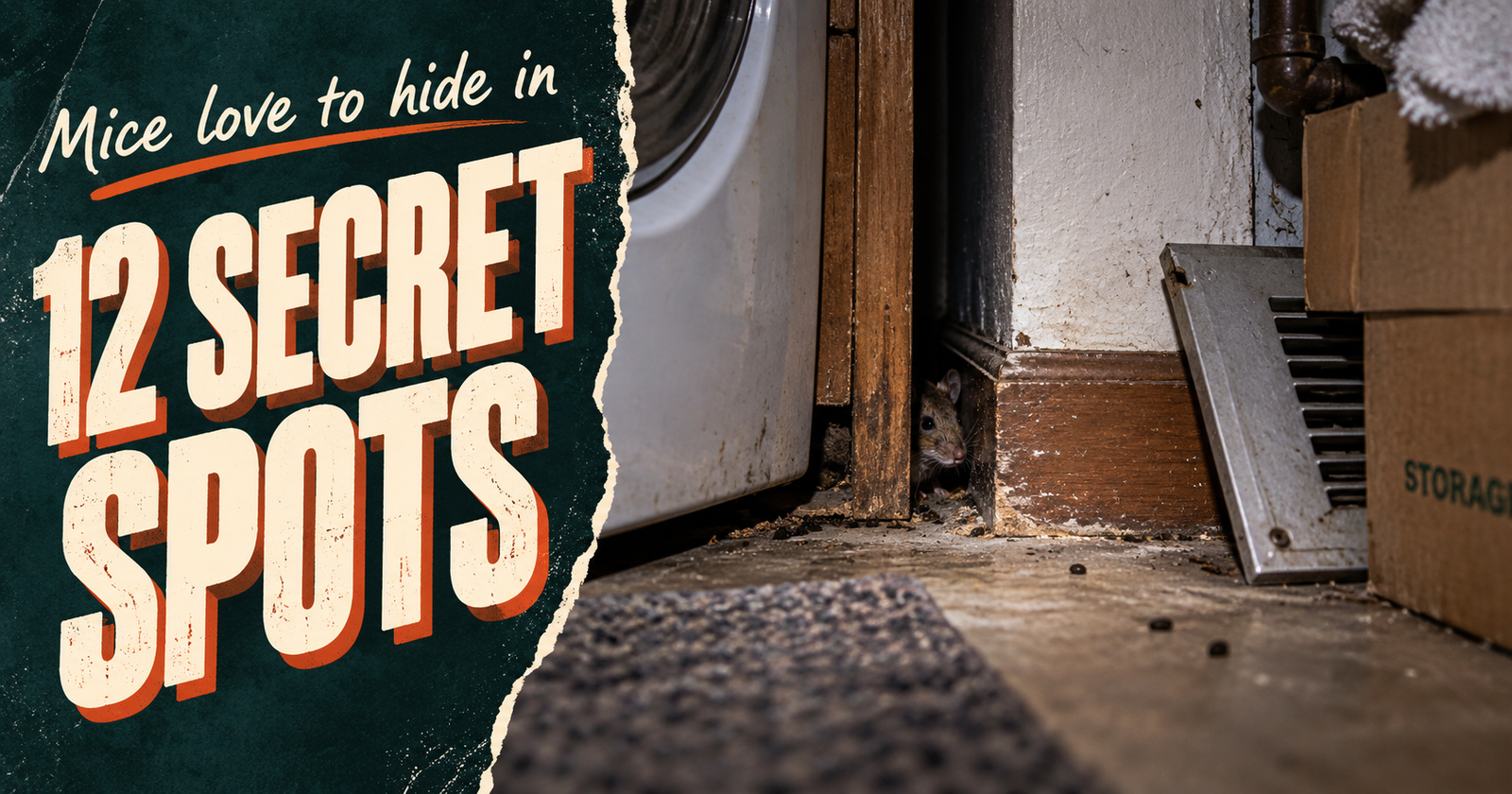
Our guide to where mice commonly hide in a house walks through the places I’d check first.
Finding a Mouse Nest Changes the Picture
A nest is much stronger evidence of established activity than one mouse sprinting through a room.
Look for a protected mass of shredded fibrous material, especially when it’s accompanied by droppings and gnawing.
Don’t handle a suspected mouse nest with bare hands.
Rodent nesting material can be contaminated with urine and droppings and should be cleaned using appropriate precautions.
And if you find an active nest with young, be careful about immediately sealing every nearby opening without understanding how the mice are moving.
The goal is to remove the population and then prevent another one from getting inside.
Daytime Mouse Sightings Can Be Concerning, but Don’t Overinterpret Them
You’ll sometimes hear:
“If you see a mouse during the day, your house is completely overrun.”
That’s too absolute.
House mice are primarily active at night, but UC IPM specifically notes that they can occasionally be seen during daylight hours.
So a daytime sighting does not automatically prove a massive infestation.
Still, repeated daytime sightings combined with abundant droppings, gnawing, nests, and multiple captures would certainly make me take the population more seriously.
Use all the evidence.
Not one internet rule.
Seeing Mice in Several Parts of the House Is More Useful
If you see a mouse in the kitchen one night and then another in the attached garage, you may be looking at a travel route between the two areas.
If you see mice upstairs and downstairs, your investigation should expand.
Mice can climb extremely well and move through concealed building spaces.
That means the problem may involve:
Wall cavities.
Utility chases.
Attics.
Basements.
Crawl spaces.
Cabinet voids.
Garages.
Don’t assume every mouse stays in the room where you saw it.
Wall Noises Add Another Clue
Maybe you’ve only physically seen one mouse.
But every night you’re hearing scratching and scurrying inside the kitchen wall.
That’s additional evidence.
It still doesn’t give you a mouse count, but it strengthens the case for ongoing activity.

Our guide on scratching sounds from mice inside walls at night explains how I would follow those noises toward accessible mouse travel routes rather than cutting open drywall.
The goal is to connect the clues.
Gnaw Marks Tell You Mice Have Been Active
CDC lists gnaw marks along with droppings as a major sign of rodent activity.
Look at:
Food packaging.
Cardboard.
Wood.
Plastic.
Utility areas.
Stored materials.
The presence of gnawing doesn’t tell you exactly how many mice are responsible.
But fresh or recurring damage tells you the mouse problem isn’t just something you imagined after one quick sighting.
A Musky Odor Can Point Toward a Larger or Long-Term Problem
House mice can produce a characteristic musky odor.
UC IPM notes that this odor is commonly associated with larger or long-term infestations.
That makes odor another clue worth considering.
One mouse running through the garage once is less likely to create a noticeable mouse odor throughout a room.
If you’re smelling a persistent musky rodent odor and finding lots of other evidence, I’d take that combination seriously.
Trap Results Are One of Your Best Population Clues
This is where the guessing starts becoming more concrete.
You saw one mouse.
Then you set traps properly.
You catch one.
Nothing else happens for a week.
No new droppings.
No gnawing.
No sightings.
No wall sounds.
That’s encouraging.
Now imagine the alternative.
You catch one mouse.
Reset the trap.
Catch another.
Then another.
New droppings keep appearing.
Another trap gets triggered in the basement.
Clearly, the mouse you originally saw wasn’t the whole problem.
Don’t Stop Trapping After the First Mouse
This is one of the easiest mistakes to make.
Mouse appears.
Trap catches mouse.
Problem solved.
Maybe.
But verify it.
CDC recommends continuing trapping until rodents are gone. Its guidance says that if you go a week without captures and there are no new signs of rodents, that’s evidence the infestation has been eliminated.
I like that much better than:
“I caught the mouse I saw, so there can’t possibly be another.”
Keep monitoring.
Let the evidence tell you when you’re finished.
Use Enough Traps to Learn What’s Happening
If you’re trying to determine the extent of mouse activity, one trap isn’t giving you much information.
Suppose you have evidence:
Behind the refrigerator.
Under the sink.
In the pantry.
And in the garage.
Putting one trap behind the refrigerator only samples one travel route.
UC IPM recommends using enough traps and placing them strategically near evidence of mouse activity.
That’s one reason I like having multiple traps available for an established indoor problem.
A 12-Pack Makes More Sense Than One Trap for Widespread Activity
The Victor Metal Pedal Mouse Traps 12-Pack is useful here because it gives you enough traditional snap traps to target several active areas at once.

Check the Victor Metal Pedal Mouse Traps 12-Pack on Amazon
That doesn’t mean every house needs twelve traps.
It means you’re not stuck moving one trap from the kitchen to the pantry to the garage trying to figure out where mice are traveling.
Place traps according to actual evidence and keep them inaccessible to children and pets.
Our upcoming dedicated trap-placement guide will go much deeper into exactly where I’d put them.
Where You Catch the Mice Matters Too
Imagine you catch three mice.
One behind the stove.
One in the pantry.
One in the garage.
That’s useful information.
Now you know multiple active routes are involved.
Compare that with catching three mice over several days at one exact location beneath the kitchen sink.
That pattern might point you toward one particularly important route or entry area.
Don’t merely count captures.
Map them.
Can One Mouse Live Alone in a House?
It’s possible to have a single mouse inside.
I don’t want to scare homeowners into believing one mouse sighting automatically means a colony.
The problem is that you can’t safely assume it’s alone either.
That’s why the practical response to one confirmed mouse is still:
Inspect.
Trap.
Monitor.
Find the entry point.
If it truly was one mouse, you’ll solve a small problem.
If there are several, you’ll discover that before they become a much bigger problem.
How Many Mice Usually Live Together?
There’s no useful universal number I can give you for a house.
Mouse populations depend heavily on:
Food availability.
Shelter.
Building layout.
Entry access.
Breeding.
Competition.
Season.
How long they’ve been there.
Control efforts.
UC IPM notes that when house mice have plentiful and stable resources, they can reproduce year-round and reach high population densities.
That’s exactly why a generic statement like “one mouse always means ten” isn’t useful.
Different houses can have dramatically different situations.
How Quickly Can a Mouse Problem Grow?
Faster than I’d want to ignore.
MU Extension reports that a female may produce five to ten litters in a year, commonly with five or six young, and the young can reach reproductive maturity in roughly six to ten weeks.
Again, that isn’t a prediction of how many mice your particular house will contain next month.
It explains why early control matters.
The easiest mouse infestation to eliminate is the one you catch before it becomes well established.
Why Food Makes Such a Difference
A mouse doesn’t need your house to be filthy.
It needs enough resources to survive.
That might mean:
Crumbs behind the stove.
Dog food left overnight.
Bird seed in the garage.
An open bag of livestock feed.
Unsealed pantry food.
Garbage.
Spilled cereal.
A forgotten snack in a basement storage area.
Poor sanitation doesn’t create mice out of nowhere, but abundant food and shelter can allow them to thrive.
UC IPM recommends reducing food and shelter as part of house-mouse control.
Clutter Can Support a Larger Population Too
Think about a mouse trying to survive in two garages.
Garage one is nearly empty.
Everything is organized.
Food is sealed.
There are few hiding places.
Garage two contains cardboard boxes stacked along every wall, bags of feed, piles of stored materials, and corners that haven’t been disturbed in years.
Which one offers better mouse habitat?
Reducing clutter won’t magically remove every mouse.
But removing shelter makes it harder for a larger population to remain hidden.
Finding the Entry Point Matters No Matter How Many Mice You Have
Suppose there really is only one mouse.
You trap it.
Great.
But the pencil-width opening it used to enter is still there.
Now the next mouse can come inside.
CDC and UC IPM both note that mice can use openings around 1/4 inch in size.

Our mouse entry-point guide shows where I’d inspect around doors, plumbing, utilities, foundations, garages, vents, crawl spaces and roofline areas.
This is why mouse control can’t be only about the mouse you can see.
Don’t Seal the House and Ignore Mice Already Inside
Exclusion is essential, but timing matters.
If mice are already active indoors, you also need population reduction.
UC IPM describes effective mouse management as a combination of sanitation, exclusion and population reduction rather than relying on a single tactic.
So think of the process as:
Remove the mice already inside.
Stop more from entering.
Reduce the food and shelter supporting them.
That’s much more durable.
Is One Mouse an Infestation?
People use the word infestation differently.
I wouldn’t get hung up on whether one confirmed mouse technically earns the label.
If a mouse is living inside your house, that’s enough reason to act.
You don’t need to wait until you meet some arbitrary mouse quota.
The practical question is:
Is there ongoing activity?
That’s what we’re trying to determine.
Five Clues That Suggest the Problem Is Bigger Than One Mouse
I would become increasingly suspicious of multiple mice when several of these occur together:
- Repeated sightings, especially over multiple days.
- Fresh droppings returning after proper cleanup.
- Evidence in several different areas of the house.
- Multiple trap captures after the first mouse is removed.
- Nests, repeated gnawing, or persistent musky odor suggesting established activity.
No single clue gives you an exact population.
Together, they tell a story.
Five Clues That Suggest You May Have Caught the Problem Early
On the other hand, I’d be encouraged if:
- You had one sighting.
- Evidence is confined to one small area.
- You catch one mouse promptly.
- No fresh droppings or damage appears afterward.
- Properly placed traps remain empty and no new signs appear for at least a week.
That’s not an eternal guarantee that another mouse will never enter.
But it gives you a much stronger reason to believe the immediate indoor problem has ended.
What Should You Do Tonight If You Just Saw One?
Don’t panic.
But don’t ignore it.
Start by checking the room where you saw the mouse.
Look along walls and behind nearby objects.
Inspect behind appliances when safe.
Check cabinets.
Look beneath sinks.
Look for droppings and gnawing.
Then put appropriate mouse traps along active travel routes.
CDC recommends traditional snap traps for reducing rodent populations around the home and says traps should be placed where rodents or their evidence have been observed.
Don’t Put One Trap in the Middle of the Room
Mice commonly travel along walls and objects for protection.
CDC recommends putting a snap trap against the wall with the baited end toward the wall so the trap forms a T with it.
That’s a much smarter setup than dropping a trap wherever it’s easiest for you to see.
The mouse doesn’t care about your convenience.
Put the trap where it travels.
Keep Children and Pets in Mind
Any trapping plan needs to account for the people and animals living in the house.
CDC recommends keeping traps and bait inaccessible to children and pets and following the trap manufacturer’s instructions.
If an exposed trap isn’t appropriate for a particular location, use a safer placement or an appropriate enclosed design.
Don’t create a new household hazard while solving the mouse problem.
Don’t Assume the Cat Will Tell You How Many Mice You Have
Cats can certainly catch mice.
They aren’t a reliable population survey.
UC IPM notes that predators may make rodents more secretive and can give the impression they’ve reduced the population even when mice remain in protected hiding areas.
So if your cat catches one mouse, I’d still inspect and monitor.
Maybe it caught the only one.
Maybe it didn’t.
Don’t Depend on Ultrasonic Devices to Answer the Question Either
An ultrasonic repeller isn’t going to tell you whether there are two mice or twenty.
More importantly, UC IPM says high-frequency electronic devices aren’t effective for established house-mouse control.
I’d spend my effort on:
Evidence.
Trapping.
Exclusion.
Food control.
Monitoring.
Those things actually help you understand what’s happening.
When the Number of Mice Almost Doesn’t Matter
There’s a point where trying to calculate the population becomes a distraction.
If you have:
Fresh droppings in several rooms.
Multiple captures.
Nesting material.
Nighttime wall activity.
Repeated sightings.
Food damage.
And obvious entry points.
does it really matter whether there are seven mice or eleven?
You already know what needs to happen.
The population needs to be removed and the house needs to be mouse-proofed.
When I’d Call a Pest-Control Professional
I’d consider professional help if the evidence suggests an extensive infestation or your own trapping and exclusion aren’t getting ahead of it.
Especially when:
Mouse activity spans much of the house.
You continue catching mice without seeing activity decline.
You can’t locate important entry points.
Mice are occupying inaccessible structural spaces.
There’s extensive contamination.
You’re uncomfortable handling traps or cleanup.
A good professional inspection should help determine where mice are active and how they’re entering—not simply give you another guessed mouse count.
The Best Answer Comes From What Happens Next
If you saw one mouse tonight, I can’t responsibly tell you there are exactly six more behind the wall.
Nobody can determine that from one sighting.
What you can do is turn the next week into a much better test.
Inspect for droppings and gnawing.
Safely clean old evidence.
Set enough traps in the right places.
Record where mice are caught.
Watch for new droppings.
Inspect for entry points.
Reduce food and shelter.
If you catch one mouse and everything goes quiet with no new evidence, that’s encouraging.
If traps start catching mice in multiple areas and fresh droppings keep appearing, you have your answer:
The mouse you saw wasn’t alone.
Either way, don’t wait for the problem to become obvious enough that you’re seeing mice every night.

If you’re ready to tackle the entire problem rather than simply count them, our complete guide to getting rid of mice in your house for good walks through trapping, exclusion, sanitation and monitoring together.
One mouse is enough reason to investigate.
You don’t need twenty of them to make it worth fixing.
About the author: Caleb Rourke researches how mice and other rodents get into homes, where they hide, and the practical steps homeowners can use to identify and prevent them. He writes straightforward rodent-control guides for Critter Answers.