
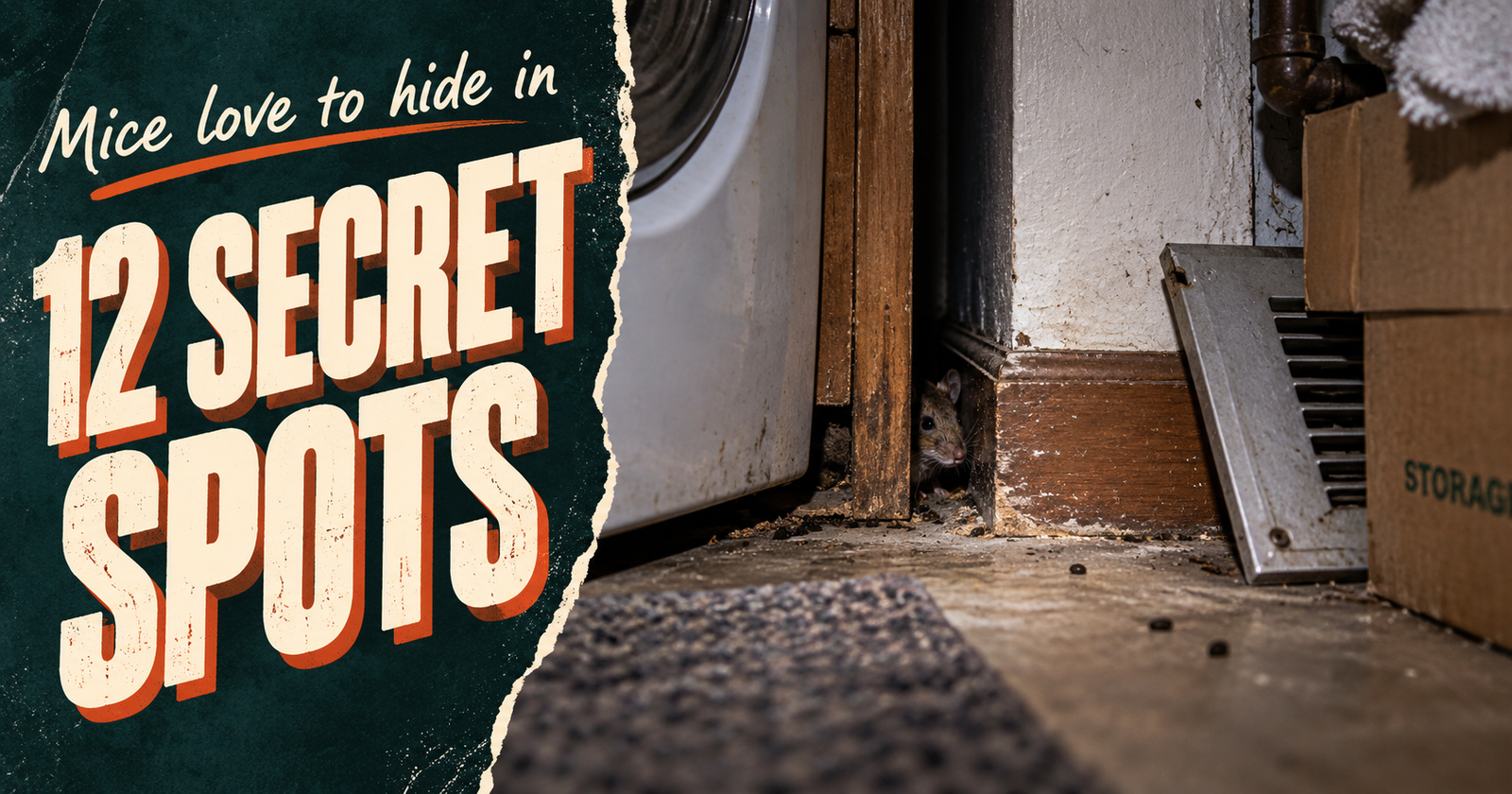
If you know mice are somewhere in your house but can’t figure out where they’re spending the day, don’t assume they’re traveling halfway across the building every night.
They may be hiding surprisingly close to where you’re finding the evidence.
House mice look for protected places with access to food and shelter. That often puts them behind appliances, inside cabinet voids, among stored belongings, in garages, attics, basements, crawl spaces, and sometimes inside walls.
The easiest way to find them isn’t to tear the house apart.
It’s to follow the clues.
Droppings, gnaw marks, shredded nesting material, damaged food, tracks, odors, and repeated nighttime sounds can all help narrow down where mice are hiding. The same evidence can also help with figuring out what critter is in your house when mice are not the only possibility.
Once you start thinking like a tiny animal that wants to remain unseen, a house suddenly contains a lot more hiding places than you realized.
Mice Usually Have a Reason for Choosing a Hiding Place
A good mouse hiding place tends to offer some combination of three things:
Shelter.
Food.
Low disturbance.
Think about the areas in your house that you rarely touch.
The narrow space behind your refrigerator.
The back of the cabinet beneath the sink.
A cardboard box that hasn’t moved since Christmas three years ago.
The corner of an attic.
The clutter beside a garage wall.
Those are much more attractive to a mouse than the middle of your brightly lit living room.
UC IPM notes that house mice thrive around people where food and shelter are abundant, and nests may be found behind boxes, in drawers, garages and other protected locations.
So rather than searching randomly, I start with the places that give mice what they’re looking for.
1. Behind the Refrigerator
This is one of the first places I’d inspect in a kitchen.
Think about what’s back there.
It’s dark.
It’s protected.
It’s rarely disturbed.
The refrigerator produces warmth.
And food crumbs can accumulate beneath and around it.
That’s a pretty good arrangement if you’re a mouse.
CDC specifically recommends placing rodent traps in closed areas such as behind refrigerators and stoves when mice are active there.
How to Check Behind Your Refrigerator
Don’t yank the refrigerator into the middle of the kitchen without thinking about what’s connected to it.
Some refrigerators have:
Water lines.
Ice-maker connections.
Electrical cords.
Flooring that scratches easily.
If you can safely pull yours forward, use a flashlight and inspect the floor and wall behind it.
Look for:
Droppings.
Shredded material.
Food debris.
Gnawing.
A possible hole or gap.
Don’t focus solely on finding an actual mouse.
Finding concentrated evidence is enough to tell you the area is being used.
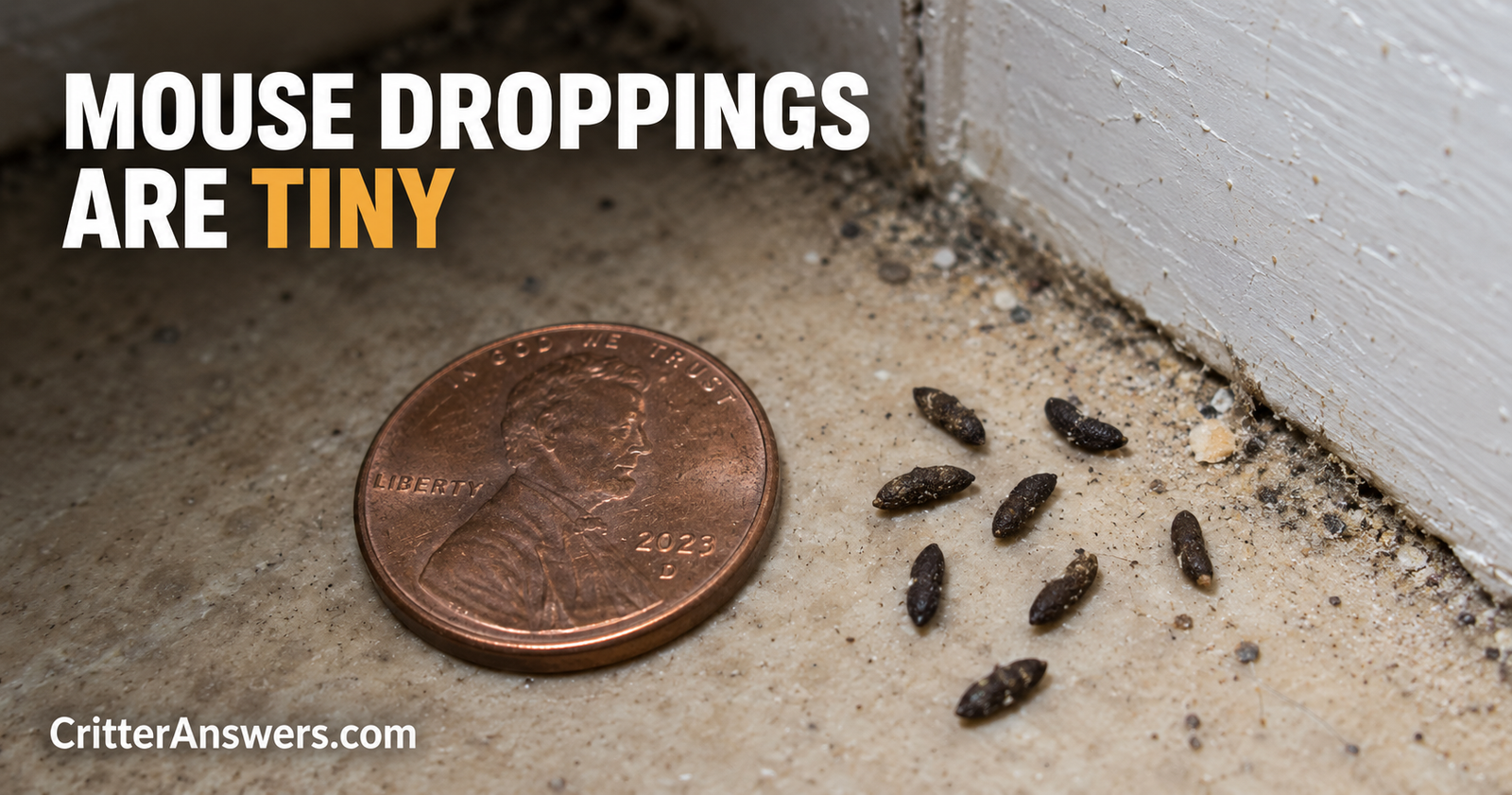
If you discover droppings, our mouse-dropping identification guide will help you determine whether the evidence fits mice and how to handle the cleanup safely.
2. Behind and Under the Stove
The stove offers many of the same advantages as the refrigerator, with one additional benefit:
Food.
Crumbs, grease, pasta, rice, pet kibble and all kinds of tiny food scraps can disappear beneath an appliance.
You may not notice them.
A mouse can.
CDC includes behind stoves among the areas where traps can be placed when rodent evidence is present.
If the stove can be moved safely, inspect behind it.
But don’t disconnect gas lines or start moving a heavy appliance if you aren’t comfortable doing so safely.
The mouse isn’t worth creating a gas or electrical hazard.
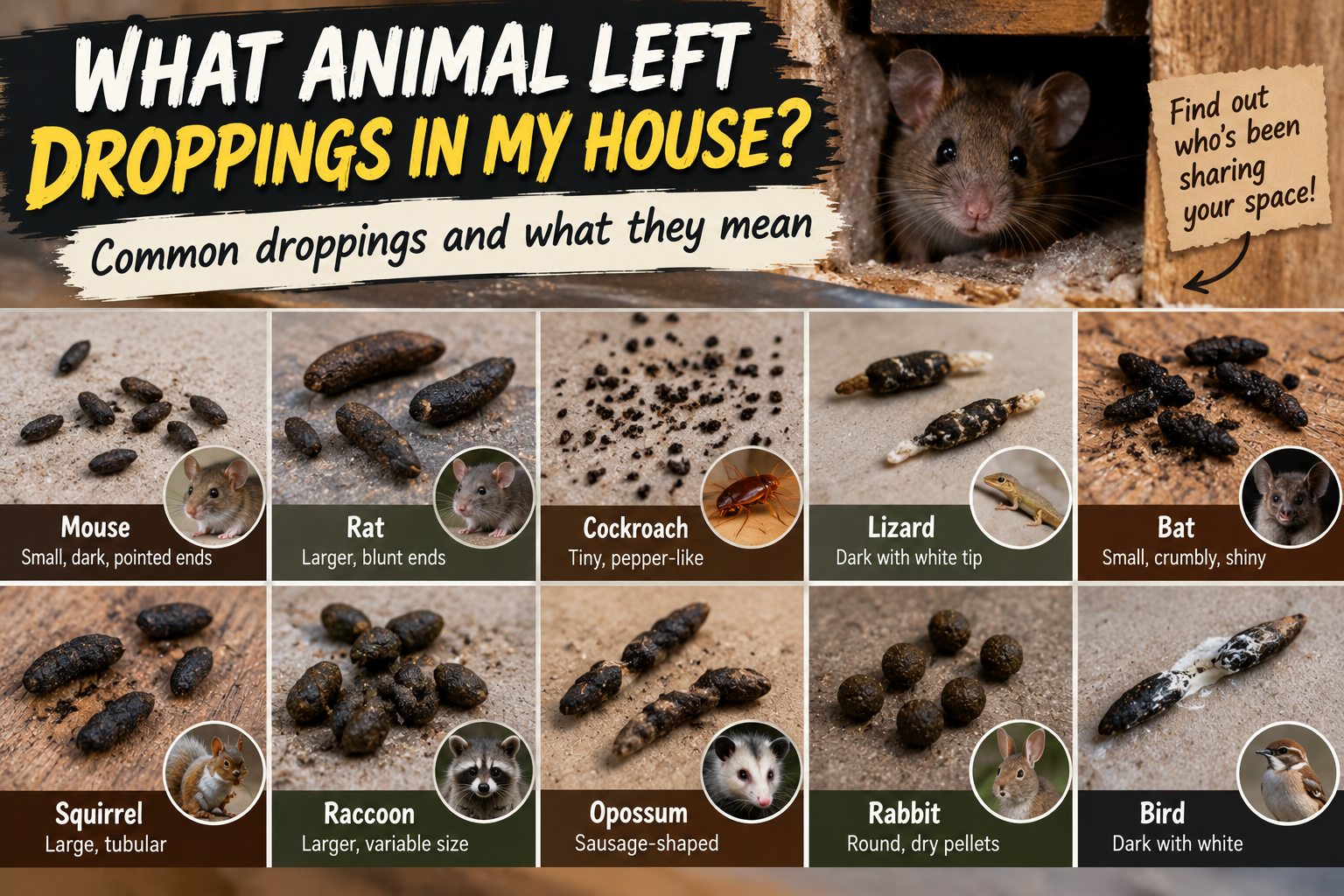
Don’t Just Look at the Floor
Use your flashlight to inspect the wall behind the appliance too.
Are there utility penetrations?
Is there a gap where a line enters?
Do you see droppings concentrated along one edge?
That could reveal more than simply where the mouse is hiding.
It may show you how it’s moving into and out of the kitchen.
3. Inside and Behind Kitchen Cabinets
Kitchen cabinets are another favorite place to investigate because they combine darkness and shelter with immediate access to food.
CDC specifically recommends checking inside, underneath, and behind kitchen cabinets when inspecting a house for rodents and their entry openings.
Don’t merely open the cabinet doors and glance inside.
Remove enough items that you can see:
The back corners.
The floor.
Shelf edges.
Plumbing penetrations.
Gaps between cabinet sections.
The wall behind items.
Sometimes the mouse isn’t actually nesting in the cabinet you use.
It may be occupying a hidden void behind the cabinet and entering through a small opening.
Check Your Drawers Too
This one surprises people until they open a drawer and find mouse poop.
CDC specifically identifies drawers as one of the concealed locations where rodent droppings may appear.
If you find droppings in a drawer, empty it and inspect farther than the visible interior.
If possible, remove the drawer and look into the cabinet cavity behind it.
You may discover a much larger protected space.
That’s the area I’d really want to investigate.
4. Under the Kitchen and Bathroom Sinks
Under-sink cabinets deserve special attention because plumbing creates pathways.
A plumber has to get those pipes through something.
That means holes.
And those holes aren’t always cut to exactly the diameter of the pipe.
CDC specifically tells homeowners to inspect around pipes beneath sinks and other plumbing penetrations when looking for rodent access.
Open the cabinet and look at every place a pipe disappears into a wall or floor.



A Hole Under the Sink May Be a Travel Route
Here’s an important distinction.
Finding a mouse-sized opening around a pipe doesn’t necessarily mean you’ve found the exterior entrance.
The mouse might enter your house somewhere completely different.
Once inside a wall or floor cavity, it can use the plumbing opening as a convenient doorway into the cabinet.
So think of mouse movement as a route:
Outside → structure → wall/floor void → plumbing gap → cabinet → food.
Finding one part of that route helps you find the rest.

Our guide to how mice are getting into your house goes much deeper into tracking those entry routes.
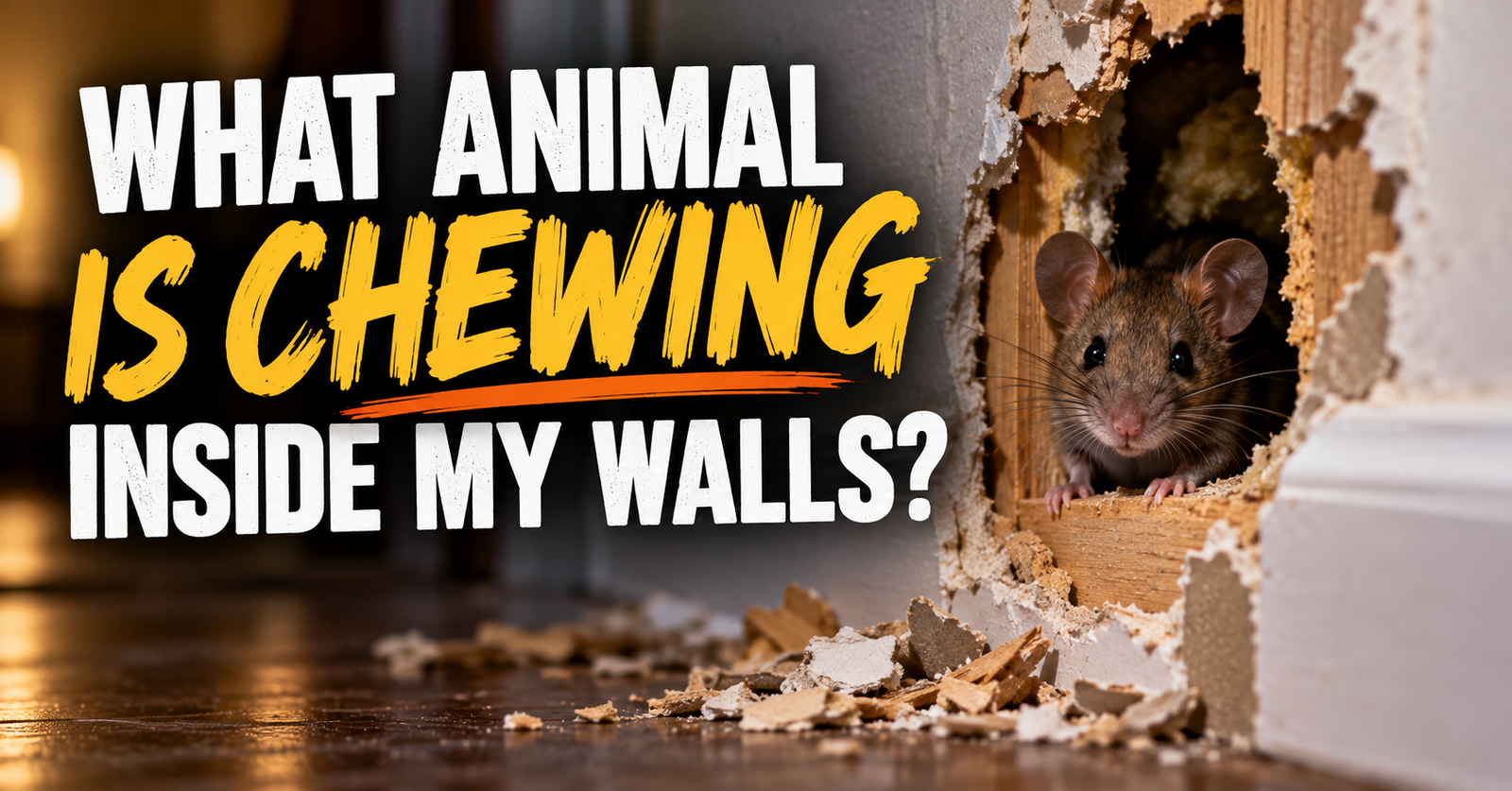
5. Inside Wall Voids
This is the hiding place that drives people crazy because you can’t simply open the cabinet and look.
You hear:
Scratching.
Scurrying.
Rustling.
Maybe gnawing.
Then everything stops.
A wall cavity gives mice protection while also allowing them to move through parts of the house without crossing open rooms.
Older CDC rodent-control guidance specifically identifies wall voids among protected locations where evidence of rodents can occur.
But hearing something inside a wall does not automatically mean mice.
Other animals can make wall noises too.
How Do You Know Mice Are Hiding in a Wall?
I want supporting evidence.
For example:
You hear light scurrying at night.
You find mouse droppings beneath the kitchen sink.
There’s a plumbing opening leading into that wall.
You catch a mouse nearby.
Now the mouse theory is getting much stronger.
If the only evidence is one unexplained scratching noise, keep investigating before cutting drywall open.

Our earlier guide to what animal may be scratching in your walls at night can help when the animal hasn’t actually been identified yet.
Don’t Start Cutting Holes Everywhere
I wouldn’t open a wall simply because I heard a mouse behind it.
First inspect both sides of that wall.
What’s nearby?
Kitchen?
Bathroom?
Pantry?
Garage?
Utility room?
Exterior wall?
Then check above and below it.
A mouse moving inside a wall cavity may enter and exit somewhere accessible.
Finding that route can save you from unnecessary demolition.
6. Pantries and Food-Storage Areas
If mice could design a room specifically for themselves, a poorly protected pantry wouldn’t be a bad start.
It’s quiet.
Sheltered.
And full of food.
Inspect behind and underneath food packages.
Look at lower shelves and corners.
Check cardboard boxes and bags for gnawing.
Pay particular attention to food that sits undisturbed for long periods.
A mouse doesn’t necessarily need to build a nest inside the pantry to use it heavily.
Its hiding place may be only a few feet away.
Look Beyond Human Food
Check:
Dog food.
Cat food.
Bird seed.
Chicken feed.
Livestock grain.
Pet treats.
Grass seed.
Any stored edible material.
MU Extension specifically recommends securing bird seed, livestock feed and pet food as part of rodent prevention.
This becomes particularly important in garages, mudrooms and rural homes where larger bags of feed may be stored.
7. Cardboard Boxes and Cluttered Storage
This one is easy to underestimate.
A cardboard box that’s opened every week isn’t particularly peaceful.
A cardboard box sitting untouched in the basement for two years is different.
Boxes and clutter create:
Darkness.
Cover.
Nesting material.
Protected travel routes.
And lots of spaces humans rarely inspect.
UC IPM specifically recommends searching behind boxes and other sheltered locations for mouse nests made from finely shredded paper or fibrous material.
Look Inside Boxes Carefully
If you find:
Shredded paper.
Chewed cardboard.
Droppings.
Stored food.
Or a nest.
Don’t immediately shake the box around.
Rodent nests and waste should be treated carefully.
CDC says not to sweep or vacuum dry rodent droppings, urine, or nesting material because disturbing contaminated material can put particles into the air.
If a box is contaminated, handle the cleanup according to current rodent-cleanup guidance.
8. Closets
Closets are easy to overlook because we think of mice as kitchen pests.
But CDC specifically includes closet floors, especially corners, among the places homeowners should inspect for rodent openings.
A closet can provide excellent shelter.
Especially one containing:
Boxes.
Paper bags.
Clothing.
Blankets.
Stored linens.
Seasonal decorations.
Items that rarely move.
Check the back corners and floor.
Look behind boxes rather than merely looking over the top of everything.
9. Basements
Basements can provide mice with a whole collection of hiding places.
Utility penetrations.
Storage.
Foundation edges.
Mechanical equipment.
Ceilings.
Wall cavities.
Boxes.
Floor drains.
CDC specifically recommends checking basements for rodent access and inspecting the junction where floors and walls meet.
I’d start along the perimeter rather than wandering around the middle of the room.
Mice commonly travel close to walls and objects because those routes provide cover.
Follow the Basement Walls
Look for droppings along the edges.
Check behind stored belongings.
Inspect around the furnace and water heater.
Look where utilities enter.
Check any basement windows and exterior doors.
A basement hiding-place search can easily turn into an entry-point inspection.
That’s a good thing.
Finding where mice spend time is useful.
Finding how they’re getting there is even better.
10. Crawl Spaces
A crawl space can give mice shelter beneath the entire house.
From there they may have access to:
Plumbing.
Insulation.
Utility lines.
Wall cavities.
Floor penetrations.
And other hidden pathways.
CDC specifically identifies crawl spaces as areas homeowners should inspect for rodents and potential entry points.
If mouse evidence inside your house is concentrated around plumbing or floor penetrations, the crawl space underneath deserves attention.
Don’t Crawl Into an Unsafe Space
Not every crawl space should be a DIY adventure.
If it’s:
Heavily contaminated.
Extremely tight.
Structurally questionable.
Difficult to access.
Or otherwise unsafe,
don’t force yourself into it just to find a mouse.
A professional inspection is much cheaper than getting hurt beneath your house.
11. Attics and Insulation
Yes, mice can hide above you.
CDC specifically includes attics among the areas that should be checked when inspecting for rodents.
An attic provides plenty of protected locations, especially around:
Insulation.
Stored boxes.
Wall plates.
Eaves.
Utility penetrations.
And roofline openings.
Look for droppings and shredded nesting material.
Also pay attention to where evidence is concentrated.
Mice in an Attic Don’t Necessarily Enter Through the Attic
This is important.
Finding mice upstairs doesn’t prove they’re coming through the roof.
They may enter lower down and climb through wall cavities.
House mice are excellent climbers. UC IPM specifically notes their climbing ability and recommends removing or thinning plants growing against buildings partly for this reason.
So inspect both possibilities:
High exterior entry.
And movement upward from lower parts of the structure.
12. Garages
Garages may be one of the best mouse habitats attached to a house.
They can offer:
Shelter.
Clutter.
Cardboard.
Pet food.
Bird seed.
Grass seed.
Animal feed.
Garbage.
And a giant exterior door with seals that aren’t always perfect.
UC IPM specifically mentions garages as places to look for house-mouse nests.
If you find evidence in an attached garage, take it seriously.
The garage may be the first stage of the infestation rather than the final destination.
Inspect the Wall Between the Garage and House
Once mice enter the garage, look for ways they could continue into the living space.
Check:
The door into the house.
Utility penetrations.
Plumbing.
Wall openings.
Cabinetry.
Storage areas.
The garage may contain the original exterior entrance while another small opening gives mice access to the rest of the house.
Where Do Mice Hide During the Day?
Usually somewhere protected.
House mice are most active at night, although seeing one during daylight is possible. UC IPM notes that mice are primarily active at night but can sometimes be seen during daytime hours.
During quieter periods, expect them to remain around sheltered nesting and resting areas.
That could mean:
Behind an appliance.
Inside a wall.
In stored belongings.
Inside a cabinet void.
In an attic.
Under or behind clutter.
You usually don’t need to physically locate the sleeping mouse.
You need to identify the active area and travel route.
How Far Is the Mouse Hiding From the Droppings?
Potentially not very far.
House mice tend to operate within relatively limited areas when food and shelter are available nearby.
MU Extension notes in its rodent-control guidance that house mice seldom venture more than a few feet from nests or food sources when discussing bait placement.
That makes concentrated droppings particularly useful.
If most of your evidence is behind the refrigerator and inside one neighboring cabinet, I wouldn’t begin my investigation at the opposite end of the house.
Start close.
Then expand outward.
Can Mice Hide Inside Furniture?
They can use protected spaces around furniture, and upholstered or hollow furniture can potentially provide shelter when accessible.
But I wouldn’t assume every mouse in a living room has moved into your couch.
Look for evidence.
Check underneath and behind furniture that sits against walls.
Look for droppings.
Look for gnawing.
Look for damaged fabric or stuffing.
If nothing supports the theory, keep investigating.
Can Mice Hide in a Mattress?
This is not where I’d start looking for a typical house-mouse problem.
Mice want protected nesting areas, but that doesn’t mean your mattress is automatically their preferred home.
If a mattress or upholstered item has been stored undisturbed in a garage, barn, basement, or storage building, that’s a different situation.
Again, let the evidence lead you.
Don’t turn every soft object in the house into a suspected mouse nest.
Can Mice Hide in Kitchen Appliances?
Behind appliances?
Absolutely.
Inside accessible cavities around appliances?
Potentially.
But don’t start disassembling electrical or gas appliances looking for mice.
Inspect the accessible surrounding areas first.
Droppings and nesting material behind an appliance are enough to identify an active zone.
If you suspect an animal is actually inside equipment that can’t be safely inspected, call someone qualified to handle the appliance.
Where Do Mice Build Nests?
Mouse nests are generally built in protected areas from shredded fibrous material.
UC IPM describes nests made from finely shredded paper or other fibrous materials, while MU Extension similarly notes nests made from fine shredded materials.
That could include material from:
Paper.
Cardboard.
Fabric.
Insulation.
Other soft fibers.
A nest isn’t necessarily sitting in plain view.
It may be tucked behind something where it can remain undisturbed.
What Does a Mouse Nest Look Like?
Think about a little mass of shredded soft material gathered into a protected location.
The context matters.
A handful of shredded paper in the middle of a busy room isn’t automatically a mouse nest.
Shredded paper packed into the back of an undisturbed box with droppings nearby?
That’s considerably more convincing.
Don’t handle a suspected mouse nest bare-handed.
Treat it as potentially contaminated rodent material.
Finding the Nest Isn’t Required to Get Rid of the Mice
This is a big one.
Homeowners sometimes become obsessed with locating the exact nest.
You don’t necessarily need to.
If you know where mice are traveling, you can trap them.
If you know how they’re entering, you can exclude them.
If you know where their food is coming from, you can remove it.
Finding the nest is useful.
It isn’t a requirement for solving the infestation.
Droppings Can Show You Where to Start
If I walked into a house with suspected mice, droppings would be one of my best maps.
CDC recommends placing traps in locations where you’ve seen droppings, nesting material, nibbled food, gnaw marks, or other evidence.
That’s because you don’t need to guess where mice travel when they’ve already shown you.
Safely clean the existing droppings.
Then monitor.
New droppings help confirm that an area remains active.
Gnaw Marks Can Narrow the Search Too
Look for freshly damaged:
Food packaging.
Cardboard.
Wood.
Plastic.
Stored materials.
CDC identifies gnaw marks alongside droppings as one of the major physical signs of rodent presence.
If you have droppings and gnawing concentrated around one kitchen cabinet, start there.
If all the evidence is in the garage, don’t begin by tearing apart the attic.
Follow the Walls
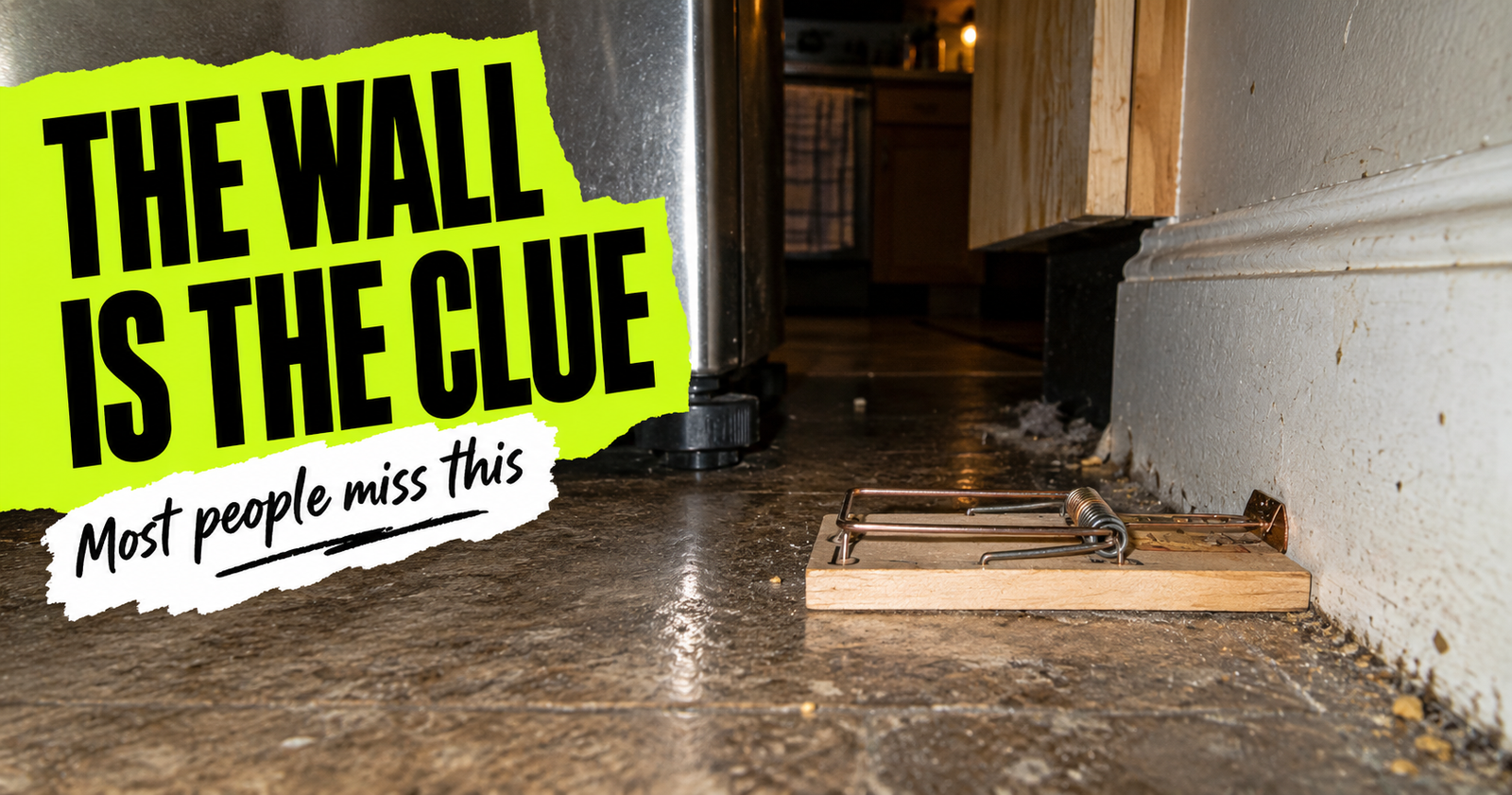
Mice often travel along walls and other edges rather than running across exposed open spaces.
CDC recommends placing traps against walls for this reason.
So when looking for hiding areas, trace the perimeter.
Follow the wall from where you found droppings.
Where does it lead?
Behind a stove?
Under a cabinet?
Toward a pantry?
To a utility penetration?
Sometimes the mouse route starts becoming obvious once you stop thinking room-by-room and start thinking edge-by-edge.
Where Should You Put Traps Once You Find the Hiding Area?
Near the active route — not necessarily directly inside the nest.
If droppings are behind the refrigerator, that’s useful.
If mice travel along the wall between the refrigerator and pantry, that’s even better.
CDC recommends placing snap traps on the floor against walls, with the baited end toward the wall so the trap forms a T with it.
This is exactly why finding the hiding area matters.
It turns trap placement from guessing into targeting.
Multiple Hiding Areas Call for Multiple Traps
One trap in the kitchen isn’t much of a trapping strategy if you have evidence in the kitchen, basement and garage.
That’s where our saved Victor Metal Pedal Mouse Traps 12-Pack makes sense.
It gives you enough traditional snap traps to target several active routes instead of expecting one trap to intercept every mouse in the house.

Check the Victor Metal Pedal Mouse Traps 12-Pack on Amazon
Don’t automatically put all twelve out.
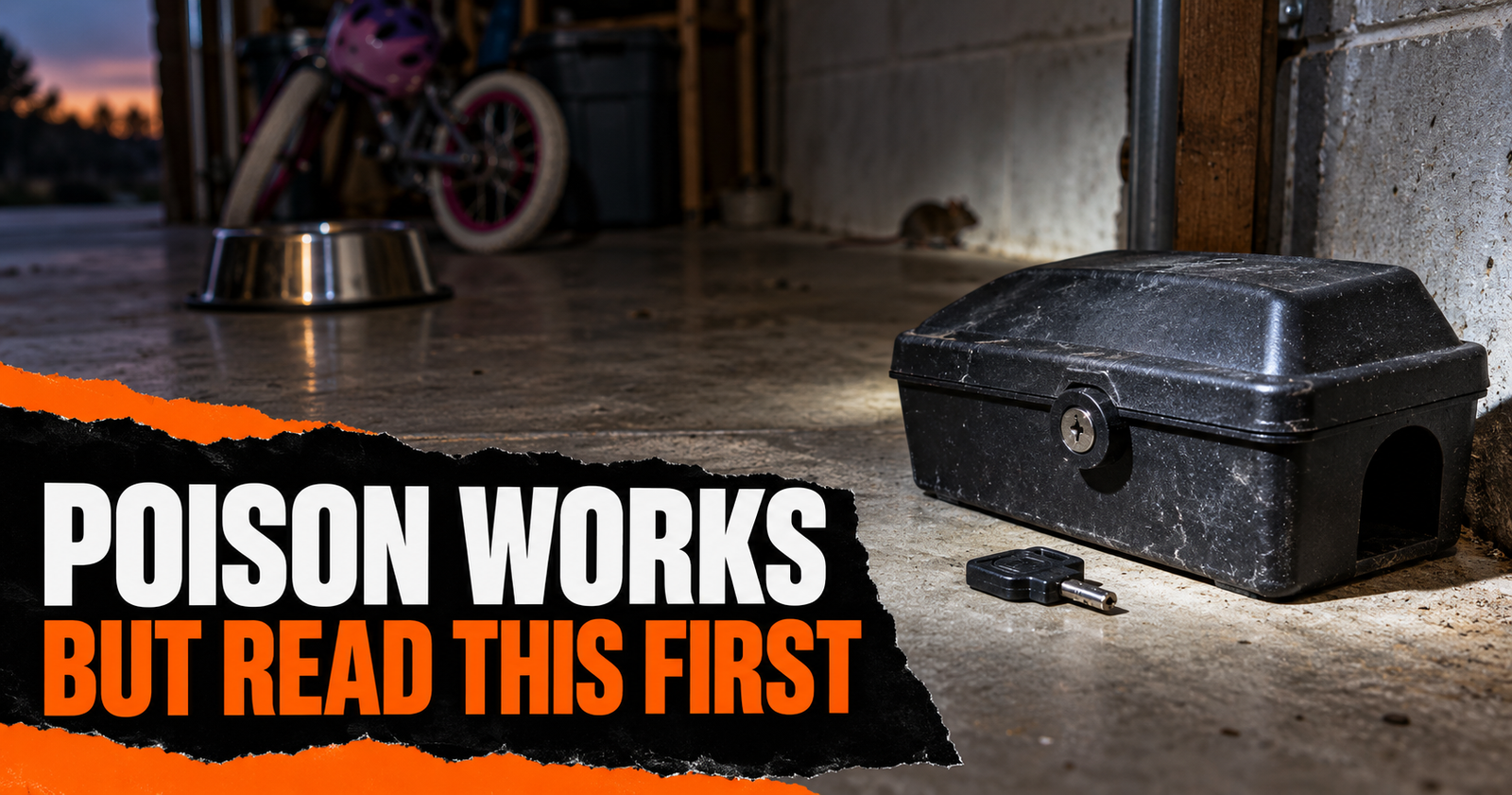
Use the amount appropriate for the activity you’re seeing, follow the manufacturer’s directions, and keep traps inaccessible to children and pets.
What If You Don’t Want to See the Mouse in the Trap?
Some homeowners prefer an enclosed option.
The OWLTRA OW-2 Indoor Electric Mouse Trap 2-Pack is an enclosed electronic trap intended for indoor mouse control.

Check the OWLTRA OW-2 Indoor Electric Mouse Trap 2-Pack on Amazon
Again, you don’t need both just because I’m giving you two choices.
The bigger point is to put whichever appropriate trap you choose where mice are actually active.
Location matters.
Don’t Forget the Hole That Let Them In
Finding where mice hide solves only part of the problem.
You also need to know how they entered.
Mice can squeeze through an opening about 1/4 inch wide — roughly pencil-width. CDC recommends inspecting behind appliances, inside cabinets, around pipes and utilities, attics, basements, crawl spaces, doors, windows, eaves and soffits for openings.
That’s why hiding-place hunting and entry-point hunting work so well together.
You find droppings beneath the sink.
You find a gap around the plumbing.
You follow the wall.
Then you find the exterior utility penetration.
Now you’re building an actual explanation rather than randomly plugging holes.
Remove Food and Shelter While You’re at It
Catching mice is only one piece of control.
CDC recommends reducing food, water, and shelter that support rodents around homes.
That means:
Secure pantry food.
Store pet food properly.
Protect bird seed and livestock feed.
Clean crumbs beneath appliances.
Reduce unnecessary clutter.
Manage garbage.
Move or organize stored materials.
The fewer protected places and easy meals you provide, the less attractive your house becomes.
Don’t Vacuum a Mouse Nest or Droppings
If your hiding-place search turns up a nest or pile of droppings, resist the urge to grab the shop vacuum.
CDC specifically says not to vacuum or sweep rodent urine, droppings, or nesting material before proper disinfection because that can put contaminated particles into the air.
Wear rubber or plastic gloves.
Wet contaminated material thoroughly with an appropriate disinfectant.
Allow the required contact time.
Then remove and clean it according to current CDC rodent-cleanup guidance.
This matters especially when you uncover an old hidden nesting area that’s accumulated significant waste.
Heavy Infestations Are Different
One little nest behind a box is one thing.
An attic with widespread droppings, contaminated insulation, multiple nests, and dead rodents is another.
CDC recommends additional precautions for heavy rodent infestations.
That’s a situation where professional cleanup may make much more sense than turning it into a weekend DIY project.
Especially if contaminated insulation or difficult-to-access spaces are involved.
What If You Still Can’t Find Where the Mice Are Hiding?
Stop searching randomly.
Go back to the evidence.
Where did you last see a mouse?
Where are the newest droppings?
Where is food being chewed?
Where do you hear activity?
Where have traps been triggered?
Put those locations on a mental map.
Then look at what connects them.
A wall.
A cabinet run.
A plumbing chase.
A basement ceiling.
An attached garage.
A mouse doesn’t teleport between rooms.
There’s a route.
Your job is to find enough of that route to intercept it and shut down the access.
You Don’t Need to Find Every Mouse’s Bedroom
This is the part I want homeowners to remember.
You’re not trying to conduct a census of every mouse nest.
You’re trying to find where the activity is concentrated.
Once you know that, you can place traps where mice actually travel, remove the food and shelter supporting them, and find the openings allowing new mice inside.

If you’re ready to move from detective work to actually eliminating them, our complete guide to getting rid of mice in your house for good ties those steps together.
Behind the refrigerator.
Inside a cabinet void.
Along a basement wall.
In an attic corner.
Behind boxes in the garage.
Those hiding places may look completely different to us.
To a mouse, they’re all versions of the same thing:
A protected place where people rarely bother them.
Find those quiet places, follow the evidence around them, and suddenly the mouse problem becomes a lot less mysterious.
About the author: Caleb Rourke researches how mice and other rodents get into homes, where they hide, and the practical steps homeowners can use to identify and prevent them. He writes straightforward rodent-control guides for Critter Answers.