
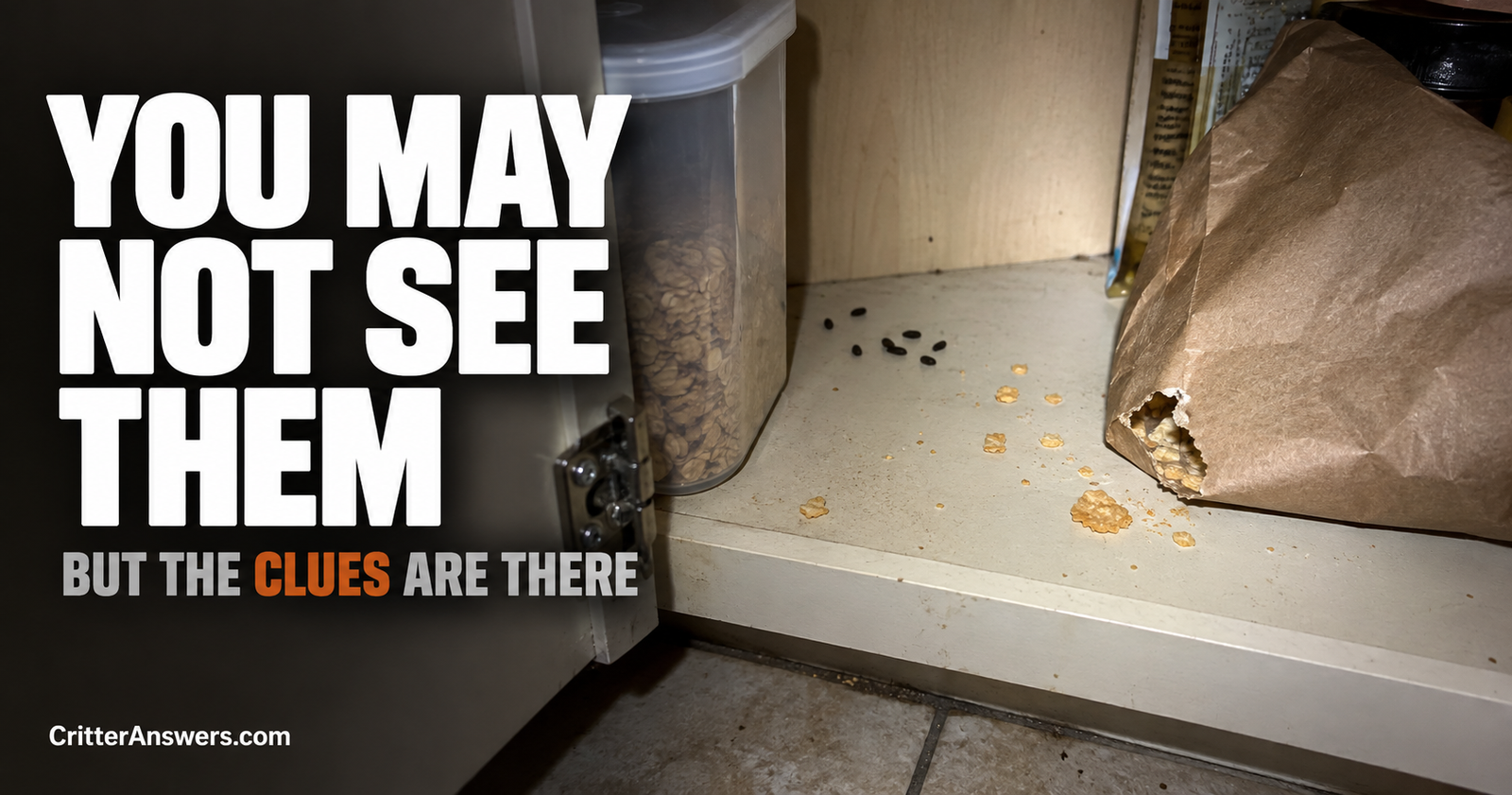
You don’t have to see a mouse running across the kitchen to know mice are in your house.
In fact, that’s often not how people discover them.
Maybe you find a few little black droppings beneath the sink.
A cereal box suddenly has a chewed corner.
Something scratches behind the wall after you go to bed.
Or you open a drawer you haven’t used in a while and find shredded paper tucked into the back.
Those clues can tell you quite a bit.
The most common signs of mice in a house include small droppings, fresh gnaw marks, nighttime scratching or scurrying, shredded nesting material, tracks, disturbed food, and sometimes a musky odor.
And when several of those signs appear in the same area, I’d take the possibility of mice pretty seriously.
The trick is learning how to separate possible mouse evidence from evidence that actually points strongly toward mice.
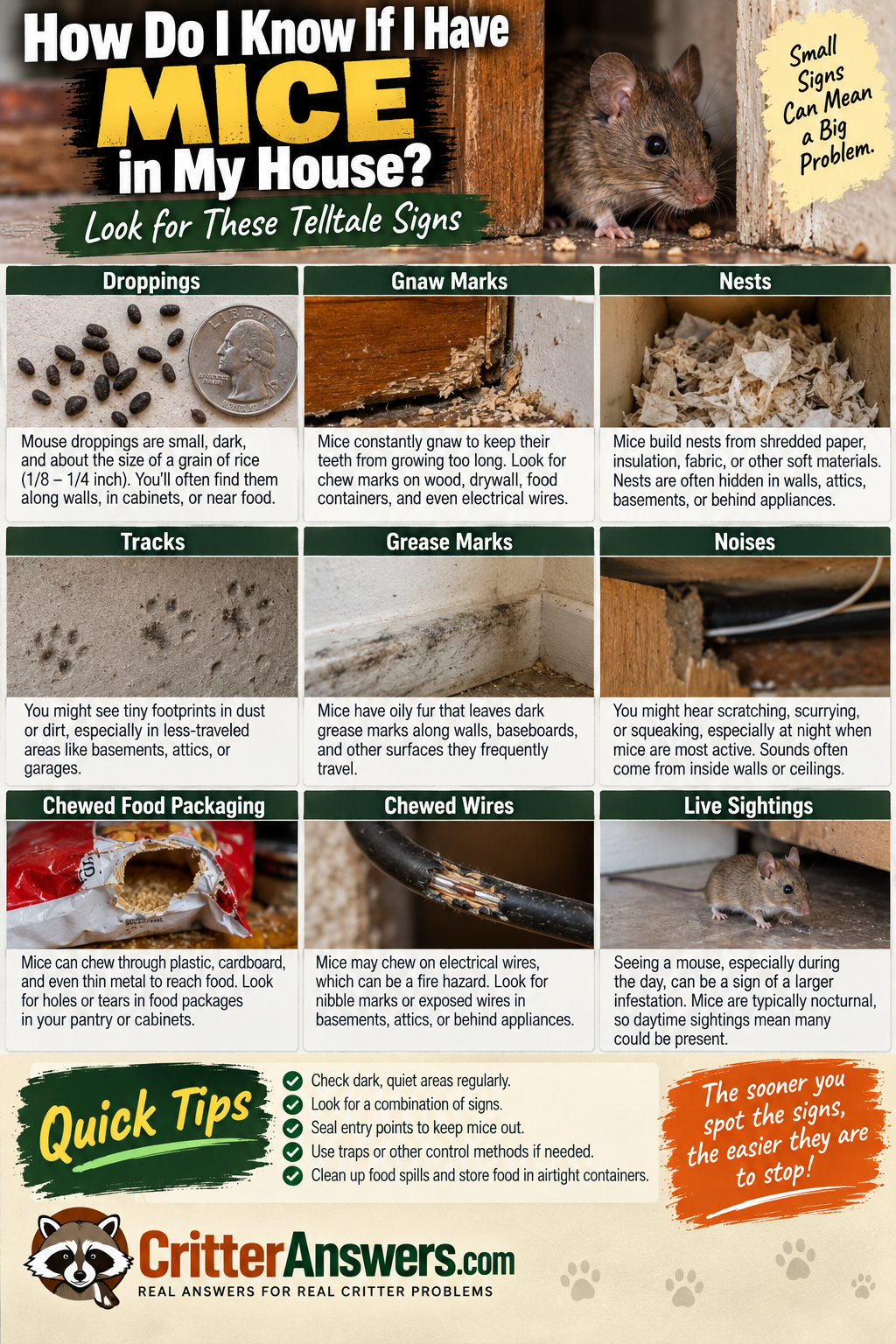
The 7 Mouse Signs I’d Look for First
If I suspected mice in a house, these are the first things I’d investigate:
- Small dark droppings
- Fresh gnaw marks
- Scratching or scurrying at night
- Shredded nesting material
- Chewed or disturbed food
- Tracks or travel marks
- A persistent musky odor
One clue might not be enough.
Several clues together are much stronger.
For example:
A weird noise inside the wall?
Could be several things.
A weird nighttime noise + mouse-sized droppings + a chewed bag of dog food?
Now mice move much higher on my list.
1. Mouse Droppings Are Usually the Biggest Giveaway
For many homeowners, droppings are the first undeniable evidence.
You may find them:
- Inside kitchen cabinets
- In drawers
- Beneath the sink
- Behind appliances
- In pantries
- Along basement walls
- In garages
- Around stored food
- In attics
- Inside closets
- Near nesting areas
CDC specifically notes that rodent droppings commonly appear in cabinets, drawers, and other out-of-sight areas.
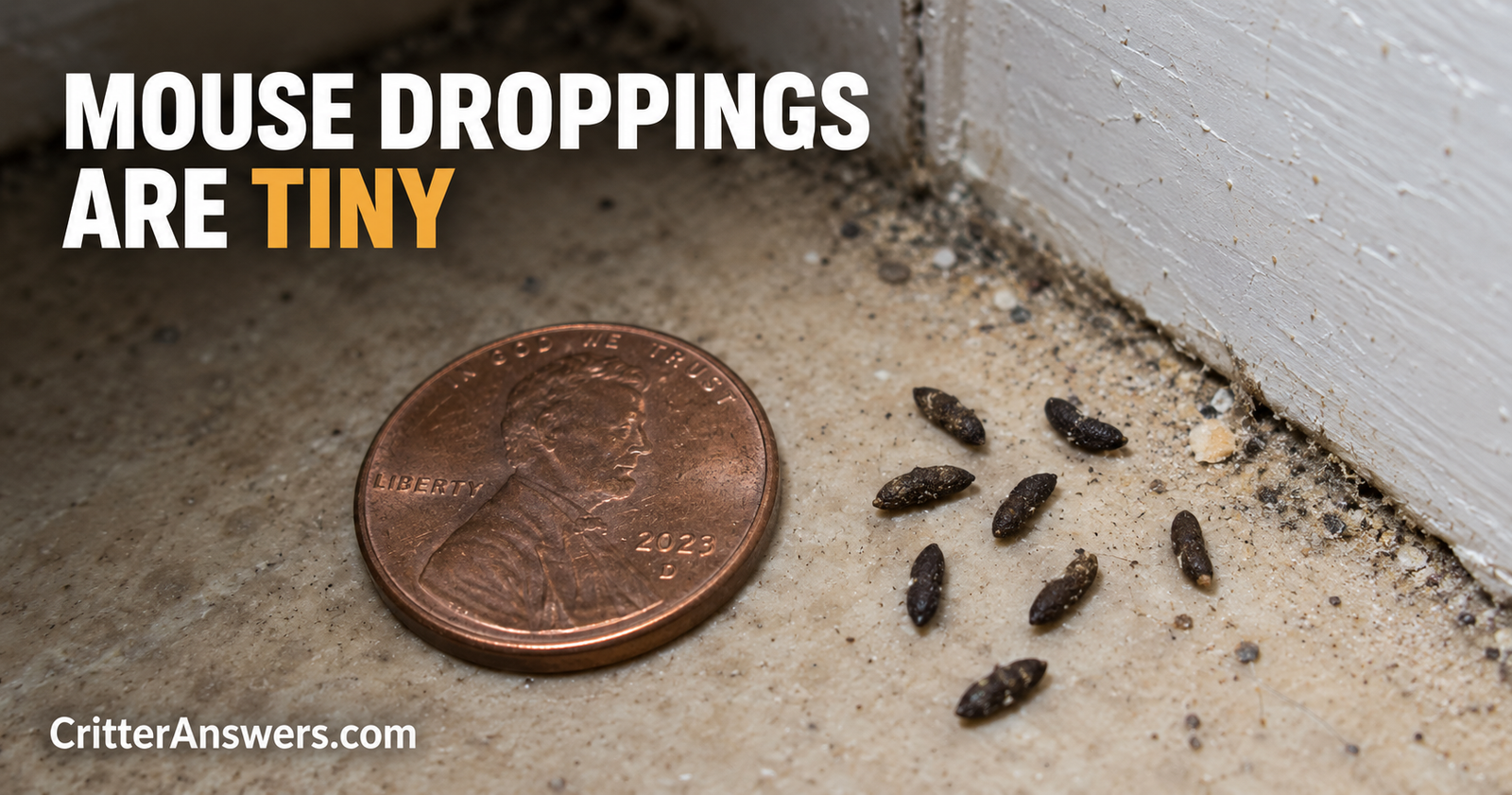
House-mouse droppings are small and dark and are often compared in general appearance to little dark grains of rice.
But don’t identify an animal from a random black speck alone.
Cockroach droppings, rat droppings, bat guano, seeds, and other debris can sometimes confuse homeowners.
We’re going to build an entire article specifically on what mouse droppings look like because that deserves a much closer comparison.



New Droppings Are More Useful Than Old Droppings
Finding droppings tells you mice or another rodent have been there.
It doesn’t necessarily prove they’re active there tonight.
That’s an important distinction.
CDC recommends safely cleaning existing rodent droppings and then watching for new evidence.
If fresh droppings appear again after you’ve properly cleaned the area, you have much stronger evidence of current rodent activity.
That simple test can be surprisingly useful.
Clean.
Document.
Check again.
Don’t keep staring at the same ten old droppings for three weeks wondering whether they’re new.
Don’t Vacuum Mouse Droppings to Test This
Before you clean anything, there’s an important safety issue.
Don’t sweep or vacuum dry rodent droppings.
CDC warns that sweeping or vacuuming rodent urine, droppings, or nesting materials before they’ve been properly disinfected can put contaminated material into the air.
Wear rubber or plastic gloves and thoroughly wet the material with an appropriate disinfectant before wiping it up according to current cleanup guidance.
If you’re finding widespread contamination rather than a handful of droppings, treat that as a more substantial cleanup problem.
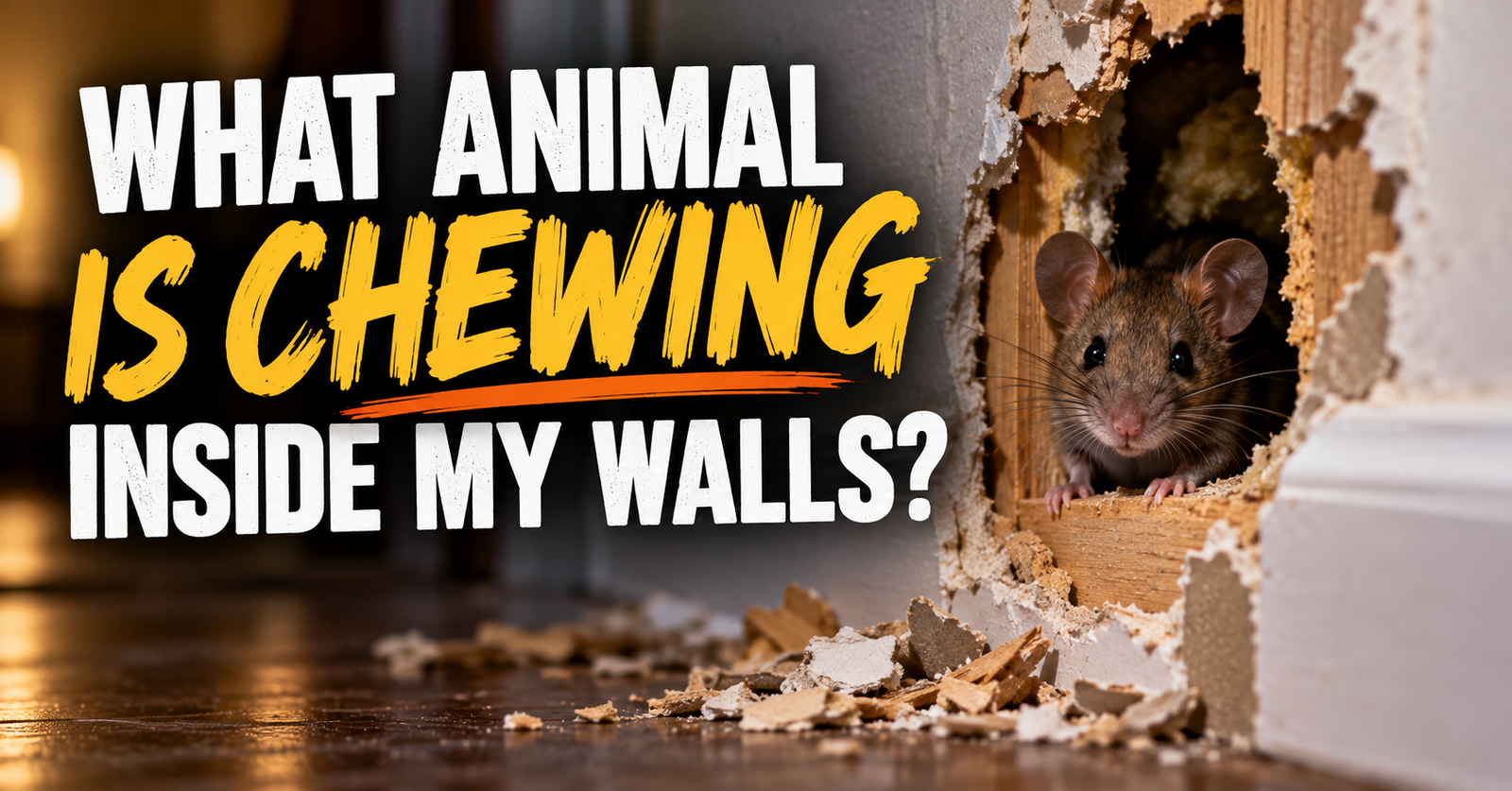

2. Look for Fresh Gnaw Marks
Mice are rodents.
Their front teeth continue growing, so gnawing is a normal part of mouse behavior.
CDC identifies gnaw marks as one of the major signs homeowners should watch for.
Look around:
- Food packages
- Cardboard
- Wood
- Plastic containers
- Cabinet edges
- Utility areas
- Stored materials
- Areas around suspected entry holes
Fresh gnawing can be particularly helpful.
An old chewed corner in a garage doesn’t necessarily tell you what’s happening today.
A package you know was intact yesterday and is chewed this morning is much more interesting.
Food Packages Can Tell on Mice Quickly
The pantry is one of the first places I’d inspect.
Look at the bottom corners of:
Cereal boxes.
Cracker packages.
Pasta.
Rice.
Pet treats.
Bags of baking ingredients.
Anything stored where a mouse could reach it.
You may find a small opening chewed through the package and food disturbed inside.
Don’t continue eating food from a package that rodents have accessed or contaminated.
Throw contaminated food away and start thinking about sturdier food storage.
Check Pet Food Too
Pet food is easy to forget.
A mouse doesn’t care that the 30-pound bag says DOG FOOD across the front.
It’s food.
If pet food is stored in a pantry, garage, mudroom, or basement, inspect the bag.
Look underneath it too.
You may find:
- Droppings
- Chewed corners
- Spilled kibble
- Nesting material nearby
Bulk pet food is much better protected in a sturdy container with a tight-fitting lid than in a chewable bag.
Bird Seed and Animal Feed Can Hide a Mouse Problem
This is especially important around rural properties.
Bird seed, chicken feed, livestock grain, grass seed, and wildlife feed can all support mice.
MU Extension specifically recommends securing bird seed, livestock feed, pet food, and garbage because they can attract rodents.
If you’re finding mouse evidence in the garage rather than the kitchen, inspect whatever feed or seed is stored there.
The mice may have little reason to venture farther into the house if you’ve already given them a grocery store beside the garage door.

3. Scratching and Scurrying at Night Can Point Toward Mice
You finally get into bed.
The house gets quiet.
Then:
scratch… scratch…
Silence.
Then something seems to run inside the wall.
House mice are most active at night, so nighttime noises fit.
But sound alone isn’t enough.
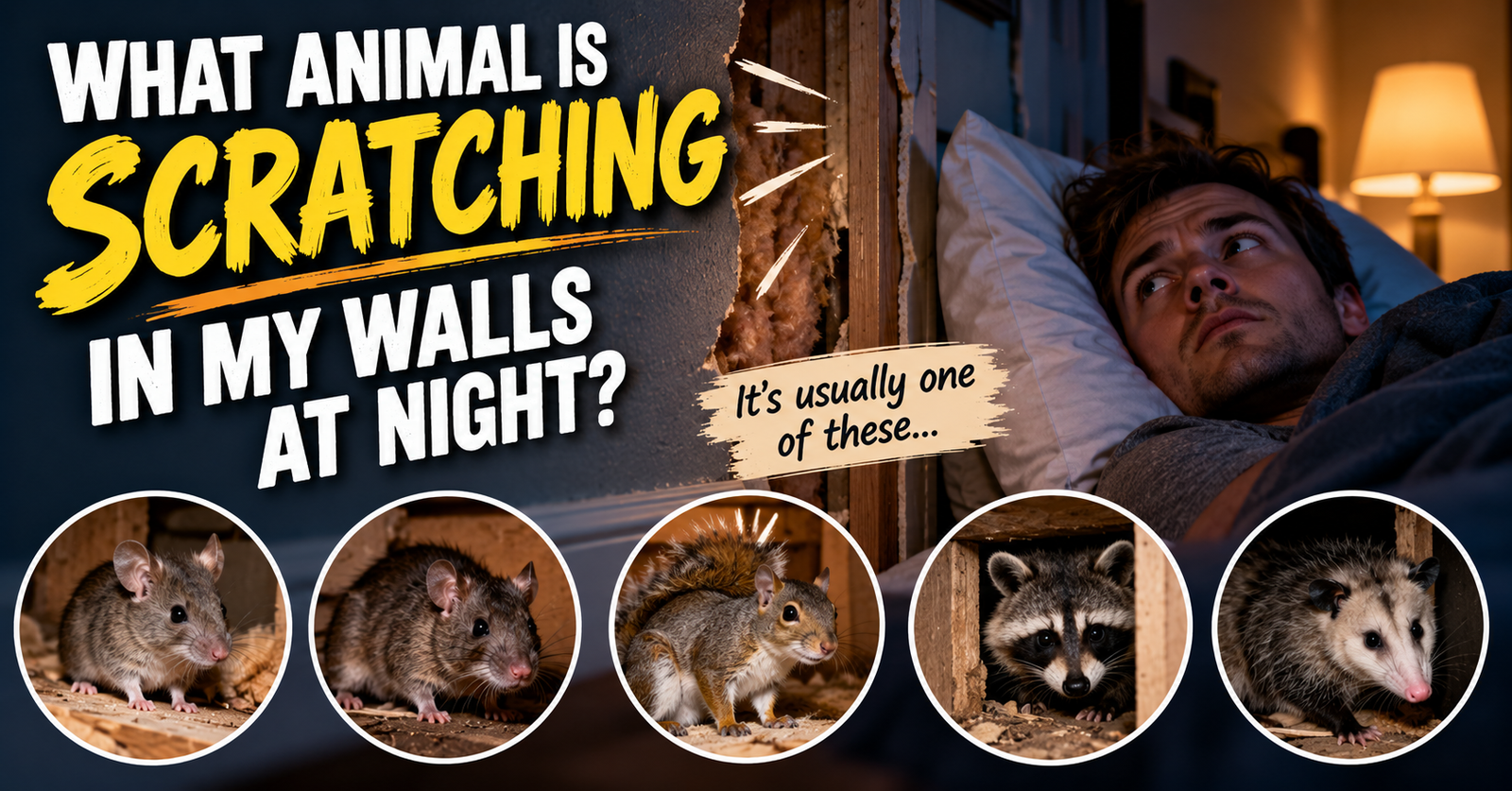
Our broader guide to what animal may be scratching in your walls at night covers the other possibilities.
For mice, I want the sound to agree with other evidence.
What Do Mice in Walls Sound Like?
People describe mouse activity in different ways.
Common descriptions include:
Light scratching.
Tiny footsteps.
Scurrying.
Rustling.
Gnawing.
Occasional squeaks.
Walls and ceilings can amplify noise, so I wouldn’t attempt to identify the exact size of an animal from sound alone.
Something surprisingly loud can still be small.
Instead, pay attention to the pattern.
Tiny rapid movement at night plus mouse droppings elsewhere in the house is useful.
Heavy thumping overhead may point toward something considerably larger.
Listen to Where the Sound Goes
If you hear movement repeatedly, try to determine its route.
Does it remain behind one kitchen wall?
Does it seem to travel upward?
Does it cross the ceiling?
Does it stop behind the refrigerator?
Does it occur near the pantry?
This may help you locate a nesting or feeding area.
Don’t start cutting drywall open because you heard three scratches.
Use the noise to narrow the inspection.
4. Mouse Nests Are Another Strong Sign
House mice build nests from soft fibrous materials.
MU Extension describes mouse nests as being made from fine shredded paper or other fibrous material and notes that they’re generally placed in sheltered locations.
That means a strange little pile of shredded material tucked into a protected corner deserves attention.
Mouse nesting material may include:
- Shredded paper
- Cardboard
- Fabric
- Insulation
- Other soft fibrous material
The key is the location and arrangement.
A pile of torn paper on a busy desk isn’t a mouse nest.
Shredded material packed into a protected cavity beside droppings is much more suspicious.
Where Might You Find a Mouse Nest?
Think dark, protected, and relatively undisturbed.
Possible locations include:
Behind appliances.
Inside cabinets.
Inside wall voids.
In storage areas.
Inside boxes.
In attics.
In insulation.
In garages.
In basement clutter.
Behind stored materials.
House mice don’t need a huge den.
A small protected cavity close to food can work extremely well.
We’ll cover these locations much more deeply in our upcoming article on where mice hide inside a house.
Don’t Tear Apart a Mouse Nest With Your Bare Hands
If you find a suspected rodent nest, don’t shake it around or start pulling it apart bare-handed.
Rodent nesting materials can be contaminated with urine and droppings.
CDC recommends disinfecting rodent nests and waste before cleanup rather than disturbing them dry.
The same basic principle applies here as with droppings:
Don’t turn contaminated dry material into airborne dust.
5. A Musky Smell Can Be a Mouse Clue
This clue is harder to describe.
MU Extension notes that house mice can produce a characteristic musky odor.
With heavier or established activity, you may notice an unusual stale or musky smell concentrated in:
- Cabinets
- Pantries
- Closets
- Attics
- Storage areas
- Wall-adjacent spaces
But smell is not specific enough to identify mice by itself.
Animal urine, feces, moisture problems, mold, dead animals, and other sources can produce strange household odors.

If you’re trying to identify a mystery wildlife smell, our guide to why a house may smell like an animal goes through those broader possibilities.
A Sudden Terrible Smell Is Different
Don’t confuse ordinary mouse odor with the smell of a dead animal.
If a strong decomposition odor suddenly develops inside one wall, ceiling, or cabinet area, something may have died there.
That’s one reason I prefer trapping strategies that let you recover the mouse rather than automatically using poison inside a house.
A mouse you catch in a trap can be removed.
A mouse that dies somewhere inside an inaccessible wall may introduce you to a completely different problem.
6. Look for Mouse Tracks
Tracks can be surprisingly useful in dusty, dirty, or rarely disturbed areas.
Look along:
- Basement edges
- Garage walls
- Attic surfaces
- Utility areas
- Dusty shelves
- Stored materials
You may see tiny footprints or signs of a tail dragging through dust.
CDC rodent-survey guidance identifies tracks and tail-drag marks as useful signs of active rodents.
Don’t expect perfect wildlife-photography footprints on a clean kitchen floor.
You’re much more likely to find them somewhere dusty and undisturbed.
Rub Marks Can Be Another Rodent Clue
Rodents often follow established routes.
Over time, repeated body contact can leave dark smudges or greasy-looking rub marks along surfaces.
MU Extension lists dark smudges and rub marks among possible signs of mice and rats.
This isn’t usually the first mouse sign a homeowner notices.
But if you’re already finding droppings and gnawing along the same wall, a well-used travel route makes sense.
Again, multiple clues agreeing with one another is what I want.
7. Seeing the Mouse Is Pretty Convincing
Sometimes the investigation is considerably easier.
A mouse runs across the floor.
At that point, yes, you have a mouse.
But even then, you haven’t answered the bigger questions:
Where did it come from?
Is it the only one?
Where is it hiding?
How did it enter?
Is there a nest?
Are other mice present?
A sighting confirms the animal.
It doesn’t tell you the extent of the problem.
Does Seeing a Mouse During the Day Mean You Have a Huge Infestation?
Not automatically.
House mice are most active at night, but they can occasionally be seen during daylight.
I wouldn’t tell someone that one daytime mouse sighting proves their house is overrun.
That’s too strong.
I’d use the sighting as a reason to inspect more carefully.
Look for fresh droppings.
Check food.
Inspect likely hiding areas.
Set traps.
Look for entry points.
Let the amount of evidence tell you how extensive the activity appears to be.
What About a Mouse Running Across the Kitchen at Night?
That’s classic mouse timing, but I still wouldn’t stop investigating.
Watch where it goes.
Did it disappear:
Under the refrigerator?
Behind the stove?
Into the pantry?
Under a cabinet?
Through a tiny gap beside a pipe?
That escape route may tell you much more than the sighting itself.
If you can safely observe rather than immediately chasing the mouse around with a broom, you may learn where it’s traveling.
Mouse Urine Can Leave Evidence Too
Rodents contaminate areas with urine as well as droppings.
You may notice staining or odor around heavily used areas.
But I wouldn’t encourage homeowners to start sniffing mysterious stains or touching them to determine whether they’re mouse urine.
Treat suspected rodent contamination carefully.
Use the rest of the evidence.
Droppings + gnawing + nighttime activity + urine staining is much more convincing than a random discolored spot.
Check Behind Your Refrigerator
If I had to choose one kitchen location to inspect first, this would be high on my list.
It’s:
Dark.
Protected.
Warm.
Close to food.
Rarely disturbed.
And food debris can accumulate underneath or behind it.
Pull the refrigerator out only if you can do so safely without damaging the floor, water line, or appliance.
Look for droppings along the wall and floor.
Then check nearby cabinets and the stove.
Check Behind the Stove
Same idea.
Food falls behind and underneath a stove.
It’s quiet back there.
There may be utility penetrations.
And the wall provides a protected travel edge.
If you find concentrated droppings behind the stove but almost none elsewhere, you’ve learned something valuable.
That becomes an area to target when you move from identification to control.
Check Under the Sink
This is another major inspection point because of plumbing penetrations.
Look where pipes pass into the wall or floor.
Remember that mice can fit through extremely small openings.

CDC says mice can squeeze through a hole roughly 1/4 inch wide — about the width of a pencil. That size makes it worth checking the small gaps mice use to enter around the outside and inside of the house.
A plumbing hole that looks tiny to you may be plenty big enough.
Look for droppings around those openings.
Check the Pantry
This one is obvious, but don’t merely look at the floor.
Inspect:
Lower shelves.
Corners.
Behind food.
Inside boxes.
Under shelving.
Along the wall.
Look for small holes chewed into packaging.
If something has contaminated accessible food, discard it.
Then start moving vulnerable dry foods into sturdier containers.
Check the Garage
The garage can reveal a mouse problem before the living space does.
Look around:
Pet food.
Bird seed.
Chicken feed.
Grass seed.
Cardboard boxes.
Garbage.
Workbench drawers.
Wall edges.
Garage-door corners.
Storage shelves.
An attached garage can also become a staging area between outdoors and the house.
Mouse activity there deserves attention even if you haven’t found droppings in the kitchen yet.
Check the Basement and Crawl Space
These areas can provide shelter and entry opportunities.
Inspect along foundation walls and around:
- Pipes
- Wiring
- Utility lines
- Vents
- Stored belongings
- Insulation
- Floor drains
- Wall-to-floor junctions
CDC specifically recommends inspecting basements and crawl spaces when looking for rodent entry points and activity.
Don’t crawl into an unsafe or heavily contaminated space just to prove you have mice.
Know when the inspection itself has become a professional job.
Check the Attic
Yes, mice can end up above you too.
Look for droppings and nesting material around accessible areas.
Pay attention to insulation and stored belongings.
And inspect how rodents might be reaching the attic.
Mice are capable climbers, so an upper-level mouse problem doesn’t require a ground-level hole directly beneath the noisy spot.
We’ll dig into all of these locations in the dedicated Where Do Mice Hide in a House? article.
How Can You Tell If the Mouse Problem Is Active Right Now?
This is a better question than simply asking whether mice have ever been there.
Old evidence can remain for a long time.
So establish a baseline.
Photograph what you find.
Safely clean existing droppings.
Remove damaged food.
Note existing gnaw marks.
Then monitor.
If you find:
New droppings tomorrow.
Freshly damaged packaging.
New gnaw marks.
A trap triggered.
More nighttime movement.
you have current activity.
CDC specifically suggests safely cleaning droppings and watching for their return as one way to determine whether rodents remain active.
How Do I Know If Mice Are in My Walls?
Walls are harder because you can’t simply inspect the cavity.
So look at the evidence surrounding it.
Do you hear light movement primarily at night?
Are there droppings near the base of that wall?
Is there a plumbing or utility opening nearby?
Is food stored on the other side?
Are there gnaw marks?
Can you find an exterior opening corresponding with that part of the house?
The more clues that line up, the stronger the case becomes.
Don’t cut open drywall based on one scratching sound.
Mice vs. Rats Is Worth Getting Right
If you know you have rodents but aren’t sure which one, don’t assume every small rodent sign means mouse.
Norway rats are considerably larger than house mice.
Their droppings are larger.
Their gnawing can be larger.
Their tracks are larger.
Their movement may sound heavier.
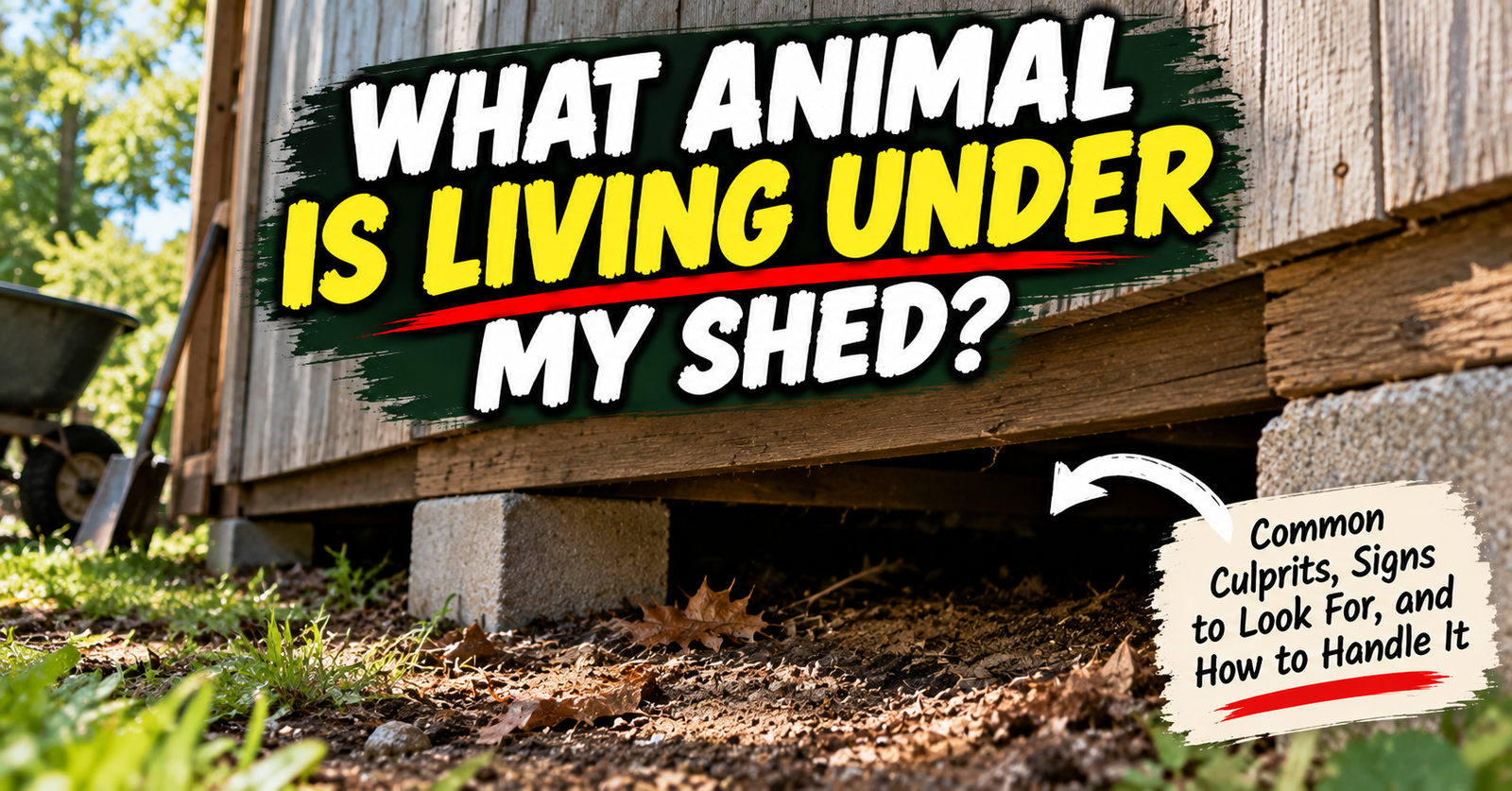
Norway rats also commonly burrow around foundations and beneath structures, while house mice readily exploit much smaller openings throughout buildings. MU Extension notes that Norway-rat droppings are larger and that rats commonly create burrows around structures. That distinction is also useful when rats burrowing beneath structures, where the size of the entrance and the surrounding excavation can point in different directions.
This matters because your control strategy can change.
Trap size changes.
Placement can change.
Behavior differs.
Identify the rodent as accurately as you reasonably can.
Mouse Droppings vs. Rat Droppings
For now, the simple distinction is size.
House-mouse droppings are small.
Rat droppings are noticeably larger.
Don’t use that sentence as your entire identification method, though.
Our dedicated mouse-droppings article will compare them much more carefully.
If you’re uncertain, photograph the evidence beside a ruler without handling it.
That gives you an actual measurement instead of relying on memory.
Could the Droppings Be From a Cockroach?
Possibly, depending on what you’re seeing.
Some insect droppings can be confused with rodent evidence, especially when the material is very small.
That’s why I’d look for the rest of the mouse package.
Mouse-sized gnawing?
Mouse nest?
Mouse tracks?
Nighttime scurrying?
Actual mouse sighting?
If none of that exists, don’t force the diagnosis.
Could It Be a Bat Instead?
Bat droppings can also cause confusion, particularly in attics.
The location matters.
Bat evidence concentrated beneath an upper roost tells a different story from mouse droppings scattered along kitchen travel routes.
And bats don’t gnaw like rodents.
If the mystery involves high-pitched sounds or upper-wall activity, our article on what animal may be making chirping sounds inside your wall can help you look at the broader evidence.
Again:
Don’t identify from one clue when you can use five.
Is One Mouse Dropping Enough to Prove You Have Mice?
I wouldn’t make a confident identification from one mysterious speck.
Inspect the area carefully.
Look behind nearby objects.
Check food.
Look for additional droppings.
Check for gnaw marks.
If you find ten similar droppings in a protected cabinet along with a chewed food package, that’s a much different situation.
The pattern matters.
What If You Never Find Droppings?
You can still have mice.
Maybe the activity is concentrated somewhere you haven’t inspected.
Maybe they’re in a wall cavity.
Maybe evidence is behind an appliance.
Maybe you’re hearing an animal that isn’t a mouse.
This is where you keep investigating rather than deciding the absence of visible poop proves the absence of mice.
Check the areas where mice have food, shelter, and access.
Don’t Forget to Look for the Entry Point
Once the evidence starts pointing strongly toward mice, don’t spend all your time staring at the mouse signs.
Ask:
How did they get inside?
Remember the pencil-width rule.
Inspect:
Doors.
Garage doors.
Utility penetrations.
Foundation gaps.
Pipes.
Vents.
Soffits.
Eaves.
Crawl-space openings.
CDC recommends checking all of these types of areas because mice need remarkably little space to enter.
Finding the entry point is what eventually turns identification into prevention.
What Should You Do Once You’re Sure It’s Mice?
Now we move from diagnosis to control.
That’s exactly what our cornerstone guide is for.

Read how to get rid of mice in your house and keep them out next.
The short version is:
Trap the mice already inside.
Find and seal their entry points.
Remove accessible food.
Reduce hiding and nesting areas.
Clean contaminated areas safely.
Continue monitoring until fresh evidence stops.
Catching one mouse is useful.
Stopping the cycle is better.
A Good Mouse Trap Can Also Confirm Activity
Once the evidence strongly suggests mice, strategically placed traps can help both control the problem and confirm that mice are actively using an area.
For homeowners who prefer a traditional snap trap, the Victor Metal Pedal Mouse Trap 12-Pack makes sense for this type of job because it gives you enough traps to cover multiple active locations rather than relying on one lonely trap behind the refrigerator.

Check the Victor Metal Pedal Mouse Traps 12-Pack on Amazon
The important part isn’t simply owning twelve traps.
It’s putting traps where you’ve actually found mouse evidence.
Droppings behind the refrigerator?
Target that route.
Gnawing in the pantry?
Target that area.
Mouse disappearing behind one cabinet every night?
That’s useful information.
Keep traps inaccessible to children and pets and follow the product instructions.
Don’t Scatter Traps Randomly Around the House
This is where the identification work you’ve just done becomes valuable.
CDC recommends putting traps in places where you’ve found droppings, nesting material, gnawed food, or other rodent evidence and along the areas rodents naturally travel.
So use your evidence.
The goal isn’t:
Put traps everywhere.
It’s:
Put enough traps in the right places.
We’ll cover exact orientation, spacing, wall placement, appliance locations, and other details in the upcoming Where Should I Put Mouse Traps in My House? article.
When I’d Stop Investigating and Start Acting
You don’t need a laboratory confirmation.
If I had:
Mouse-sized droppings behind the refrigerator.
A chewed food package.
Light nighttime scurrying.
And then an actual mouse caught in a properly placed mouse trap…
I’m comfortable calling that a mouse problem.
At some point, more detective work isn’t helping.
Start control.
When I’d Call a Professional
I’d consider professional help sooner if:
- The signs are widespread
- You can’t determine what rodent you have
- Mice keep returning
- Activity is inside inaccessible spaces
- Contamination is extensive
- You can’t find entry points
- Trapping isn’t reducing the activity
- You aren’t comfortable dealing with rodents or cleanup
A professional inspection can also be worthwhile when the house has complicated construction or the mouse activity appears to involve several levels.
My Quick Mouse Identification Checklist
Before deciding you have mice, I’d run through this:
Droppings?
Check size, location, and whether new ones appear after safe cleanup.
Gnawing?
Look for fresh damage to food packages and other materials.
Noises?
Light nighttime scratching and scurrying support the mouse theory.
Nest?
Look for shredded fibrous material in protected locations.
Food damage?
Inspect pantry food, pet food, bird seed, and animal feed.
Tracks or rub marks?
Look in dusty, undisturbed travel areas.
Odor?
A persistent musky smell can support other mouse evidence.
Actual mouse?
That’s obviously your strongest visual confirmation.
Entry point?
Start looking for openings about 1/4 inch and larger.
The more boxes you check, the less mysterious the problem becomes.
Let the Clues Build the Answer
One scratch inside a wall doesn’t prove mice.
One mysterious black speck doesn’t prove mice.
One old chew mark doesn’t prove mice.
But put the evidence together:
Small droppings.
Fresh gnaw marks.
Shredded nesting material.
Light nighttime movement.
Food damage.
A mouse-sized entry gap.
Now you have a much stronger answer.
And that’s when I’d stop wondering whether mice are in the house and start figuring out where they’re hiding, how they’re getting inside, and how to remove them.
If the evidence points to mice, the next step is our complete guide to getting rid of mice in your house for good.
Don’t just catch the mouse you happened to see.
Find the reason it’s there.
That’s how you turn a mouse sighting into a mouse problem that actually gets solved.
About the author: Caleb Rourke researches how mice and other rodents get into homes, where they hide, and the practical steps homeowners can use to identify and prevent them. He writes straightforward rodent-control guides for Critter Answers.