
After I found a gray treefrog sitting on our weathered wooden fence, identifying it seemed pretty straightforward.
Gray mottled body.
Bumpy skin.
Big sticky-looking toe pads.
Excellent camouflage.
Gray treefrog.
Then I tried to answer the next question:
Which gray treefrog?
That’s where things get much harder.
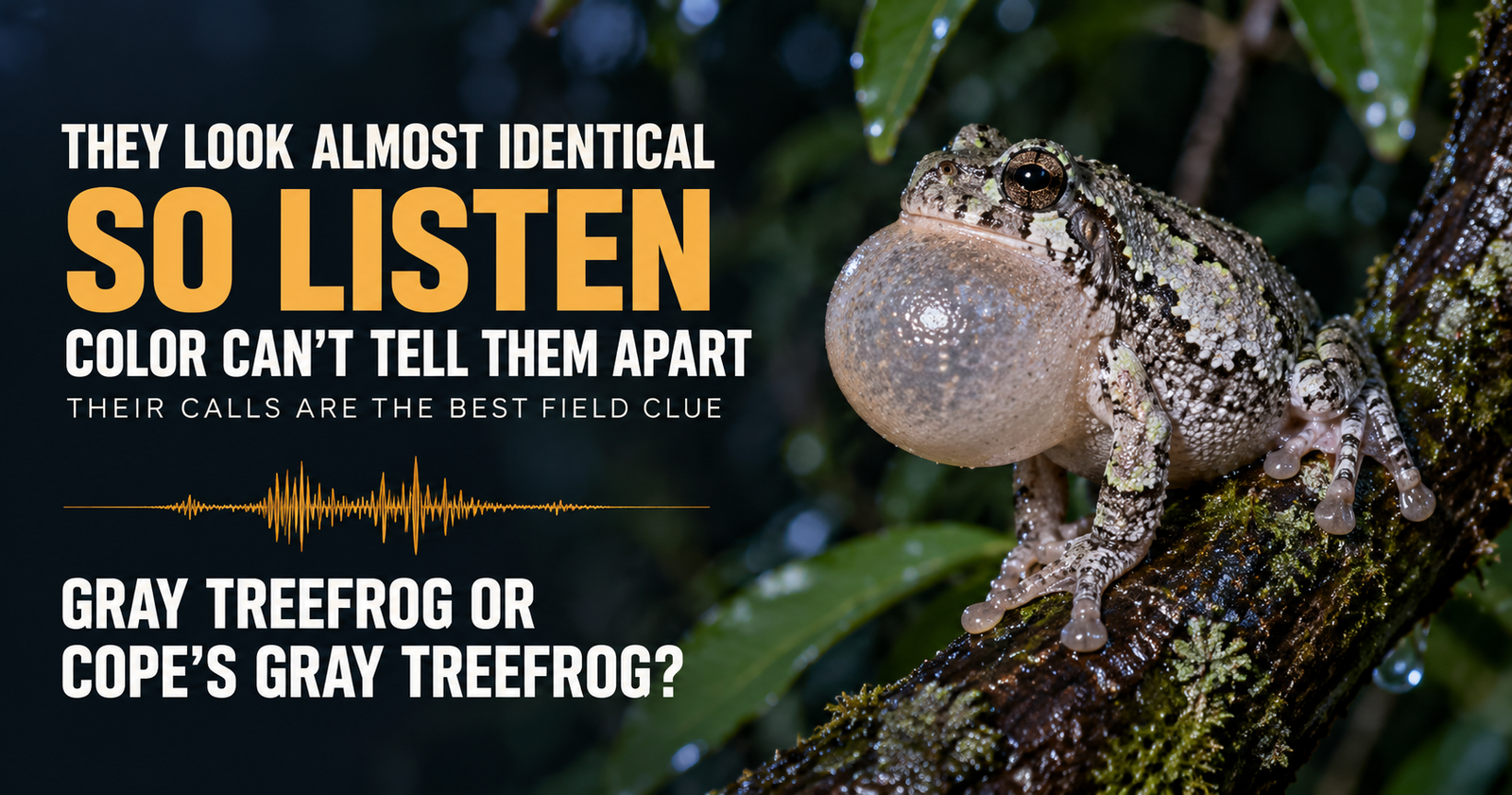
In Missouri, we have both the gray treefrog (Dryophytes versicolor) and Cope’s gray treefrog (Dryophytes chrysoscelis).
And despite being two different species, they look so much alike that I can’t responsibly tell you which one I photographed just by studying my pictures.
Missouri Department of Conservation describes the two species as basically identical in appearance. One of the better ways to tell them apart is something my photographs didn’t capture at all.
Their voices.
Can You Tell a Gray Treefrog From a Cope’s by Looking at It?
Usually, not reliably.
Both can have:
- Gray, greenish-gray, brown, or green coloration
- Dark irregular blotches across the back
- Granular or somewhat warty-looking skin
- Large adhesive toe pads
- A pale spot beneath each eye
- White or cream-colored undersides
- Yellow or orange-yellow coloring hidden on the inner hind legs
That’s a lot of overlap.
USGS goes even further and says gray and Cope’s gray treefrogs cannot be distinguished based on morphology, with calling rate or chromosomes used for identification.
So if somebody looks at one photograph and confidently tells you which of these two species you’re holding based only on its shade of gray, I’d be skeptical.
What About the Frog I Found on My Fence?
This is exactly why I’ve been careful throughout this cluster.
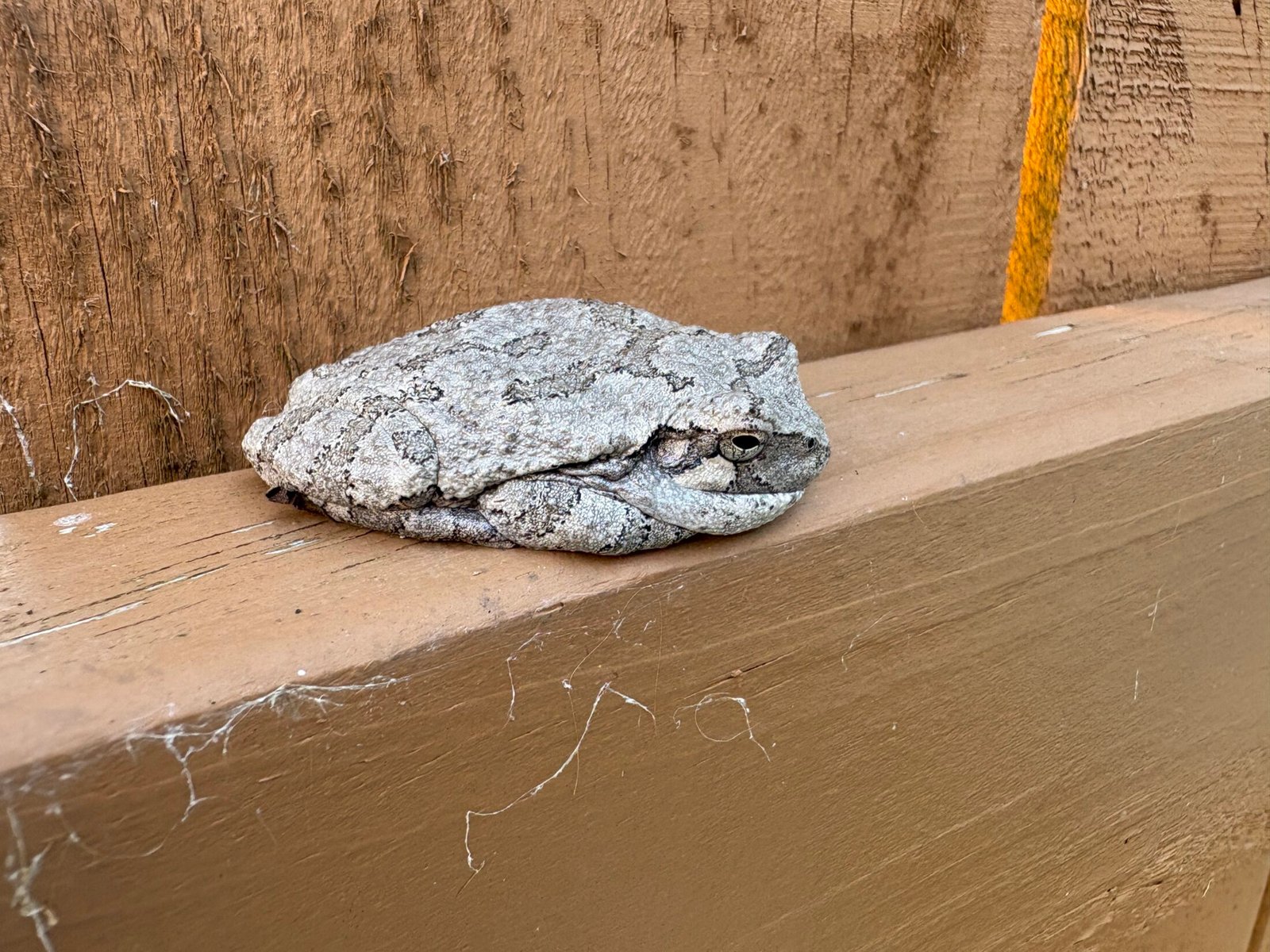
The frog I found had the characteristics I’d expect from the gray-treefrog pair.

You can see the original encounter in the gray frog I found sitting on our wooden fence.
What I can’t see in those photographs is a reliable characteristic that settles D. versicolor versus D. chrysoscelis.
And because the frog wasn’t calling when I photographed it, I don’t have the most useful field clue either.
So the most accurate identification I can give that individual remains:
Gray treefrog or Cope’s gray treefrog.
I’d rather leave a little uncertainty than make up certainty the photographs don’t provide.


Is a Green Frog More Likely to Be Cope’s?
There is a slight tendency, but this still doesn’t solve the identification.
Missouri Department of Conservation says Cope’s gray treefrog tends to be somewhat smaller and is more often greenthan the gray treefrog.
Notice the wording.
More often.
Not always.
Both species can vary considerably in color.
So this doesn’t work:
Green = Cope’s
Gray = gray treefrog
That’s much too simple.
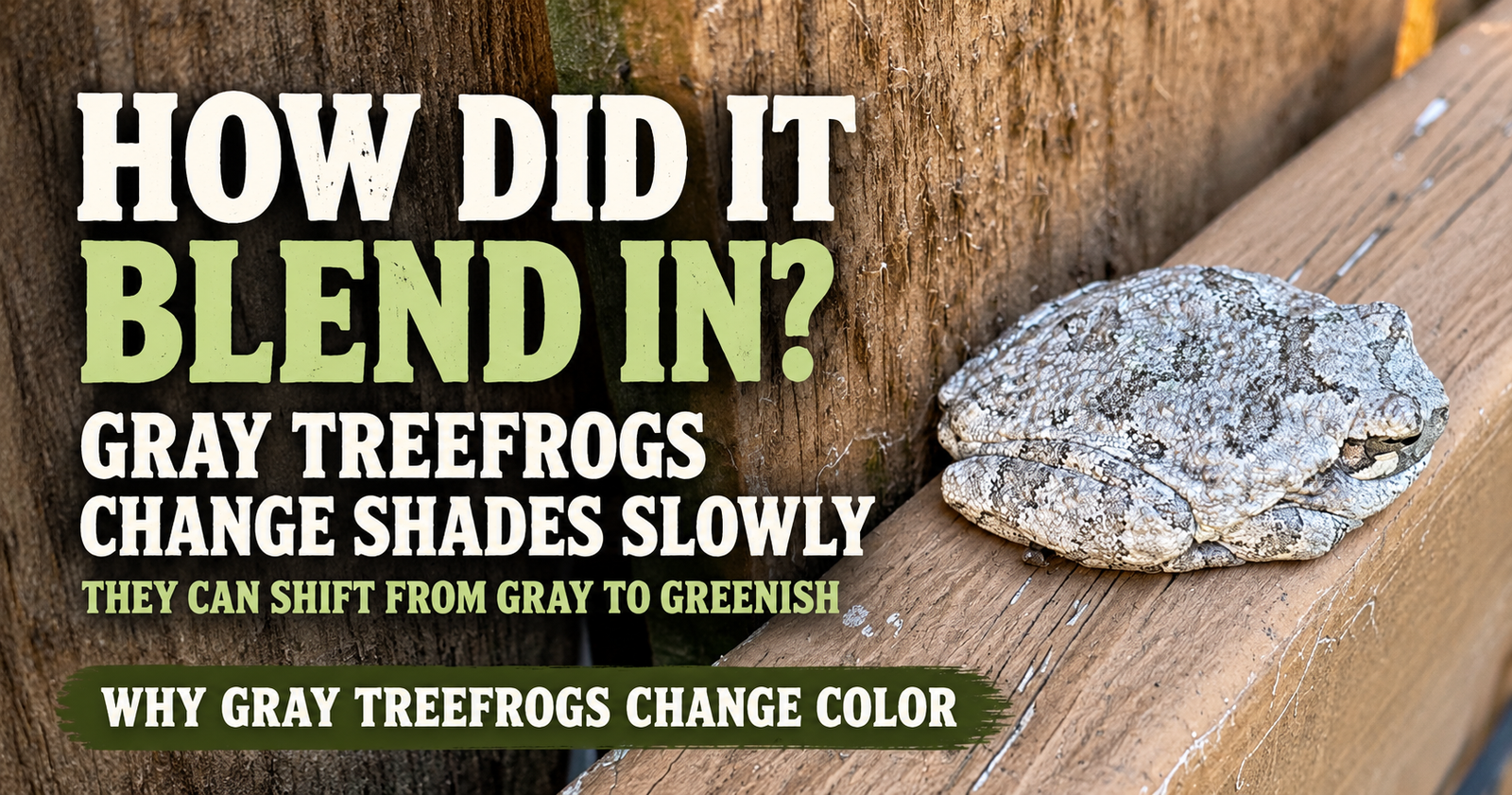
We’ve already looked at why gray treefrogs change color, which is another reason color is such a shaky way to separate these species.
Their Calls Are Much More Useful
This is where identification gets interesting.
Gray treefrog
The gray treefrog has a slower, musical, birdlike trill.
Cope’s gray treefrog
Cope’s gray treefrog gives a faster, higher-pitched buzzing trill.
MDC specifically recommends listening to their calls as one of the better ways to separate them.
Once you learn the difference, hearing the frog may tell you more than staring at it.

The Gray Treefrog Sounds More Musical
The ordinary gray treefrog’s call is often described as musical or birdlike.
That’s actually one reason someone unfamiliar with frogs might hear one during spring and assume a bird is making the sound.
Missouri conservation guidance describes it as a musical birdlike trill.
The trill is relatively slower than Cope’s.
So think:
slower and musical.
Cope’s Sounds Faster and Buzzier
Cope’s gray treefrog speeds things up.
Its trill is higher-pitched and more buzzing.
MDC notes that the faster calling rate is one of the strongest differences between the two species.
If you could put the two calls beside one another, the distinction becomes much easier than comparing photographs.
That’s why the best thing you can sometimes do when trying to identify one isn’t take another picture.
Record the sound.
Temperature Makes the Calls Trickier
Of course nature couldn’t make this completely easy.
Air temperature affects frog calls.
MDC notes that changing temperatures can alter the pitch and timbre, which can complicate identifying the two species by ear.
That’s especially important if you’re trying to compare a recording you made on one night with an example recorded under very different conditions.
For casual identification, the overall slow-musical versus fast-buzzy distinction can still be useful.
For scientific certainty, researchers can go farther.
Scientists Can Actually Count the Pulses
A frog call isn’t just one continuous noise.
It contains repeated pulses.
Scientists can analyze recordings with a sonogram and measure the number of pulses per second.
MDC specifically notes that this technique can document the difference between the species.
So what sounds to us like:
trrrrrrrrrrr
can become measurable data.
That’s considerably more reliable than deciding one frog looks 8 percent greener than another.



There’s an Even Bigger Difference You Can’t See
Here’s where these frogs become even stranger.
They differ genetically.
The gray treefrog D. versicolor is tetraploid, meaning it has four sets of chromosomes.
Cope’s gray treefrog D. chrysoscelis is diploid, with two sets.
That’s one reason chromosome analysis can definitively separate them even when their outward appearance doesn’t.
USGS specifically notes that herpetologists use calling rate or chromosomes to identify the two.
You obviously aren’t going to perform chromosome analysis on a frog sitting on your porch.
But it’s fascinating that two animals that look nearly identical can have such an important biological difference.
Can Location Tell You Which One You Found?
Sometimes geography can help narrow wildlife identification.
For these frogs in Missouri, it doesn’t necessarily solve the problem.
MDC reports that gray treefrogs occur across northeastern, eastern, southern, and central Missouri, while Cope’s gray treefrogs occur in eastern, southeastern, northwestern, and western Missouri.
More importantly, the species can occur in the same counties.
So location may give you context, but I wouldn’t use a Missouri location alone as proof.
Their Habitats Overlap Too
Both species are woodland frogs.
MDC notes a tendency for the gray treefrog to be more associated with forests, while Cope’s may be somewhat more associated with grasslands and oak savannas.
But both occur in wooded environments and around human structures.
Again, that’s a tendency.
It’s not a field identification shortcut I’d trust on its own.
Finding yours on a fence, porch, deck, window, or house doesn’t settle the species.
Both can use these kinds of places.

Our article on why gray treefrogs hang around houses explains why human structures can make surprisingly useful treefrog habitat.
Even Their Winter Survival Has an Interesting Difference
Both species can tolerate temporary freezing.
But their chemistry isn’t exactly the same.
MDC says the gray treefrog uses glycerol and glucose as cryoprotectants, while Cope’s gray treefrog uses glucose.
That’s another biological difference you’d never discover by comparing two photographs.
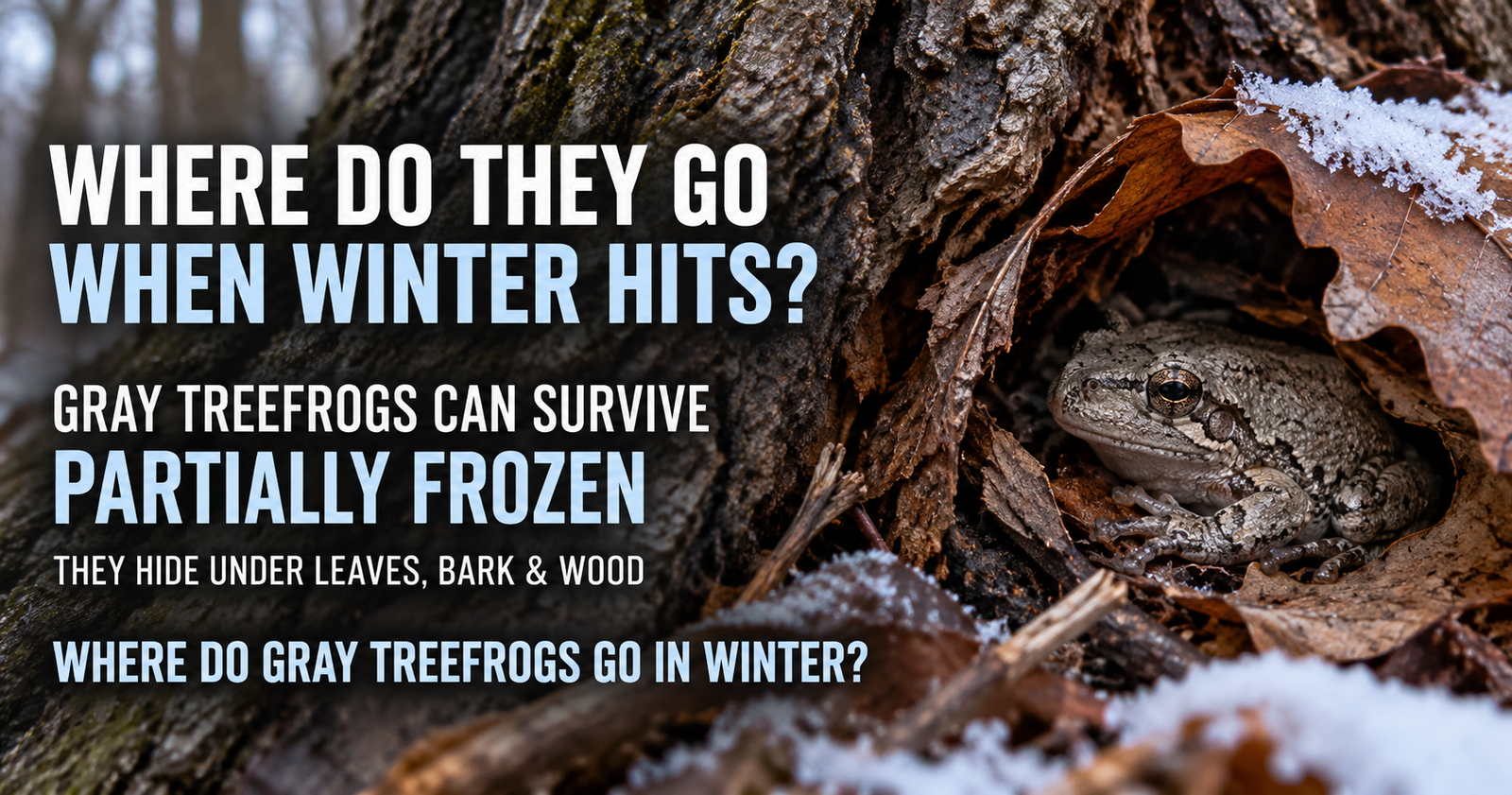
We’ve already gone deeper into the wild winter survival story in where gray treefrogs go during winter.
These frogs really are more different underneath than they look from the outside.
Don’t Confuse Either One With Missouri’s Green Treefrog
There’s another frog worth mentioning because the name causes confusion.
Missouri also has a green treefrog (Dryophytes cinereus).
That’s a separate species.
Unlike our variable gray-treefrog pair, the green treefrog is genuinely green and has a noticeable pale stripe running from the upper lip down the side of the body. In Missouri, it’s primarily associated with the southeastern part of the state, although its range has been expanding in some areas.
So a green-colored gray treefrog and a green treefrog aren’t automatically the same thing.
Wildlife names love making identification convenient like that.
What Should You Photograph for Identification?
If you find one of these frogs, I’d photograph more than just its back.
Without unnecessarily handling the animal, try to document:
- Overall body shape
- Back pattern
- Area beneath the eye
- Toe pads
- Side of the body
- Any visible hind-leg coloration
- The surface or habitat where you found it
Those features can help confirm you’re dealing with the gray-treefrog group.
But remember, even an excellent photo may still not separate gray from Cope’s.
Recording the Call May Be More Valuable Than Another Photo
If the frog is calling naturally, use your phone.
Don’t disturb it trying to make it call.
Just record what you’re already hearing.
Note:
Date
Approximate time
Weather
Temperature if known
Location
Those details can make the recording considerably more useful later.
USGS even provides recordings of both eastern gray and Cope’s gray treefrog calls for comparison.
When Are You Most Likely to Hear Them?
In Missouri, these treefrogs generally breed from spring into early summer, sometimes continuing later.
MDC says breeding normally runs from early April through early July, sometimes into August, with males beginning to gather and call when nighttime temperatures warm to around 60°F.
That’s the best time to listen for males.
My fall fence frog wasn’t giving me that advantage.
By then, the main breeding season was behind us.
So Which Gray Treefrog Did I Find?
I don’t know.
And after researching these frogs carefully, I’m comfortable saying that.
The photographs strongly support the gray-treefrog group.
But the frog wasn’t calling.
And these two species are too similar visually for me to confidently choose one based on the pictures alone.
Could it have been Dryophytes versicolor?
Absolutely.
Could it have been Dryophytes chrysoscelis?
Absolutely.
Without better evidence, pretending otherwise wouldn’t make the identification better.
It would just make it more confident than the evidence deserves.
Sometimes “I Can’t Tell From This Photo” Is the Right Answer
Wildlife identification isn’t about naming something as specifically as possible.
It’s about naming it as specifically as the evidence allows.
For the frog I found on the fence, we have enough evidence to say:
One of Missouri’s gray treefrogs.
We don’t have enough to confidently say:
Definitely gray treefrog.
or:
Definitely Cope’s gray treefrog.
And that’s okay.
If I find another one during breeding season, I’m going to pay much more attention to what it sounds like.
Because with these two frogs, your ears may tell you what your eyes can’t.
About the author: Mason Hollis writes about the frogs, toads, and other small wildlife people unexpectedly find around their homes and yards. At Critter Answers, he focuses on identifying what showed up, understanding why it’s there, and knowing when the best response is simply to leave wildlife alone.