
Finding a gray treefrog outside in the fall made me wonder what happens to these little guys once winter actually arrives.
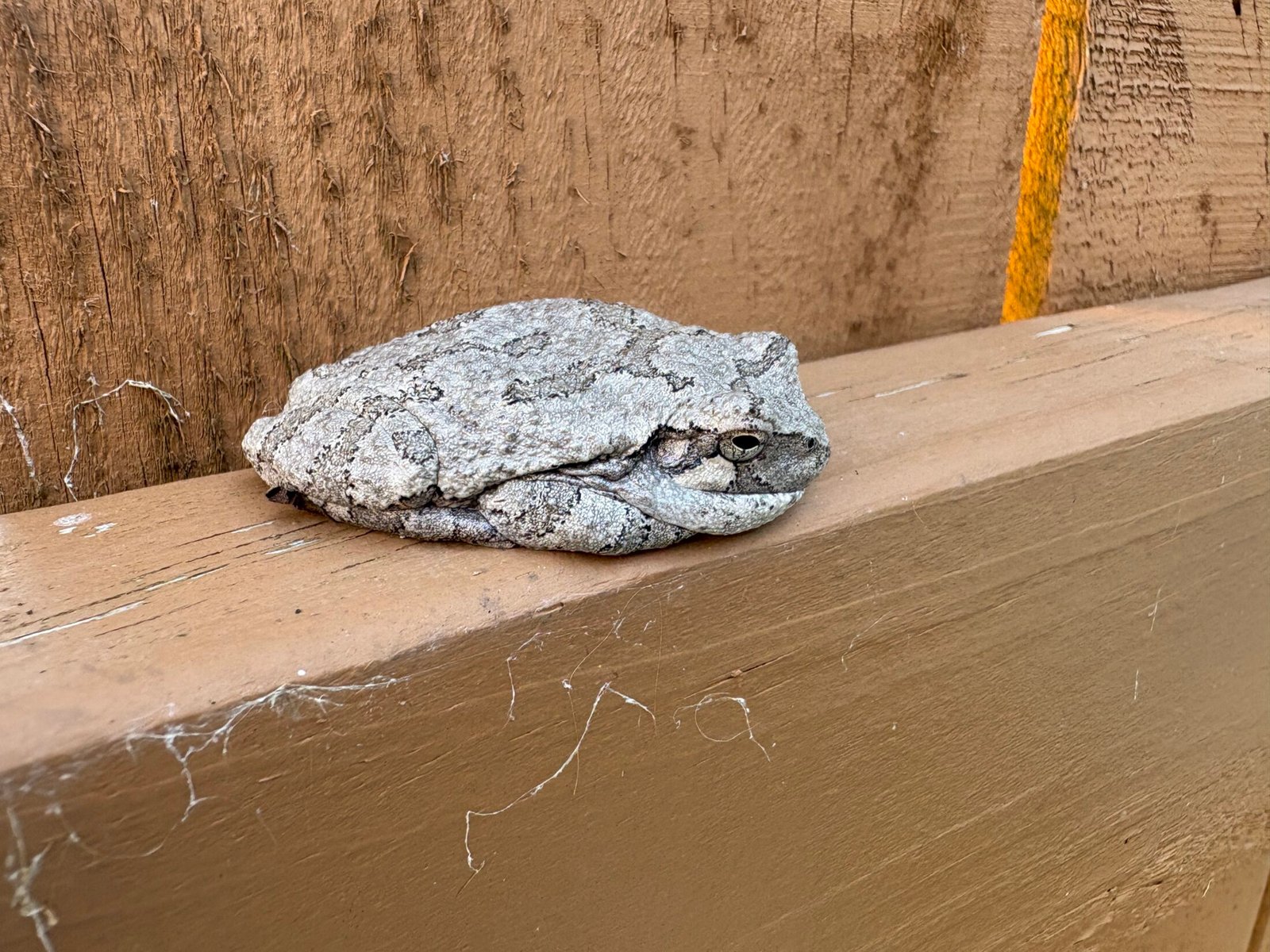
The one I found was sitting quietly on a weathered wooden fence during a cool fall day. It was still perfectly capable of being out and about.
But eventually temperatures drop below freezing.
So where does a little treefrog go when Missouri gets genuinely cold?
The answer is one of the coolest things I’ve learned about them.
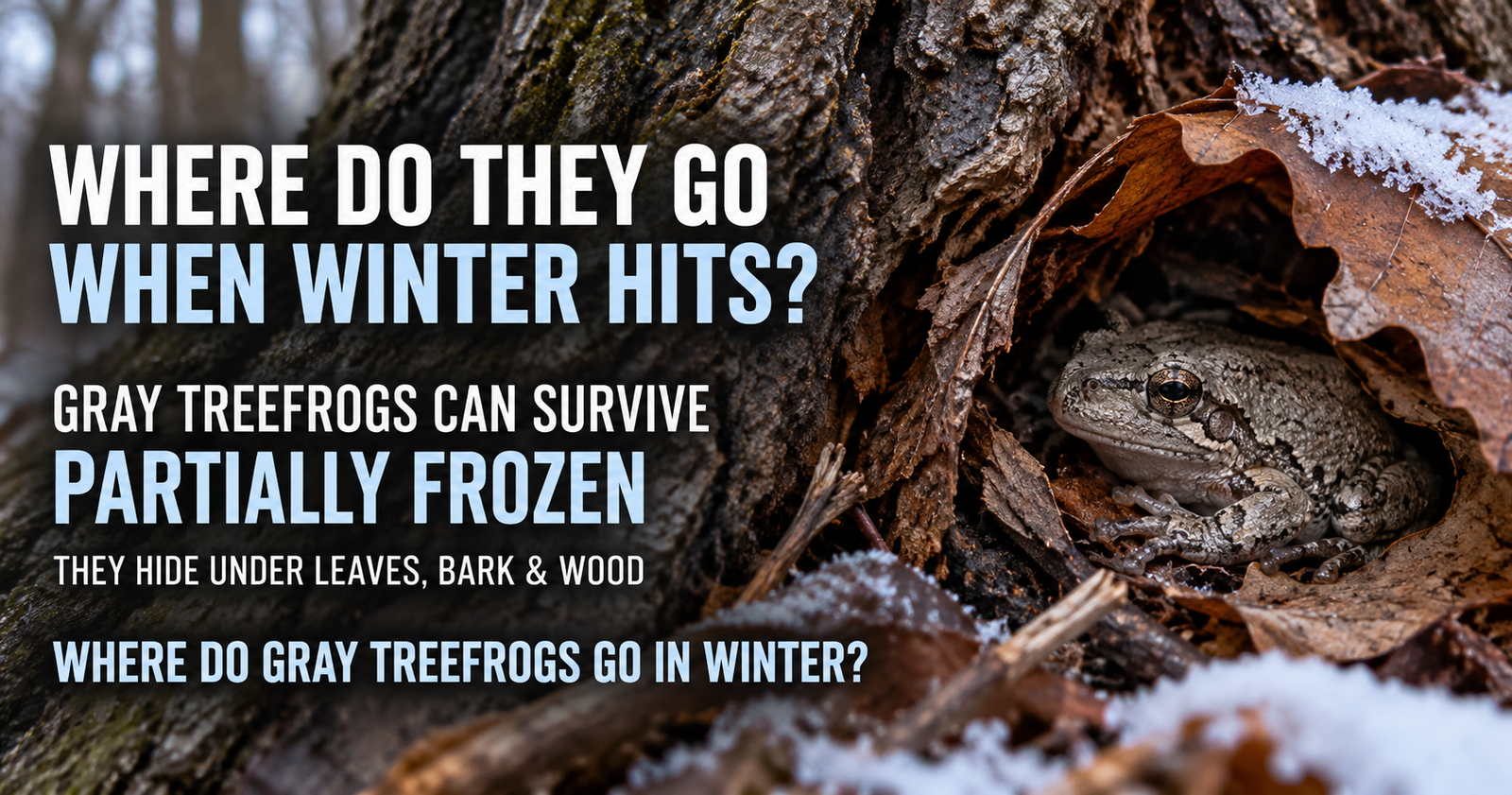
Gray treefrogs overwinter dormant close to or below ground, usually beneath leaf litter and similar natural cover. And unlike us, they can survive temporary freezing.
They don’t simply find a warm hollow tree and hope for the best.
Their bodies are actually adapted to deal with ice.
Where Do Gray Treefrogs Spend the Winter?
Despite spending much of the warmer part of the year climbing trees and structures, gray treefrogs generally come down for winter.
Missouri Department of Conservation says they typically overwinter dormant in soil beneath leaf litter, where moisture and temperature conditions are better than they would be in exposed tree cavities above ground.
That means winter shelter may be surprisingly close to the surface.
Think:
- Leaf litter
- Loose soil
- Protected ground-level cover
- Sheltered areas where temperature and moisture are more stable
They aren’t necessarily digging several feet underground.
And that’s exactly why their ability to tolerate freezing matters.
Do Gray Treefrogs Hibernate?
You can loosely think of it that way, although overwintering dormant is a better description of what’s happening.
As cold weather settles in, their activity drops dramatically.
They’re no longer spending evenings climbing around looking for insects or sitting near porch lights.
Their metabolism slows and they wait out winter in a protected location.
In Missouri, gray treefrogs are normally active from about late March through October.
That makes my fall fence sighting especially interesting.
I caught this frog toward the end of the normal active season, before winter pushed it toward its overwintering shelter.


Do Gray Treefrogs Really Freeze?
Yes, to a degree.
This isn’t one of those nature facts that’s technically true only because someone froze one frog’s toe in a laboratory.
Gray treefrogs are genuinely freeze tolerant.
Research on gray treefrogs has documented frogs surviving temporary freezing while a substantial portion of their body water became ice. One laboratory study found winter-acclimated gray treefrogs could survive 48 hours frozen at about -3°C, or roughly 27°F.
Another experiment found gray treefrogs surviving after roughly half of their body water had frozen under controlled conditions.
That’s pretty incredible for an animal I recently watched sitting on a fence.
Does the Whole Frog Turn Into an Ice Cube?
This needs a little explanation.
When scientists say a gray treefrog tolerates freezing, they don’t mean every individual cell becomes a solid block of ice without consequences.
Ice forms primarily outside the cells.
That’s important because ice crystals forming inside cells can cause devastating damage.
The frog’s body undergoes physiological changes that help protect its tissues while extracellular water freezes.
So yes, a gray treefrog can become remarkably frozen.
But there’s an entire biological protection system keeping that freezing from destroying its cells.



Gray Treefrogs Basically Make Their Own Antifreeze
This is the part that sounds made up.
As winter approaches and freezing occurs, gray treefrogs use substances called cryoprotectants to protect their tissues.
Missouri Department of Conservation describes these as blood “antifreeze” chemicals.
Research has shown that the gray treefrog Dryophytes versicolor uses compounds including glycerol and glucose as part of this freeze-protection system.
These compounds help protect cells from the damaging effects of freezing and dehydration.
Nature basically gave this tiny frog its own winterization system.
What Happens to the Frog When It Starts Freezing?
As ice begins forming in the frog, water is pulled from cells toward the areas where extracellular ice is developing.
That’s dangerous because cells can become severely dehydrated.
Cryoprotective compounds help cells tolerate that process.
Studies of gray treefrogs show dramatic increases in protective sugars associated with freezing and cold acclimation.
The frog’s metabolism also becomes extremely low.
It isn’t hopping around beneath the leaves while partially frozen.
It’s waiting.
Can a Frozen Gray Treefrog Wake Back Up?
Under conditions it can tolerate, yes.
When temperatures rise and the frog thaws, normal physiological activity can resume.
That’s what makes freeze tolerance so remarkable.
Researchers have experimentally frozen gray treefrogs under controlled conditions and observed recovery after thawing.
But don’t interpret that as meaning a gray treefrog can survive any amount of cold for any amount of time.
There are limits.
Can Gray Treefrogs Freeze Solid All Winter?
No.
This is an important distinction.
Freeze tolerance doesn’t mean invincibility.
Missouri Department of Conservation specifically notes that gray treefrogs can survive temporary freezing events, while prolonged freezing can be fatal.
Laboratory studies also show survival dropping when freezing becomes more severe. In one study, gray treefrogs tolerated -1.5°C and -3.5°C much better than -5.5°C, where survival fell below 50 percent.
That’s why choosing the right overwintering location still matters.
Leaf litter and soil help buffer the frog from the worst temperature extremes.
Its freeze tolerance is backup protection, not permission to spend January sitting exposed on top of my fence.


Why Don’t They Just Go Below the Frost Line?
Because they don’t have to.
MDC specifically points out that gray treefrogs don’t necessarily need to overwinter beneath the frost line because of their freeze tolerance.
That’s pretty unusual when you think about it.
Many animals avoid freezing.
Gray treefrogs have evolved a way to survive some of it.
Their protected ground-level winter shelter and freeze tolerance work together.
Could a Gray Treefrog Be Hiding Under the Leaves in My Yard?
Absolutely.
And that’s one reason I wouldn’t be in a hurry to make every inch of a yard perfectly bare before winter.
Leaf litter provides overwintering habitat for all kinds of small wildlife.
Gray treefrogs are among the animals that can use it.
The frog you saw on your porch in September or October may eventually move down into a protected area beneath leaves and soil as cold weather takes over.
You may walk past it all winter without ever knowing it’s there.
Gray Treefrogs Can Even Turn Up in Outdoor Flowerpots
Here’s another interesting one.
Missouri Department of Conservation has noted reports of gray treefrogs overwintering in outdoor potted plants.
That actually makes sense.
A pot can contain:
Loose soil.
Leaves.
Protected crevices.
Moisture.
A frog looking for a sheltered ground-level winter location may find that pretty attractive.
So if you’re moving outdoor pots around late in the season, don’t be completely shocked if you discover a little frog tucked away.
Should You Bring a Gray Treefrog Inside for Winter?
No.
Seeing a frog outside when cold weather is approaching can make us think it needs rescuing.
But gray treefrogs have been surviving winter long before we had heated houses.
Bringing a healthy wild frog indoors can disrupt its natural seasonal cycle and creates husbandry problems you didn’t need to create.
If the frog is outside in appropriate habitat, I’d leave it outside.
The little guy knows winter is coming.
Should You Move One Into Your Garage?
I wouldn’t.
Same reason.
A garage may experience unnatural temperature swings and doesn’t necessarily provide the moisture or appropriate overwintering conditions the frog would select naturally.
Let wild frogs choose their own winter shelter.
The gray treefrog I found on our fence didn’t need me to build it a frog hotel.
It needed me to leave it alone.
What If I Find a Gray Treefrog During Winter?
If you uncover one beneath leaves, soil, a log, or another protected spot, I’d disturb it as little as possible.
Winter isn’t a good time to decide a dormant frog needs to be photographed from 14 angles.
Put disturbed natural cover back carefully when appropriate and leave the frog where you found it.
Its overwintering location was chosen for a reason.
Don’t Assume a Frozen Frog Is Dead
This may be the strangest takeaway in the article.
With a freeze-tolerant species such as a gray treefrog, an extremely cold and apparently lifeless frog isn’t automatically dead.
Freeze-tolerant frogs can undergo dramatic physiological shutdown while frozen.
That doesn’t mean you should pick one up and attempt to thaw it inside your house.
Quite the opposite.
Leave overwintering wildlife alone whenever possible.
What Happens When Spring Arrives?
As temperatures rise, gray treefrogs become active again.
In Missouri, activity normally begins around late March, and breeding begins during spring as nighttime temperatures warm.
Eventually you’ll start hearing males calling near suitable breeding water.
Then they’ll return to the trees, vegetation, porches, decks, windows, and other places where we notice them throughout the warmer months.
The little frog hidden beneath winter leaves becomes a climbing, calling insect hunter again.
This Makes My Fall Fence Frog Even Cooler
When I first found the gray treefrog sitting on our wooden fence, the camouflage was what caught my attention.
It almost disappeared against the weathered wood.
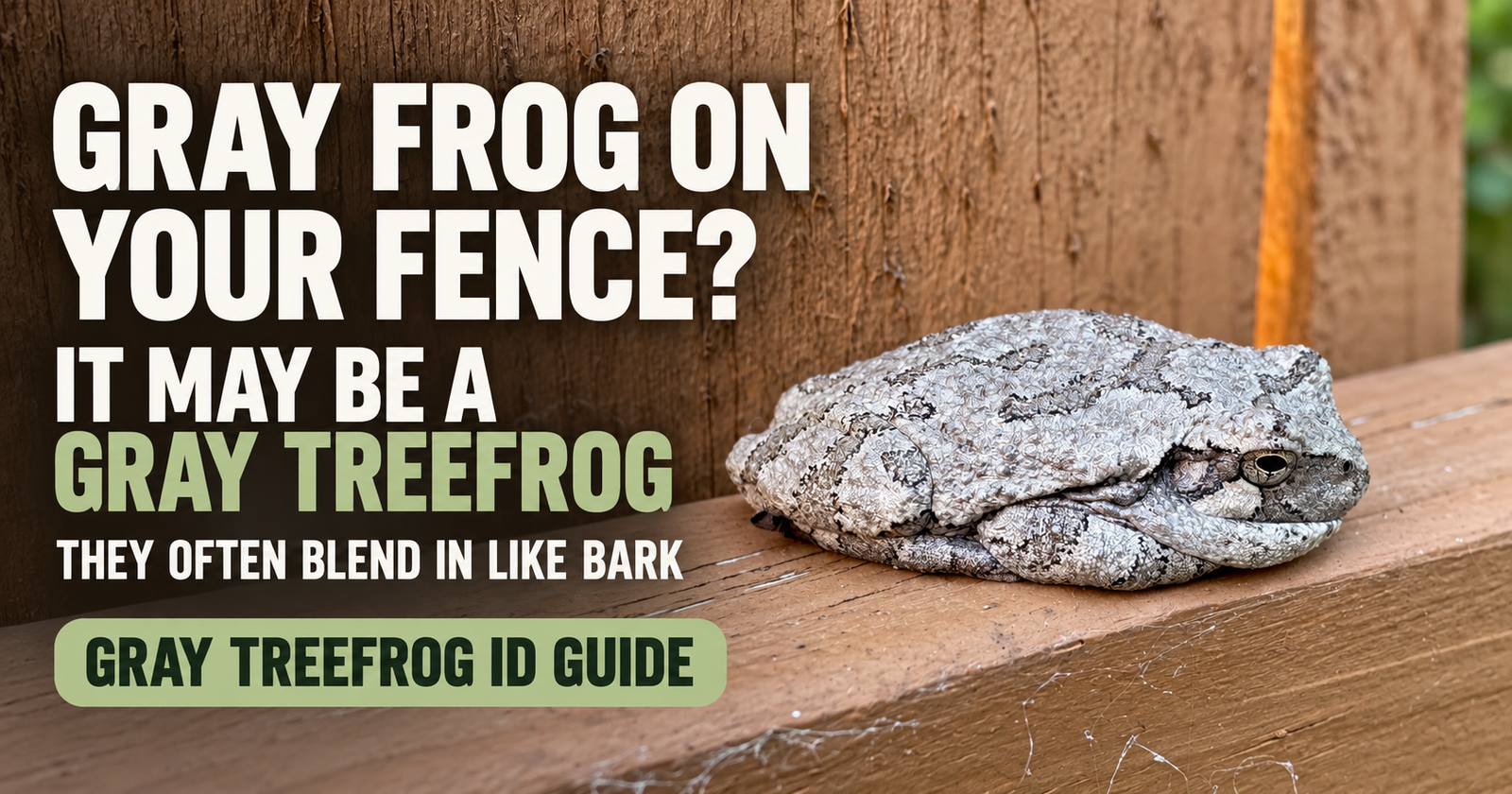
You can see that original encounter in the gray treefrog I found sitting on our fence.
Then I learned why gray treefrogs can change color and why they regularly show up around human structures.
And now there’s another layer to the story.
That little frog sitting outside during a cool fall day was approaching a season when it would eventually leave those above-ground perches, settle into protected winter cover, and rely on some remarkable biology to survive freezing weather.
You Probably Don’t Need to Help It Survive Winter
If your property has natural cover and the frog is healthy and outside where it belongs, my approach is simple:
Leave it alone.
Don’t bring it inside.
Don’t put it in a heated garage.
Don’t try to build a warm enclosure around it.
Don’t dig it up once winter arrives.
If anything, preserving some natural leaf litter and protected habitat gives small wildlife more options.
Gray treefrogs have their own winter strategy.
And it’s considerably more impressive than anything I could build for them.
A frog that can sit nearly invisible on a fence in October and survive temporary freezing a few months later is one critter I’m perfectly happy to share the yard with.
About the author: Mason Hollis writes about the frogs, toads, and other small wildlife people unexpectedly find around their homes and yards. At Critter Answers, he focuses on identifying what showed up, understanding why it’s there, and knowing when the best response is simply to leave wildlife alone.