
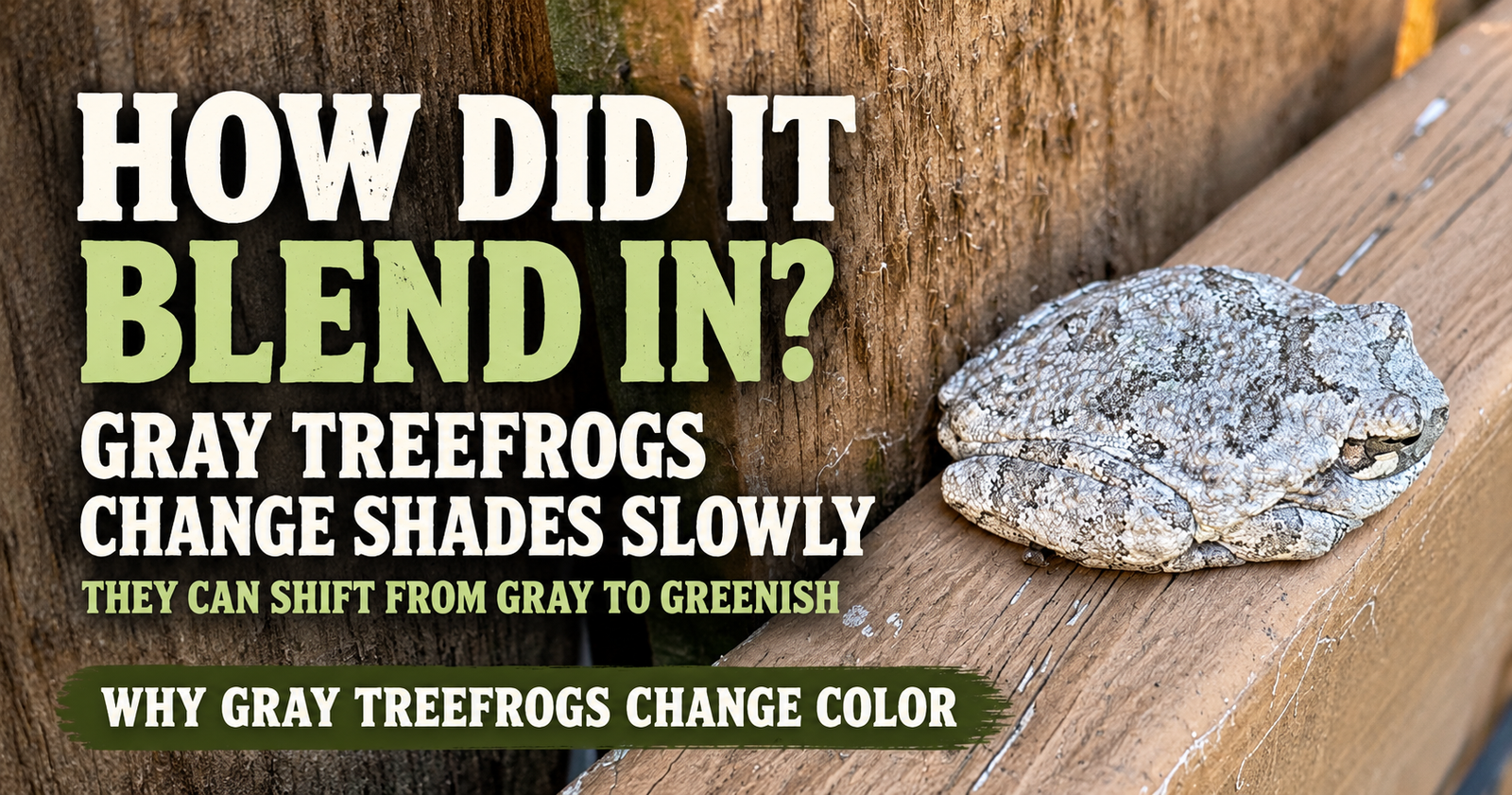
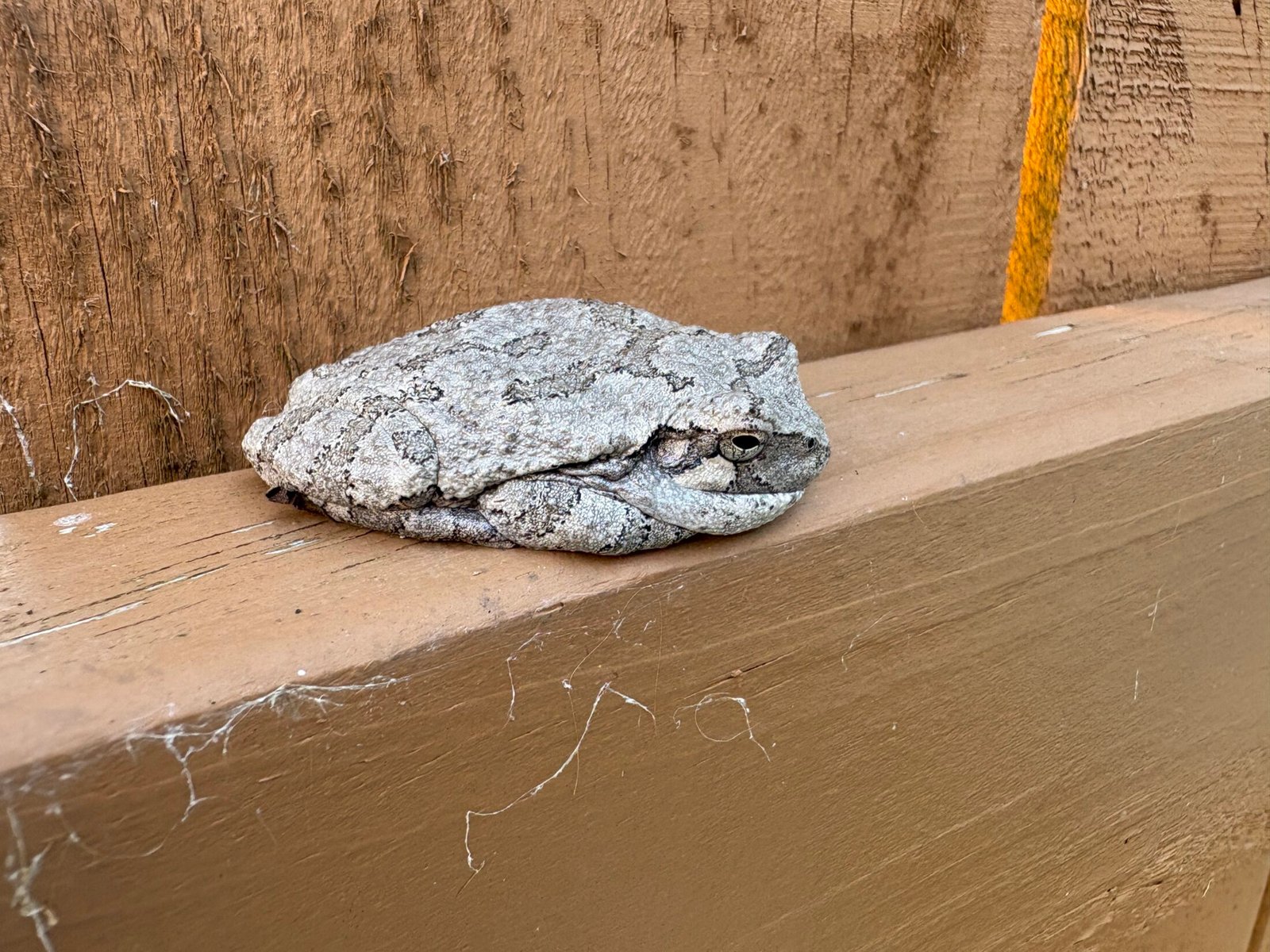
The gray treefrog I found sitting on a wooden fence looked like it had been designed specifically for that piece of wood.
Its back was pale gray with darker mottling. Its rough texture broke up the outline of its body. From farther away, it would have been incredibly easy to overlook.
And that camouflage isn’t just a lucky coincidence.
Gray treefrogs really can change color.
They can appear gray, green, brown, greenish gray, and sometimes remarkably pale depending on the individual and conditions around them. Temperature, humidity, light, activity, and the frog’s surroundings can all play a role in the color you’re seeing.
That’s also why a gray treefrog you photograph today may look surprisingly different the next time you see one.
Yes, Gray Treefrogs Really Change Color
This isn’t just a case of individual frogs naturally coming in different colors.
Gray treefrogs have the ability to change their body coloration.
Missouri Department of Conservation says several Missouri treefrogs can change color and that the change appears to be associated with factors including:
- Temperature
- Humidity
- Light
- Activity
- The frog’s temperament
Their possible colors include green, light greenish gray, gray, brown, and dark brown.
Wisconsin DNR similarly describes the gray treefrog as chameleon-like and says its coloration can change with temperature and the color of the surface it’s resting on.
So if your gray treefrog looks green one day and gray another day, you aren’t necessarily looking at two different kinds of frogs.
The Frog I Found Was Almost the Same Color as the Fence
What struck me about the frog I found was how well its appearance worked against old wood.
It wasn’t one uniform shade of gray.
Its skin had lighter and darker areas, irregular markings, and a rough texture that made its body outline surprisingly difficult to pick out against the weathered surface.
That’s exactly the sort of camouflage gray treefrogs are known for.
MDC describes their mottled gray and green coloration as excellent camouflage against lichen-covered tree bark.
Mine wasn’t sitting on a lichen-covered tree trunk.
It was sitting on a wooden fence cross board.
The effect still worked remarkably well.



Why Would a Frog Need to Change Color?
The biggest advantage is camouflage.
A frog sitting exposed on a tree trunk can potentially become food for another animal.
Gray treefrogs are preyed upon by animals including snakes, birds, and larger frogs.
Being difficult to see has an obvious advantage.
But camouflage works in the other direction too.
Gray treefrogs eat insects, spiders, and other small invertebrates.
MDC notes that blending with their surroundings may help them avoid predators and surprise prey.
So disappearing against the background can help keep a treefrog from becoming dinner while making it easier to find dinner of its own.
Gray Doesn’t Always Mean Gray
The name can be misleading.
A gray treefrog doesn’t have to look gray.
You might see one that’s:
- Silvery gray
- Dark gray
- Brownish
- Greenish gray
- Bright green
- Very pale gray
MDC says their color can range from green to light greenish gray, gray, brown, or dark brown.
The Smithsonian similarly describes gray treefrogs as ranging from green to gray or brown depending on their environment and activity.
So don’t reject a gray-treefrog identification simply because the frog in front of you is green.


Can a Gray Treefrog Turn Green?
Yes.
And this can really confuse identification.
Someone finds a bright green frog on a window and naturally searches for “green frog.”
But a gray treefrog can absolutely appear green.
That doesn’t automatically make it a green treefrog.
In Missouri, the actual green treefrog (Dryophytes cinereus) is a separate species. MDC says it occurs mainly in southeastern Missouri, with several isolated populations elsewhere in the state.
You need to look at more than the background color.
Look for the Light Spot Under the Eye
One of the field marks I like for gray treefrogs is the pale spot beneath each eye.
MDC describes a large white or gray spot below each eye in both the gray treefrog and Cope’s gray treefrog.
That feature is useful because the frog’s overall body color can change.
You may be looking at a green individual.
Or a brown one.
Or a gray one like the frog I found.
The underlying identification features still matter.
Look at the Skin Texture Too
Gray treefrogs don’t have the slick, smooth appearance people sometimes imagine when they picture a frog.
Their skin is granular and somewhat warty.
That rough texture contributes to the camouflage.
A mottled gray frog with irregular dark markings and bumpy skin can blend incredibly well with rough bark and lichen.
That’s part of why the frog on my fence looked so convincing.
It didn’t merely have the right color.
It had the right texture too.
And Then There Are Those Bright Yellow Legs
Here’s the funny part.
A gray treefrog can spend all day trying to look like a piece of bark while hiding a shockingly bright color underneath.
The concealed portions of the hind legs are yellow to orange-yellow with dark mottling.
You often won’t see that color when the frog is sitting still with its legs folded.
Then it jumps.
Suddenly that bright yellow or orange flashes into view.
It’s one of the best identifying features when you happen to see it.



Why Have Bright Legs if You’re Trying to Hide?
Those colors may work differently from the frog’s camouflage.
The muted back helps the resting frog disappear.
The bright hidden leg color is exposed when the frog moves.
Wildlife biologists believe this type of flash coloration may startle or confuse a predator. North Carolina Wildlife Resources Commission notes that the bright orange or golden-yellow underside of the legs is believed to help confuse predators.
Imagine tracking a gray blob that suddenly jumps and flashes bright yellow.
Then it lands, folds its legs underneath itself, and turns back into a piece of bark.
Pretty clever setup.
Does a Gray Treefrog Instantly Match Whatever It Sits On?
Not exactly.
I wouldn’t describe it like a cartoon chameleon that touches a red cup and immediately turns bright red.
Gray treefrogs have a range of colors they’re capable of displaying.
The change responds to physiological and environmental conditions rather than perfectly copying every object beneath them.
They’re not going to turn blue because they landed on a blue cooler.
Their mottled pattern and range of gray, brown, and green shades happen to work extremely well against the natural surfaces they commonly use.
How Fast Can a Gray Treefrog Change Color?
The change can be noticeable over a relatively short period, but I wouldn’t promise readers a specific number of seconds or minutes for every frog.
Several things influence the response.
Temperature matters.
Light matters.
Activity matters.
Background conditions matter.
And individual frogs can look different.
The important thing is that the color you’re seeing right now isn’t necessarily the frog’s permanent color.
If you encounter the same animal under different conditions, it can look surprisingly different.
Does Temperature Change a Gray Treefrog’s Color?
Yes, temperature is one of the factors associated with color change.
Wisconsin DNR specifically says gray treefrog color changes with temperature or substrate color.
MDC likewise includes temperature among the factors affecting coloration.
That’s especially interesting considering when I found mine.
It was a comfortable fall day, around 70°F, and the frog was sitting quietly in the shade.
It had taken on that beautiful pale mottled gray appearance that worked incredibly well against the fence.
I can’t say temperature alone caused that exact coloration.
There are too many variables involved.
But the conditions were absolutely within the range of factors known to influence how these frogs look.
Humidity Can Matter Too
MDC also lists humidity as one of the factors associated with treefrog color change.
That makes sense for an amphibian whose physiology is closely connected to moisture.
Again, I wouldn’t turn this into an overly simple rule such as:
High humidity = green frog.
Biology isn’t that neat.
Think of humidity as one of several inputs affecting what color the frog displays.
Light Can Influence Their Appearance
Light is another factor.
A frog sitting in a bright location isn’t necessarily going to display exactly the same coloration as one resting in a shaded crevice.
This is one reason photographs of gray treefrogs can look so different from each other.
Search for gray treefrog pictures and you may see:
A gorgeous bright green frog.
A mottled brown frog.
A silvery gray frog.
A nearly white-looking frog.
And yet they can all fit within the normal appearance of this group.
Activity Can Change Their Color Too
A resting treefrog and an active treefrog may not look identical.
MDC includes activity among the factors associated with color changes.
The frog I found was doing almost nothing.
It was flattened down on the wooden board with its legs tucked in and eyes open.
It looked like a frog whose plan for the moment was simply:
Don’t move. Don’t be noticed.
And it was doing a very good job.
Why Was My Gray Treefrog Sitting on a Wooden Fence?
Because human-built wooden structures aren’t particularly strange places for these frogs.
MDC says gray treefrogs are often seen around houses and other structures, including:
- Farm buildings
- Porches
- Decks
- Gutters
- Birdhouses
- Windows
They may also gather around porch lights at night to hunt insects attracted to the light.
A shaded wooden fence board fits nicely with the kind of elevated resting surface a treefrog can use.
So I wouldn’t consider finding one there abnormal at all.
How Does a Treefrog Stay on a Vertical Surface?
Look at the toes.
Gray treefrogs have enlarged adhesive pads on their fingers and toes.
Those specialized pads allow them to climb surfaces that would be impossible for many other frogs.
That’s why you can find gray treefrogs:
On windows.
On siding.
On decks.
On fences.
In trees.
Around gutters.
Sometimes surprisingly high above the ground.
MDC specifically identifies those adhesive pads as a characteristic feature of both gray-treefrog species.
Gray Treefrog or Cope’s Gray Treefrog?
Here’s where I’m going to stay careful.
Missouri has two frogs that look essentially identical:
The gray treefrog (Dryophytes versicolor).
And Cope’s gray treefrog (Dryophytes chrysoscelis).
MDC says they’re basically identical in appearance and that both occur in Missouri, sometimes even in the same counties.
That means I cannot look at my photographs and responsibly tell you:
“This is definitely Dryophytes versicolor.”
It could be.
It could also be Cope’s gray treefrog.
That’s why in these articles I’m comfortable calling the animal a gray treefrog in the broader everyday sense while being transparent that photographs alone don’t reliably separate the two species.
Color Won’t Reliably Tell You Which Gray Treefrog You Have
Cope’s gray treefrog tends to be slightly smaller and is more often green, according to MDC.
But that’s not enough to identify an individual frog confidently.
Both species change color.
Both can be gray.
Both can be green.
Both have similar markings.
Both have the light spot beneath the eye.
Both have the yellow-orange hidden leg coloration.
Trying to identify the species because one happens to look greener today is asking too much from color.
The Call Is Much More Useful
If you hear the frog calling, now you have something much more useful.
MDC describes the gray treefrog’s call as a musical, birdlike trill.
Cope’s gray treefrog produces a higher-pitched buzzing trill.
Temperature complicates things because it can affect the sound, but experienced listeners can distinguish them. Scientists can analyze the number of pulses in recordings to separate them more precisely.
We’ll give that question its own article later in this little cluster because it deserves one.
Is a Gray Treefrog Turning White Sick?
Not necessarily.
A very pale gray treefrog can still be showing normal color variation.
These frogs can become surprisingly pale.
MDC describes their possible coloration as including light greenish gray, and other wildlife agencies document individuals becoming nearly white under some conditions.
So pale coloration alone doesn’t automatically mean disease, albinism, or something wrong with the frog.
Look at the entire animal and its behavior.
Is a Green Gray Treefrog a Different Species?
Again, not necessarily.
That’s one of the coolest things about them.
The name gray treefrog describes a species capable of looking decidedly un-gray.
If the frog has the right overall build, granular skin, adhesive toe pads, pale spot beneath the eye, characteristic markings, and hidden yellow-orange leg coloration, green can be completely normal.
Don’t identify a frog from color alone.
Why This Camouflage Works So Well
Look at a lichen-covered tree trunk.
It isn’t one color.
There are patches.
Lines.
Rough textures.
Dark areas.
Pale areas.
Irregular edges.
Now look at a gray treefrog.
Same basic visual problem for a predator.
The frog’s outline gets broken up by irregular markings and rough texture.
MDC specifically compares their coloration with lichen and notes that other animals use similar lichen-and-bark camouflage.
The frog doesn’t need to become invisible.
It just needs to be difficult enough to notice.
Mine Was Hiding in Plain Sight
That’s what I like most about the frog I found.
It wasn’t buried beneath leaves.
It wasn’t inside a hole.
It wasn’t hiding under the fence.
It was sitting right on top of a wooden cross board.
Completely exposed.
And yet the camouflage worked.
If I hadn’t been looking in its direction, it would have been incredibly easy to walk right past.
That’s probably the best demonstration of gray-treefrog camouflage I could have asked for.
Should You Move a Gray Treefrog You Find on a Fence?
Usually, I wouldn’t bother it.
If the frog is sitting safely on a fence, deck, porch, tree, or similar surface, it probably doesn’t need rescuing.
It’s a treefrog.
Being perched somewhere above the ground is normal.
If it’s in immediate danger, that’s different.
But don’t assume a frog sitting motionless during the day is stuck or sick simply because it isn’t hopping around.
MDC notes that gray treefrogs commonly rest during the day in cavities and protected areas and become active hunters at night.
Sometimes sitting still is exactly what the frog is supposed to be doing.
Be Careful About Handling Treefrogs
I prefer observing rather than handling amphibians unnecessarily.
Their skin is biologically important and sensitive.
If you must move a frog out of immediate danger, keep handling brief and gentle, and make sure your hands are clean and free from chemicals such as insect repellent, sunscreen, lotion, cleaners, or other residues.
Then let the frog get back to being a frog.
For the one I found, there was no reason to interfere with it.
It had picked a quiet shaded board and appeared perfectly content there.
Are Gray Treefrogs Good to Have Around?
I consider them a welcome visitor.
They eat insects, spiders, and other invertebrates.
MDC notes that insects and spiders make up their diet and says ants and beetles can account for a large portion of what they eat.
That doesn’t mean one gray treefrog is going to eliminate every mosquito or pest around your house.
But it’s certainly not an animal I’d want to remove just because I found one resting on the fence.
It’s part of the local ecosystem doing what treefrogs do.
Will It Stay the Same Color All Day?
Maybe.
Maybe not.
That’s another reason these frogs are so interesting.
The color you photograph at 10 a.m. may not be exactly what you’d see later under different conditions.
Temperature can change.
Humidity can change.
Light can change.
The frog can become active.
It can move to a different surface.
All of those things can influence appearance.