
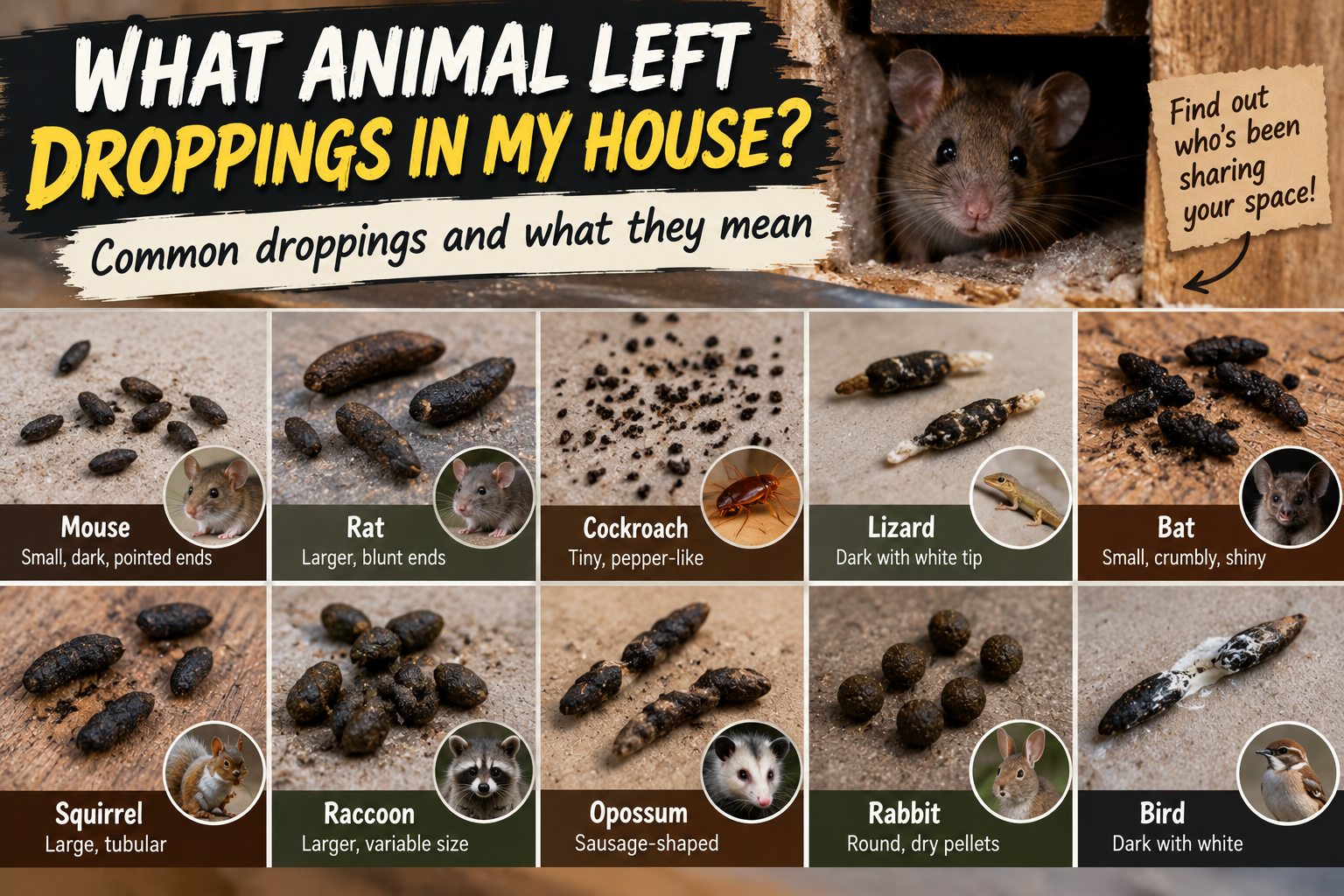
Finding mystery droppings in your house is one of those moments when you immediately want to know two things: what left them, and is that animal still here?
Mice and rats are common possibilities, but droppings found indoors can also come from squirrels, bats, and other animals depending on where they’re found. The frustrating part is that a single dropping doesn’t always give you a definite answer.
I look at the whole picture instead. Size, shape, quantity, location, freshness, and the other evidence nearby can turn a mystery pile into a much more useful clue.
Don’t Pick Them Up to Get a Better Look
Before getting into identification, this part matters.
Don’t pick up unknown animal droppings with your bare hands. I also wouldn’t crush one, break it apart, or bring my face close to it trying to inspect what’s inside.
If mice or rats are a possibility, there’s another important rule: don’t grab the vacuum cleaner.
The CDC specifically recommends against sweeping or vacuuming rodent urine, droppings, or nesting material before it has been properly disinfected. Disturbing dry contaminated material can cause particles to become airborne. The contaminated material precautions places this precaution within the site’s broader health and safety guidance.
For identification, you usually don’t need to touch anything.
Take clear pictures. Note the approximate size. Look at the shape and where the droppings are concentrated. Then look around for other evidence.
That’s plenty to start with.
Where Did You Find the Droppings?
This is one of my favorite clues because people tend to focus entirely on what the poop looks like.
Where an animal poops can be almost as useful as what the poop looks like.
Droppings inside a silverware drawer tell a different story from droppings scattered across attic insulation.
Think about exactly where you found them:
- Kitchen cabinet
- Pantry
- Behind the refrigerator or stove
- Under a sink
- Basement
- Garage
- Attic
- Crawl space
- Window ledge
- Near an exterior door
- Around stored pet food
- Near an attic or wall opening
Then look at how the droppings are distributed.
Are there two or three?
Dozens?
Are they scattered along a wall?
Concentrated beneath one spot?
Do they keep appearing in exactly the same location?
Those patterns matter.
Mouse Droppings Are One of the Most Common Indoor Finds
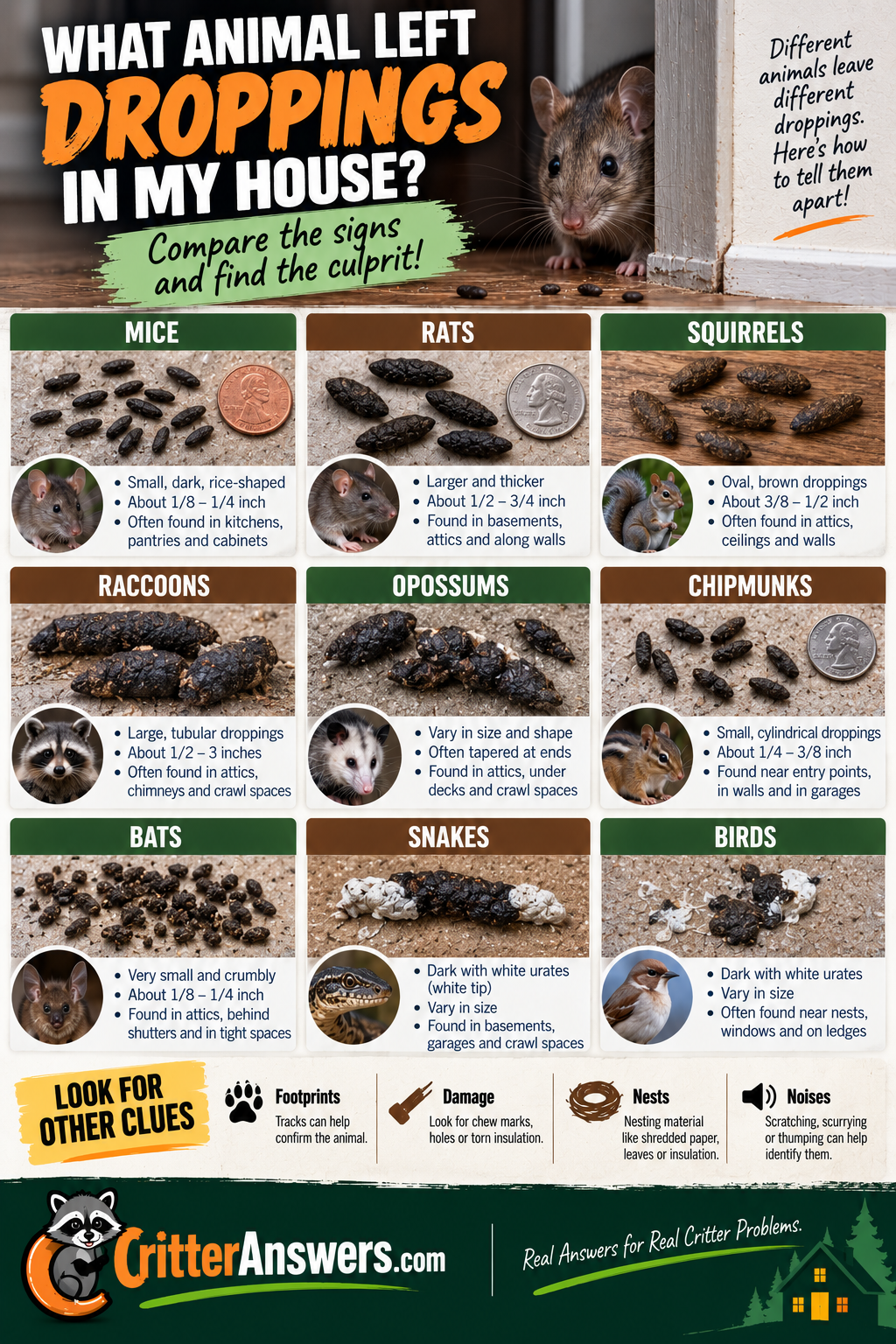
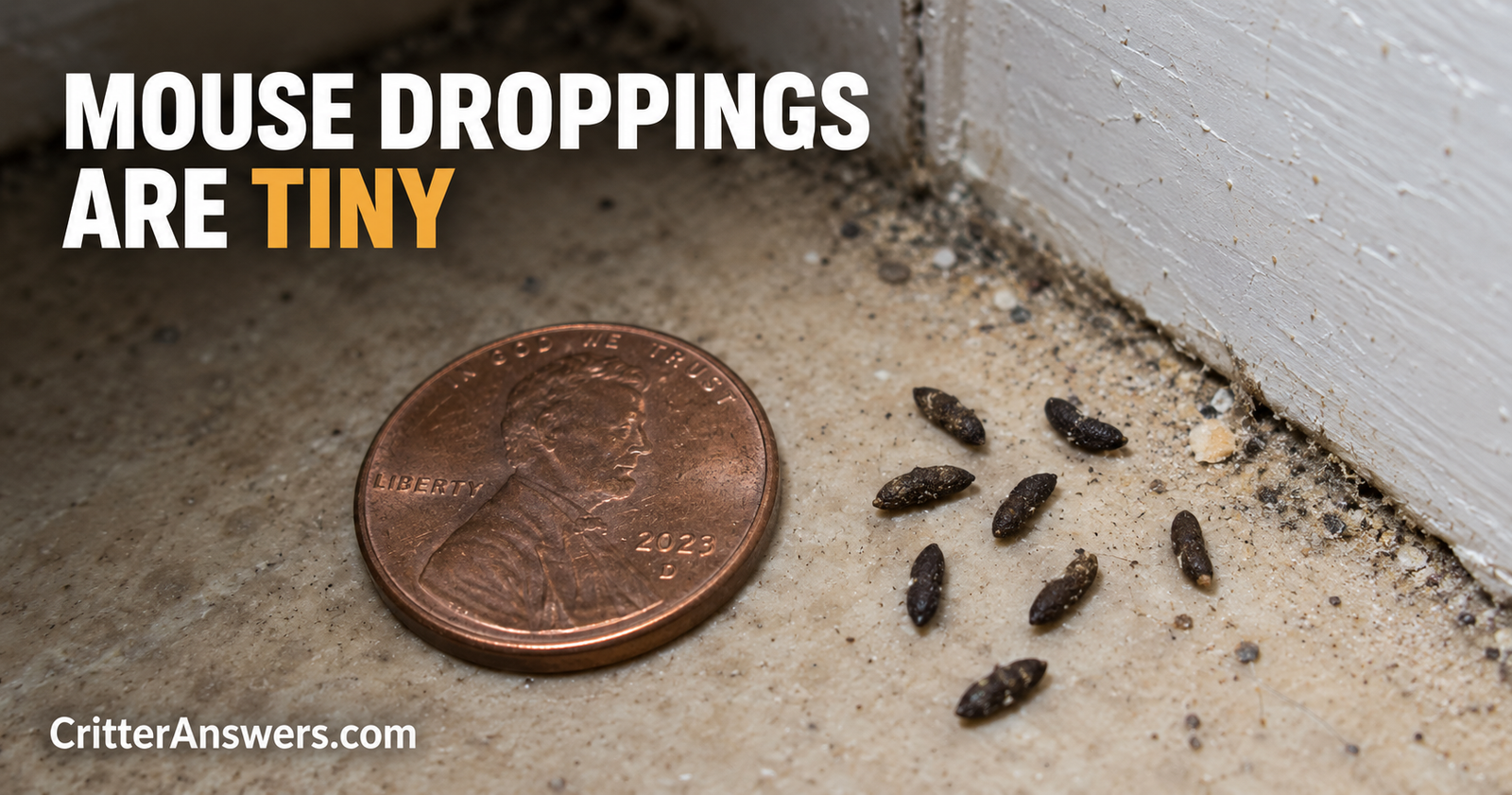
If you find small, dark droppings in kitchen cabinets, drawers, pantries, garages, basements, or other hidden areas, mice should be high on your list of possibilities.
Mouse droppings are generally small and elongated rather than round. They may appear somewhat rice-like from a distance, although I don’t recommend relying on a food comparison as your only identification method.
Location makes the identification stronger.
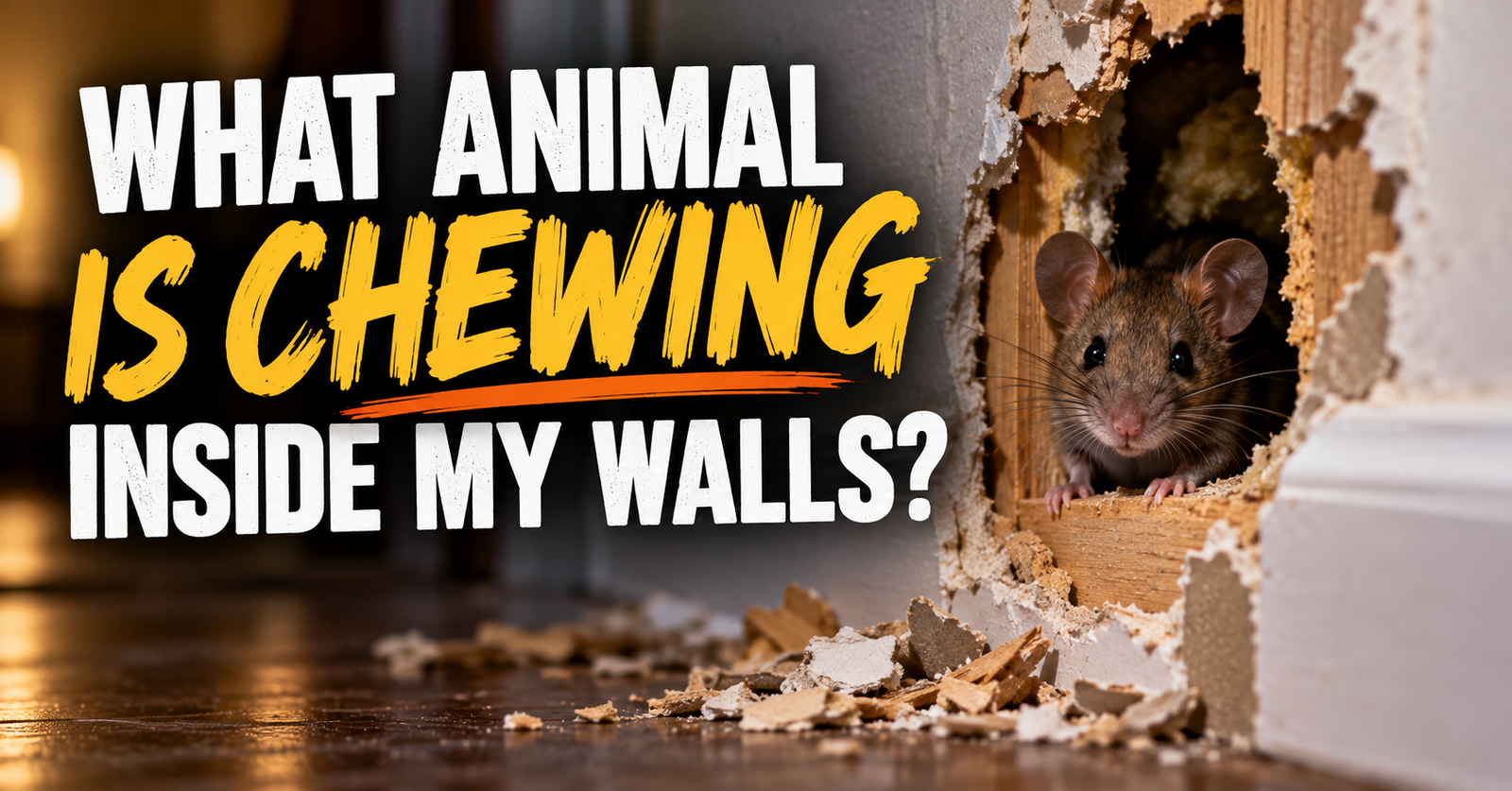
A handful of small dark droppings beneath the kitchen sink combined with gnawed food packaging and nighttime wall scratching creates a much stronger mouse case than one mysterious pellet sitting in the middle of the floor. When chewing is also part of the evidence, gnawed food packaging and nighttime wall scratching can help you compare the sound with the physical signs.

If you’re trying to identify an unknown visitor from more than its waste, my guide to figuring out what critter is in your house covers noises, nesting material, smells, damage, activity times, and entry points too.
New mouse droppings can tell you something important
One question homeowners frequently have is whether the droppings mean mice used to be there or are still there now.
Old droppings by themselves don’t necessarily prove current activity.
The CDC suggests safely cleaning rodent evidence and then watching for new droppings or other fresh signs. If droppings reappear after proper cleanup, that’s evidence of ongoing rodent activity.
That’s much more reliable than trying to decide how old a dropping is simply by staring at its color.
Rat Droppings Are Generally Larger
Rat and mouse droppings can look similar enough to cause confusion, especially when you don’t have both sitting side by side.
The biggest obvious difference is usually size.
Rat droppings are generally larger than mouse droppings, but appearance can also differ depending on the rat species.
This is where I don’t like overly neat internet identification charts that imply every rat dropping has exactly the same shape.
Instead, combine the larger droppings with other evidence.
Look for heavier gnawing, larger openings, nighttime activity, rub marks, tracks, or other rodent signs.
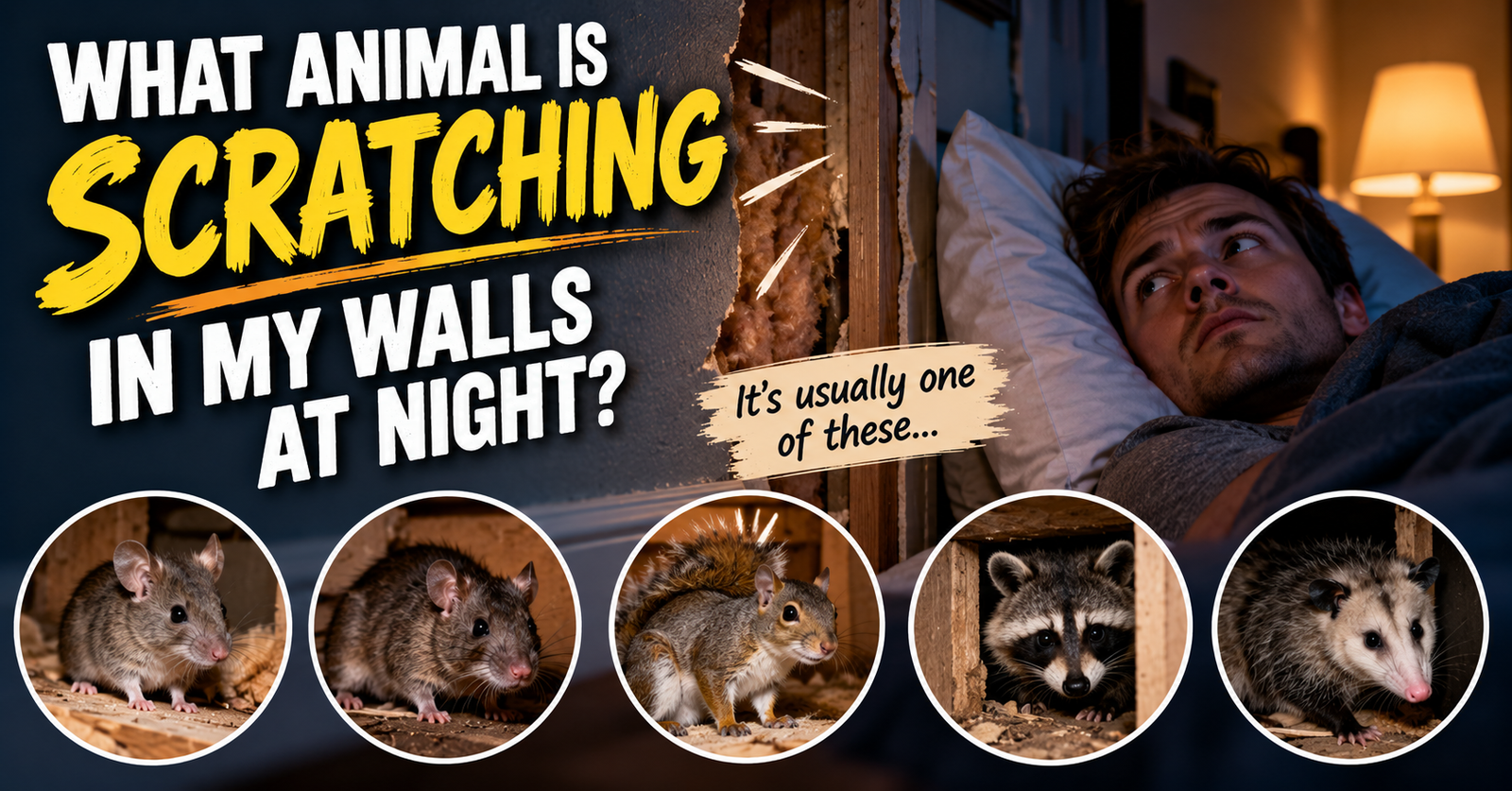
If you’ve also been hearing scratching inside your walls at night, the droppings may finally give you the physical evidence you were missing.
Squirrel Droppings Can Be Confused With Rat Droppings
This is especially relevant when the droppings are in an attic.
Squirrel droppings can be elongated and dark, which means homeowners sometimes mistake them for rat droppings.
Now the location and activity pattern become extremely useful.
If you’re finding droppings in an attic and also hearing fast scampering during daylight, squirrels become much more plausible.
If the same general evidence is accompanied by mostly nighttime activity, rodents may deserve more attention.
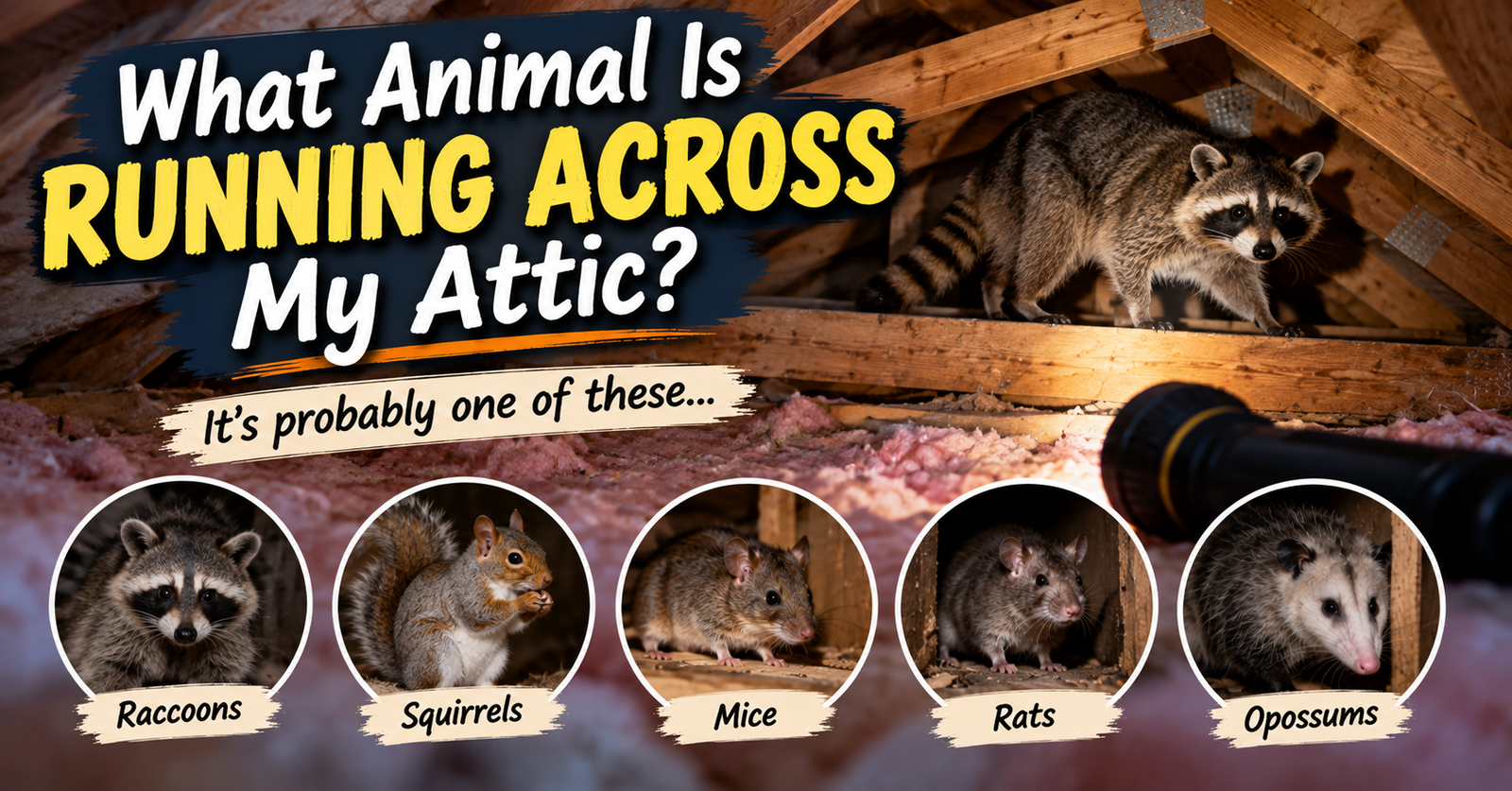
Our guide to animals running across an attic goes deeper into using activity time and movement patterns to distinguish some of these common attic visitors.
Don’t force the identification from the dropping alone.
Dropping + attic location + daytime running + roof entry evidence is a much better identification than simply saying, “It looks like squirrel poop.”
Bat Droppings Can Look Like Rodent Droppings
Bat droppings, commonly called guano, can create another confusing situation.
Small dark bat droppings may initially resemble mouse droppings.
Location becomes especially important.
Bat guano may accumulate beneath a roosting location or near an area bats are regularly using. Evidence concentrated beneath an upper structural area is different from small droppings scattered through kitchen cabinets.
Bat droppings also deserve caution.
Large accumulations of bat or bird droppings shouldn’t be casually disturbed, especially in enclosed spaces. Certain fungi can grow in soil or material enriched by bird and bat droppings, and disturbing contaminated material can create an inhalation hazard.
If you’ve discovered a substantial accumulation in an attic, I would stop treating this as a simple “what animal pooped here?” question and consider professional assessment and cleanup.
What About Cockroach Droppings?
This is worth mentioning even though Critter Answers isn’t our insect site.
Sometimes the mystery “animal droppings” aren’t from a mammal at all.
Cockroach feces can be very small, and depending on the cockroach species and situation, the material may resemble dark specks or small pellets.
If what you’re finding looks more like pepper, coffee-ground-like specks, or tiny dark spotting than individual mammal droppings, an insect source becomes possible.
That distinction matters because trying to mouse-proof a kitchen isn’t going to solve a cockroach problem.
For Critter Answers, though, I’m going to keep our focus on mammals and wildlife rather than turning this article into an insect guide.
Shape Helps, but Don’t Let It Fool You
Animal scat identification commonly uses shape as one clue.
You may see droppings described as:
- Pellets
- Tubular
- Segmented
- Twisted
- Tapered
- Rounded
That’s useful vocabulary, but shape isn’t a fingerprint.
Diet, moisture, age, and the individual animal can affect appearance.
A partial dropping may also look completely different from an intact one.
The Missouri Department of Conservation recommends considering several characteristics when identifying scat, including shape, contents, color, volume, scent, placement, and habitat rather than relying on one characteristic.
Inside a house, I’d add exact room and nearby animal evidence to that list.
Size Is One of Your Better Clues
Size can eliminate some possibilities quickly.
Tiny droppings obviously aren’t going to support the idea that a raccoon has been walking around your pantry.
Likewise, a substantial pile of large waste in an attic shouldn’t automatically be blamed on a mouse.
But don’t eyeball the size from memory.
Take a picture with a ruler positioned nearby if you can do that without touching or disturbing the droppings.
That gives you an actual scale to work with later.
A photograph without scale can be surprisingly misleading. A tiny pellet photographed close-up can look enormous.
How Many Droppings Are There?
Quantity matters too.
One old dropping may tell you that an animal passed through the area at some point.
Fresh droppings repeatedly appearing after proper cleanup suggest something very different.
Also pay attention to whether the waste is scattered or concentrated.
Some animals repeatedly use particular areas for waste. Raccoons, for example, may establish communal defecation sites called latrines.
A concentrated pile should therefore be treated differently from several tiny droppings scattered along a rodent travel route.
And once again, don’t start handling the material to investigate.
Raccoon Droppings Need Extra Caution
If you find a larger concentration of droppings in an attic, on a roof, deck, woodpile, or other area accessible to raccoons, don’t casually scoop it up.
Raccoon feces can carry the eggs of the raccoon roundworm Baylisascaris procyonis, which can cause serious disease in people if infective eggs are accidentally ingested.
That doesn’t mean every pile of raccoon feces is infectious.
It does mean suspected raccoon latrines deserve more caution than ordinary dirt or debris.
Children and pets should also be kept away from a suspected latrine area.
Fresh vs Old Droppings Isn’t Always Obvious
You’ve probably seen advice saying:
“Shiny and soft means fresh. Gray and crumbly means old.”
There is some practical value in noticing condition, but I wouldn’t use appearance alone to confidently date droppings.
Humidity, temperature, location, airflow, and the surface underneath can all affect how material dries and ages.
There’s an easier test for ongoing activity.
Properly clean the accessible area following appropriate safety guidance and monitor it.
If new droppings appear, something is active.
You don’t need to become a poop archaeologist.
Droppings Plus Gnaw Marks Strongly Suggest Rodents
Now we’re getting somewhere.
If small or medium-sized droppings are accompanied by fresh gnaw marks, rodents become more likely.
Mice and rats gnaw regularly.
Look for damage around:
- Food packages
- Cardboard boxes
- Wood
- Plastic containers
- Cabinet corners
- Small openings
- Utility penetrations
Electrical wiring deserves special caution.
If you find chewed or damaged wiring near rodent evidence, don’t handle questionable wiring just to investigate it. Electrical damage is a separate safety issue that may require an appropriate professional.
Tracks Can Back Up the Droppings
A dusty attic, basement, garage, or crawl space may preserve footprints.
If you find clear tracks naturally, photograph them.
Don’t immediately walk through the area.
Look at approximate footprint size, number and arrangement of toes, direction of travel, and where the tracks lead.
Tracks are especially helpful when they connect the droppings to a suspected entry point or nesting area.
The best identifications often happen when several independent clues all agree.
Look for Hair and Nesting Material
Droppings aren’t the only thing animals leave behind.

Look around the same area for hair caught around openings, disturbed insulation, shredded material, leaves, paper, fabric, or other possible nesting material. When those clues appear in an attic, what attic nesting material can reveal can help narrow down which animal may be using the space.
Then ask whether all of the evidence makes sense together.
Small droppings, shredded paper, gnaw marks, and nighttime activity around a kitchen wall tell a pretty coherent story.
Droppings in an attic, a large leafy nest, daytime running, and a damaged soffit tell another.
One clue is a guess.
Four matching clues are much more useful.
Don’t Forget About the Entry Point
If an animal is leaving droppings inside your house, it either lives there or has a way to get in.
That makes the exterior inspection important.
During daylight, safely look around:
- Foundation penetrations
- Crawl-space vents
- Garage-door edges
- Utility entrances
- Soffits
- Fascia
- Roof vents
- Gable vents
- Chimneys
- Siding transitions
You may find an opening that matches the rest of your evidence.
Don’t immediately seal an active wildlife opening simply because you’ve found it. You first need to consider whether the animal is still inside and whether dependent young could be present.
Don’t Use Droppings as Your Only Identification
This may be the most important identification point in the entire article.
Droppings are evidence, not a name tag.
A photograph can sometimes narrow things down considerably, but several animals produce waste similar enough that an exact species identification isn’t always possible from feces alone.
Try to combine at least several of these clues:
- Dropping size
- Dropping shape
- Exact location
- Quantity
- Activity time
- Sounds
- Gnaw marks
- Tracks
- Nesting material
- Entry-point size and location
The more of those clues agree, the better your identification becomes.
How to Safely Deal With Suspected Rodent Droppings
If the evidence appears to be from mice or rats, don’t dry sweep or vacuum it.
Current CDC guidance recommends wearing rubber or plastic gloves and thoroughly wetting rodent urine and droppings with a household disinfectant or properly prepared bleach solution. The material should remain wet for the recommended contact time before being wiped up.
Follow the disinfectant label and current CDC instructions rather than improvising chemical mixtures.
For enclosed homes, sheds, cabins, and similar spaces with rodent evidence, CDC guidance also recommends ventilating the area before cleanup.
Heavy infestations require additional precautions.
If an attic, crawl space, abandoned building, or other area has substantial contamination, this is no longer the same job as cleaning three mouse droppings from beneath the sink.
When I Would Stop and Call Someone
There are situations where I wouldn’t keep investigating on my own.
I’d consider professional assistance when:
- Droppings heavily contaminate attic insulation.
- There is a large accumulation of bat or bird waste.
- You suspect a raccoon latrine.
- Waste is inside HVAC ductwork.
- The contaminated area can’t be safely reached.
- An unknown animal is still occupying the space.
- There may be dependent young.
- You’re finding large amounts of new waste.
- The evidence doesn’t match any reasonable identification.
- Cleanup would require disturbing a large contaminated area.
You don’t need a perfect species identification before calling for help.
Sometimes “I have a large amount of unknown animal waste in my attic” is all the information you need to know that crawling around and stirring it up isn’t a great Saturday project.
What I’d Check Before Deciding What Left the Droppings
If you just found mystery droppings, leave them alone for the moment and take a good look at the surroundings.
Start with size and shape, but don’t stop there.
Look at the room they’re in. Check whether they’re scattered or concentrated. Look for gnaw marks, nesting material, tracks, damaged food packages, and possible entrances. Think about any noises you’ve been hearing and whether those happen during the day or at night.
Then see whether the clues agree.

Small droppings in a kitchen plus gnawing and nighttime scratching may point strongly toward rodents. Similar-looking droppings in an attic accompanied by daytime scampering and roofline damage could point you somewhere else. Odor can provide another useful clue, so compare the evidence with interpreting animal odors in the house before deciding which animal is involved.
That’s the real trick to identifying animal droppings inside a house.
Don’t ask the poop to solve the entire mystery by itself.
About the author: Nolan Mercer researches the signs animals leave behind in and around homes and turns them into practical identification guidance for homeowners. His work for Critter Answers focuses on figuring out what the evidence actually tells you without pretending every footprint, noise, or dropping provides a perfect answer.