
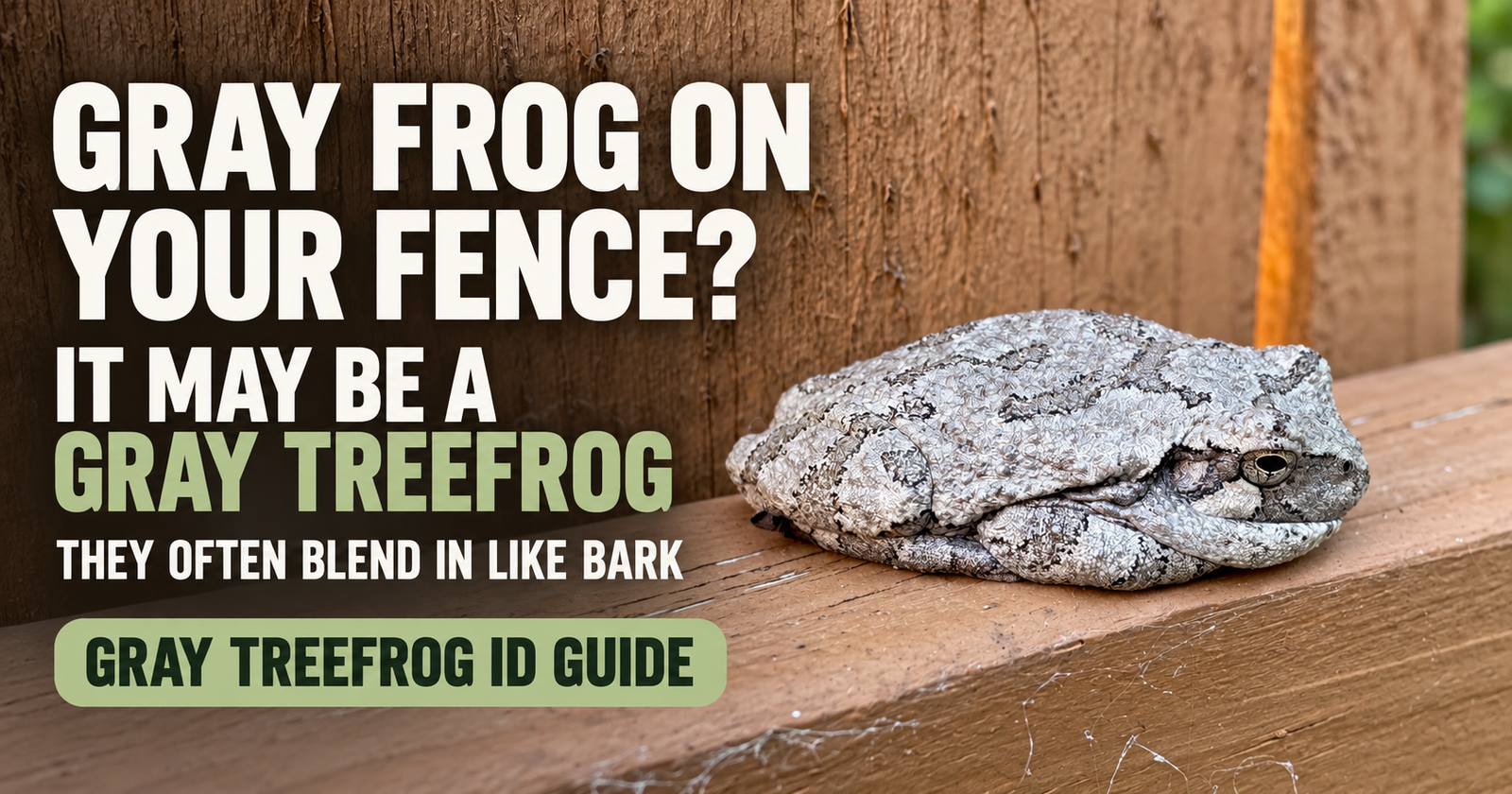
I almost could have walked right past this little guy.
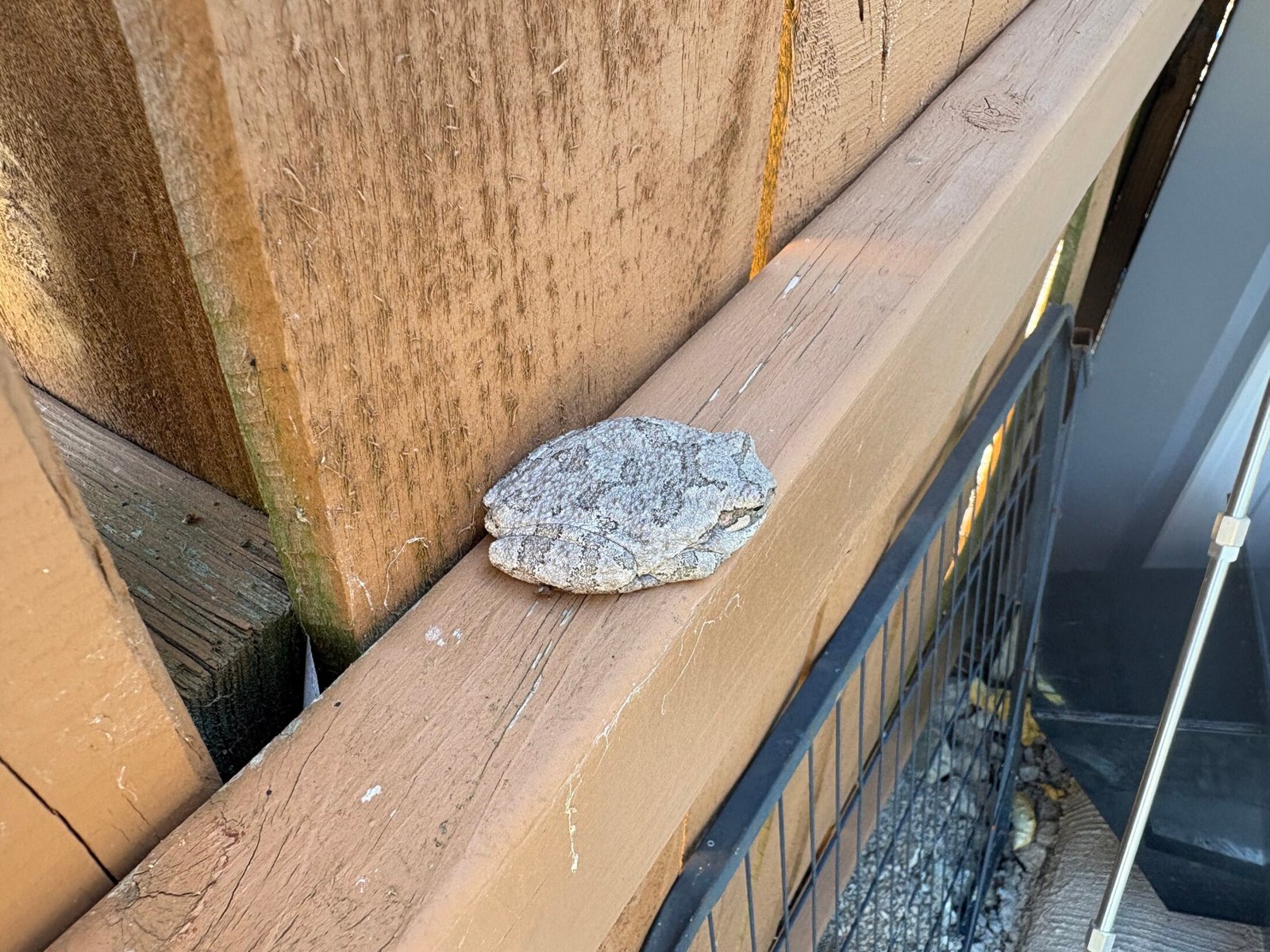
I found this gray frog sitting completely still on the horizontal cross board of a wooden fence on a cool fall day. It was roughly 70 degrees outside, the fence was shaded, and the frog’s gray mottled back blended surprisingly well with the weathered wood around it.
At first glance, it almost looked like part of the fence.
After looking closely at the frog’s shape, textured skin, coloring, and especially the light-colored patch beneath its eye, this appears to be one of Missouri’s gray treefrogs.
There’s one catch to giving it a more exact name.
Missouri actually has two nearly identical gray treefrogs: the gray treefrog (Dryophytes versicolor) and Cope’s gray treefrog (Dryophytes chrysoscelis).
They look so similar that I wouldn’t claim to know which of the two I photographed from appearance alone.
And honestly, that makes this frog even more interesting.

What Kind of Gray Frog Did I Find?
The frog in my photos fits the gray treefrog group very well.
Missouri Department of Conservation describes both species as having granular or somewhat warty-looking skin with colors that can include:
- Gray
- Light greenish gray
- Brown
- Dark brown
- Green
They usually have irregular darker blotches across the back, and there’s an especially useful identification mark:
a large white or gray spot beneath each eye.
That light patch is visible on the frog I found.
MDC actually calls the white patch below the eye an identifying characteristic of gray treefrogs.
Once you know to look for it, it’s much easier to notice.
The Camouflage Was the First Thing That Got My Attention
What impressed me most wasn’t the frog’s size.
It was how well it disappeared.
Its back looked almost like a piece of weathered bark or lichen.
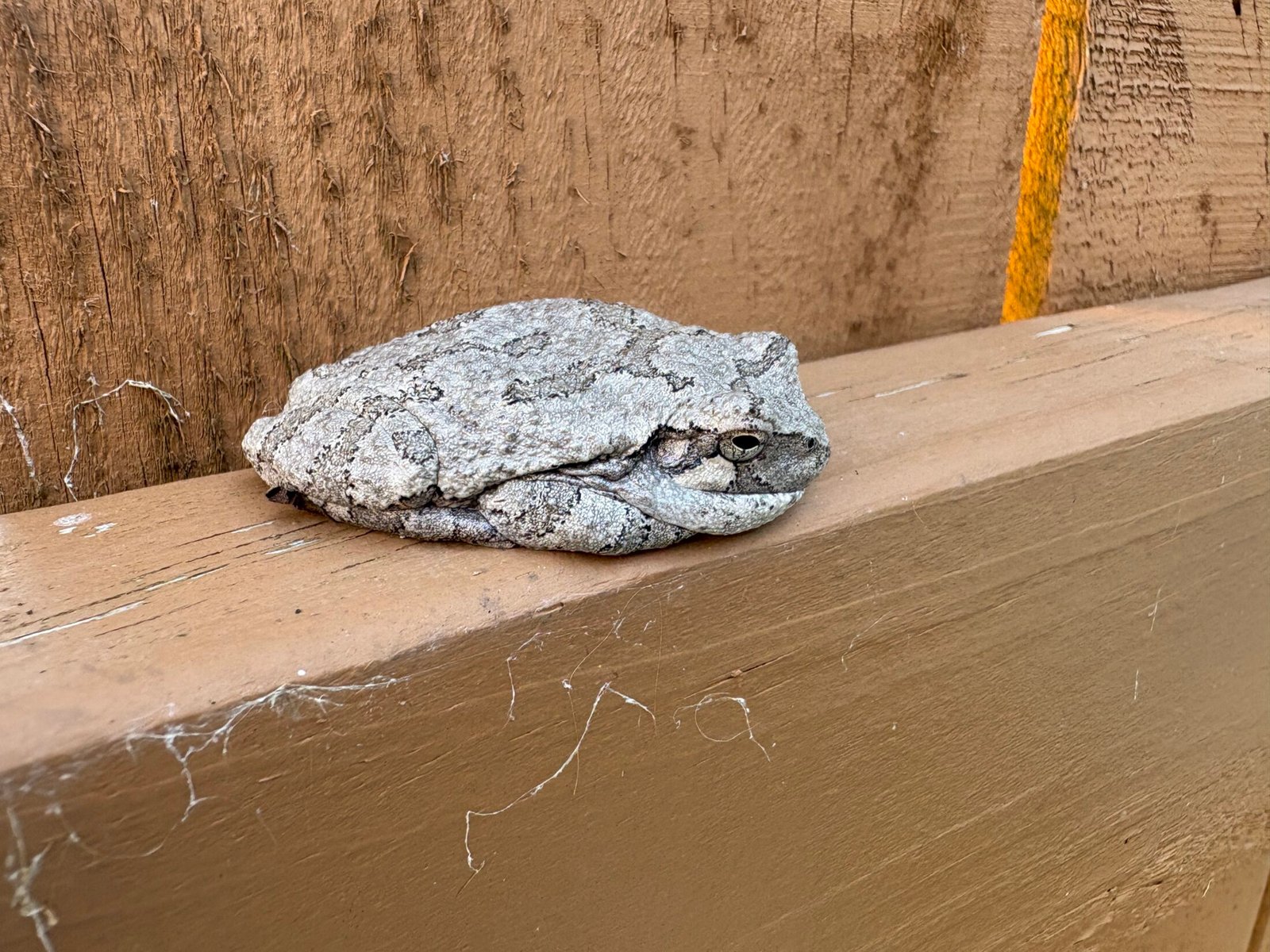
Gray.
White.
Blackish mottling.
Irregular little patterns.
Put that against an old wooden fence and the frog becomes surprisingly difficult to notice.
That’s exactly what gray treefrogs are built for.
MDC describes their mottled gray and green coloring as excellent camouflage against lichen-covered tree bark.
My frog wasn’t sitting on a tree trunk.
It was sitting on lumber.
But the camouflage still worked incredibly well.


Gray Treefrogs Can Actually Change Color
Here’s where these frogs get even cooler.
That gray coloration isn’t necessarily permanent.
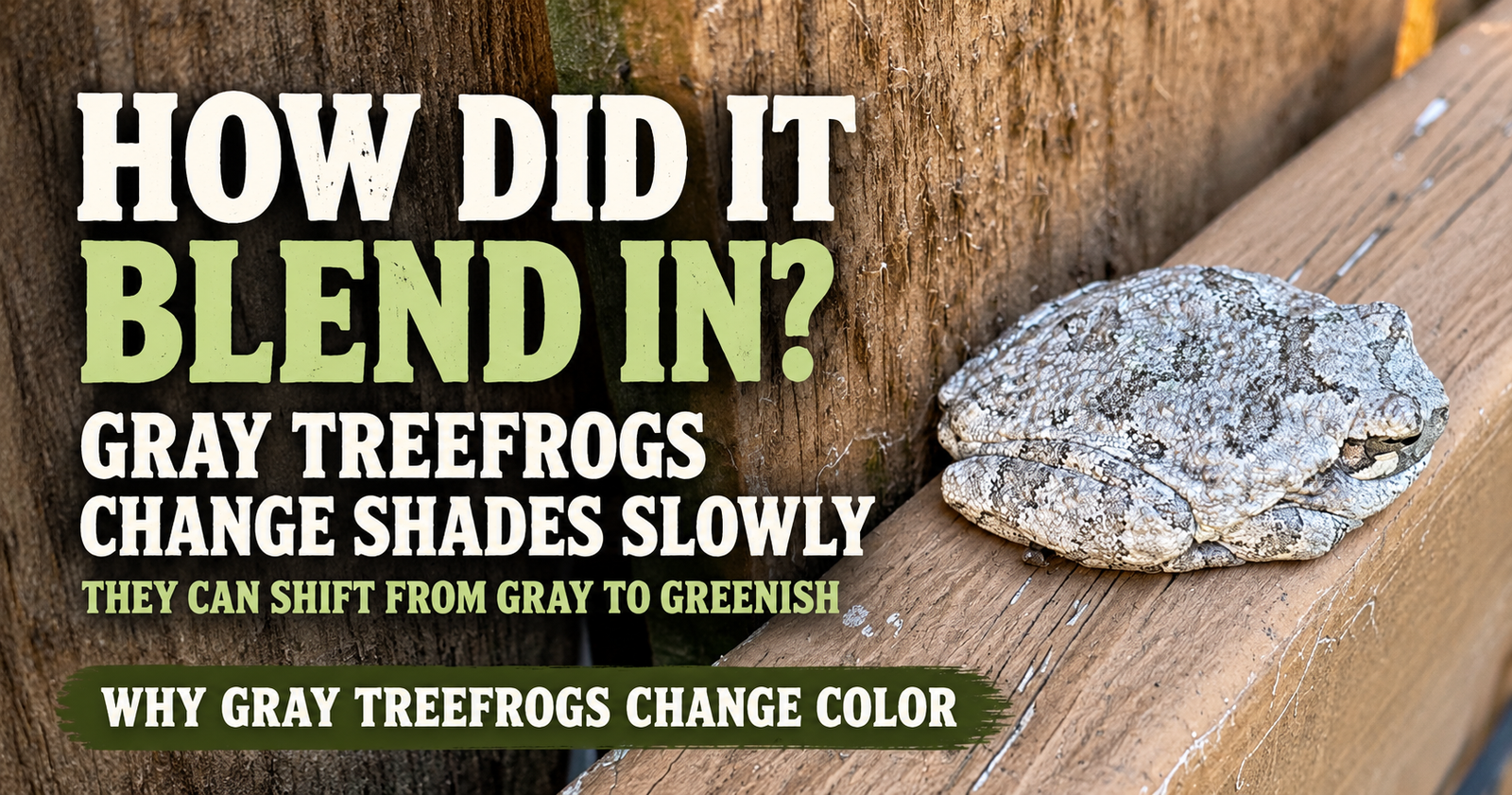
Gray treefrogs can change their body color.
MDC says temperature, humidity, light, activity, and even the frog’s temperament can influence its coloration. Depending on the conditions, a gray treefrog may appear gray, brown, greenish gray, or green.
MDC’s 2026 feature on the species describes them shifting among gravel-gray, bark-brown, and leaf-green shades to better blend with their surroundings.
So if you find a green treefrog-looking animal one day and a gray one another day, color alone doesn’t necessarily mean you’re looking at completely different species.
That deserves its own article because there’s quite a bit more going on than simply “the frog matches the fence.”
Why Was a Treefrog Sitting on My Wooden Fence?
This actually isn’t strange behavior for a gray treefrog.
Despite the name, they don’t limit themselves to trees.
MDC says people commonly encounter them around houses and other human structures, including:
- Porches
- Decks
- Farm buildings
- Gutters
- Birdhouses
- Windows
They have adhesive pads on their fingers and toes that make them excellent climbers.
A horizontal wooden fence board is therefore a completely believable resting spot.
The frog I found was flattened down and sitting quietly in the shade.
It certainly wasn’t acting like an animal desperate to get back to a pond.
That’s because adult gray treefrogs spend much of their lives away from open water.

Gray Treefrogs Spend a Lot of Time Above Ground
During summer, gray treefrogs spend much of their time in deciduous woodland canopies.
MDC says they hide in:
Knotholes.
Cracks.
Crevices.
Bird holes.
Tree cavities.
And other protected spaces.
They may even return repeatedly to the same hiding cavity.
During the day, resting and staying concealed makes sense.
At night, they’re much more active.
That’s when these little frogs become hunters.
What Do Gray Treefrogs Eat?
Mostly small animals you’d probably rather have the frog eating than crawling around your house.
Gray treefrogs eat insects, spiders, and other invertebrates.
According to MDC, ants and beetles can make up nearly three-fourths of their diet.
They also take advantage of something humans unintentionally provide:
Outdoor lights.
A porch light attracts insects.
Insects attract treefrogs.
MDC specifically notes that gray treefrogs may perch around porch lights at night to hunt the insects gathering there.
So finding one around a porch, deck, fence, siding, or another structure doesn’t mean something is wrong.
It may simply be using your property as hunting territory.
Is a Gray Treefrog Around the House a Problem?
I wouldn’t consider one a problem just because it’s sitting on a fence, deck, porch, or side of the house.
Quite the opposite.
It’s eating insects.
It’s not chewing your siding.
It’s not digging through your insulation.
It’s not raiding your pantry.
And it isn’t trying to establish a mouse colony behind the refrigerator.
For me, this is the kind of critter I’d rather observe and leave alone.
If anything, finding a native treefrog quietly resting around the property is pretty neat.
How Big Do Gray Treefrogs Get?
They’re not huge frogs.
Missouri’s gray treefrogs generally measure about 1¼ to 2½ inches from snout to vent, although MDC notes that individuals can occasionally be larger.
Their chunky body can make them look bigger than the measurement suggests.
The frog I found was tucked into a compact resting position with its legs folded tightly alongside its body.
That flattened posture probably helped the camouflage even more.



The Skin Looks Almost Like Lichen
If you’re trying to identify one yourself, don’t expect smooth, shiny frog skin.
Gray treefrogs have a noticeably granular texture.
Combined with those irregular dark blotches, the texture helps break up the outline of the body.
From even a short distance away, you may notice the frog’s eye before you really process the rest of the animal.
That’s basically what happened with this one.
Once I noticed it, the frog was obvious.
Before I noticed it, it blended into the fence surprisingly well.
Check Beneath the Eye
If you’re looking at a mystery gray frog, this is one of the features I’d check.
Gray treefrogs have that distinctive light patch beneath each eye.
The underside of the body is generally white to cream, while the concealed inner portion of the hind legs has yellow or orange-yellow coloration with darker mottling.
You may not see the bright hind-leg color when the frog is resting.
I wouldn’t bother the frog just to make it show you.
Use the characteristics you can observe naturally.
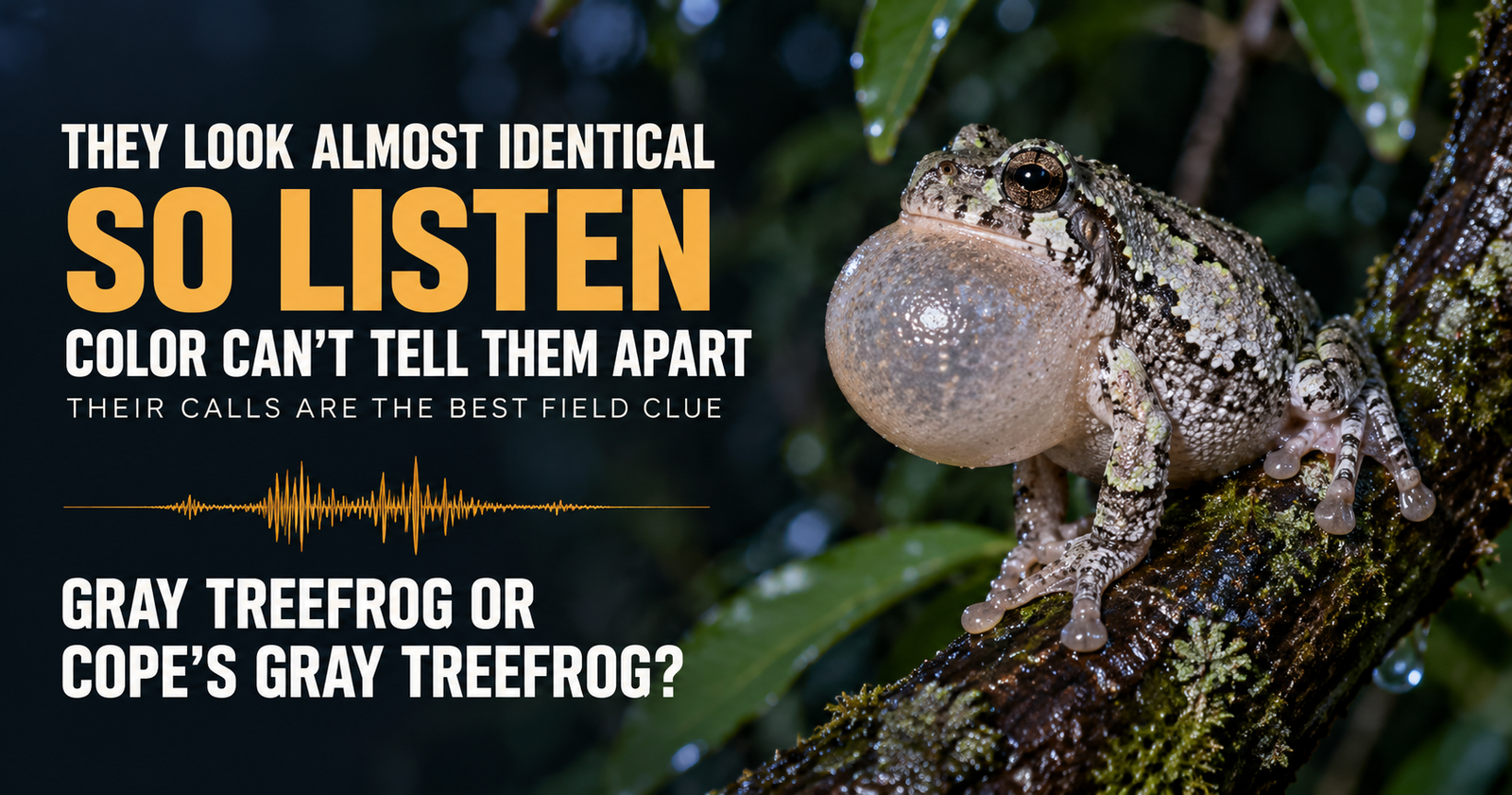
Gray Treefrog or Cope’s Gray Treefrog?
Here’s where identification gets tricky.
Missouri has both:
Gray treefrog — Dryophytes versicolor
and
Cope’s gray treefrog — Dryophytes chrysoscelis
Visually, they’re basically twins.
MDC says the two are so similar that one of the better ways to distinguish them is by listening to their calls.
The gray treefrog produces a more musical, birdlike trill.
Cope’s gray treefrog produces a faster, higher-pitched buzzing trill.
Even that isn’t always as simple as listening to one random recording because air temperature changes aspects of their calls.
Scientists can use sonograms and analyze pulse rates when they need a more certain identification.
That’s why I’m comfortable calling my frog a gray treefrog, broadly speaking, but I’m not going to pretend the photographs tell me which of the two nearly identical species it is.
Can You Tell the Two Apart by Color?
Not reliably.
MDC notes that Cope’s gray treefrog tends to be slightly smaller and is more often green than the gray treefrog.
But that’s not enough for me to look at one gray individual and confidently assign the species.
Both can vary in color.
Both can be gray.
Both can be greenish.
Both can have the same general mottled appearance.
The call is much more useful.
We’ll dig much deeper into that in a separate gray treefrog vs. Cope’s gray treefrog identification guide.
Is a Gray Treefrog the Same as a Green Treefrog?
No.
Missouri also has a true green treefrog, Dryophytes cinereus.
The green treefrog remains green and has a pale stripe running from its upper lip down the side of its body. In Missouri, it occurs primarily in the southeastern part of the state, with some isolated populations elsewhere.
Gray treefrogs are much more variable in color.
So a green frog isn’t automatically a “green treefrog.”
A gray treefrog can sometimes be green too.
Wildlife identification likes to keep things interesting.
Seeing This Frog in Fall Makes Sense
I found this one during a cool fall day when the temperature was around 70°F.
That’s not unusually late for a Missouri gray treefrog to still be above ground.
MDC says Missouri’s gray treefrogs are normally active from late March through October.
So an early-October frog resting on a wooden structure fits their normal seasonal activity.
But that raises an interesting question.
What happens when it actually gets cold?
The answer is one of my favorite things about this animal.
Gray Treefrogs Can Survive Temporary Freezing
Yes.
A frog that looks this ordinary has an absolutely wild cold-weather survival trick.
Gray treefrogs normally overwinter dormant in soil beneath leaf litter.
They don’t necessarily have to get beneath the frost line.
Their bodies produce cryoprotective substances that help protect their tissues during temporary freezing events.
Basically, they have their own biological version of antifreeze.
Even more interesting, the two gray treefrog species don’t use exactly the same chemistry.
MDC says D. versicolor uses glycerol and glucose as cryoprotectants, while Cope’s gray treefrog uses glucose.
They aren’t invincible. Prolonged freezing can still be fatal.
But surviving temporary freezing is an incredible adaptation for an animal small enough to sit in the palm of your hand.
Will This Frog Stay on the Fence All Winter?
Probably not.
As winter approaches, gray treefrogs generally move down and overwinter beneath leaf litter and in soil where moisture and temperature conditions are more suitable.
So the frog I saw resting on the fence in early fall isn’t necessarily choosing that board as its winter home.
It’s still within the species’ normal active season.
As colder conditions settle in, its behavior changes.
That’s another topic worth its own article because where gray treefrogs go in winter is much more interesting than I expected.
Should You Move a Gray Treefrog?
If it’s sitting safely outside like this one was, I wouldn’t see a reason to.
It’s already where a treefrog can reasonably be.
Let it rest.
Let it hunt.
Let it move when it’s ready.
Handling wild amphibians unnecessarily isn’t something I encourage. Their skin is important for water balance and other biological functions, and substances on our hands can potentially be harmful.
Observation is usually enough.
And honestly, watching one sit perfectly still while pretending to be part of a fence is more interesting than picking it up anyway.
What If a Gray Treefrog Is on Your Porch?
I’d leave it alone unless it’s somewhere that puts it in immediate danger.
Porches and decks are normal places to encounter these frogs.
MDC specifically lists both among the human-built structures gray treefrogs commonly use.
If your porch has an exterior light attracting moths and other insects at night, the frog may have found an excellent hunting location.
It isn’t trying to get into your house.
It may simply be waiting for dinner to fly past.
What If You Find One on Your Window?
Also normal.
Their adhesive toe pads make them impressive climbers.
MDC notes that gray treefrogs can be found climbing windows at night around homes.
A light shining through a window can attract insects outside.
That can turn the glass into another feeding area.
If you see a little gray or green frog stuck vertically to the window one evening, don’t assume something is wrong with it.
Treefrogs are built for climbing.
Are Gray Treefrogs Poisonous?
Gray treefrogs are not a dangerous animal I would worry about having around the yard.
As with other wild amphibians, I still wouldn’t encourage unnecessary handling, and I wouldn’t let pets mouth or chew on frogs.
The simple approach works:
Look.
Photograph.
Leave it where it is if it’s safe.
Wash your hands if you do have to handle an amphibian.
There’s no reason to turn a harmless fence visitor into a removal project.
Is It Good to Have Gray Treefrogs Around?
I think so.
They eat insects and spiders.
They’re native wildlife.
They’re interesting to watch.
And they’re one of those animals that can live around us without causing much trouble.
MDC specifically notes the human benefit of gray treefrogs consuming large numbers of insects.
For a site called Critter Answers, I think that’s worth emphasizing.
Not every critter around your house needs to be trapped, poisoned, excluded, or chased away.
Sometimes the answer is:
That’s a native frog doing frog things. Leave the little dude alone.
My Quick Gray Treefrog Identification Checklist
If you’ve found a frog similar to mine, here’s what I’d compare.
Color: Gray, greenish gray, brown, dark brown, or sometimes green.
Back: Usually mottled with irregular darker markings.
Skin: Granular rather than perfectly smooth.
Below the eye: Look for the distinctive white or gray patch.
Feet: Treefrog-style adhesive toe pads for climbing.
Size: Usually around 1¼ to 2½ inches from snout to vent.
Location: Trees, wooded areas, porches, decks, farm buildings, gutters, birdhouses, windows, and other structures can all fit.
Season in Missouri: Generally active from late March through October.
Exact species: Don’t confidently choose gray treefrog versus Cope’s gray treefrog from appearance alone. Their calls are much more useful.
Those clues together make a much stronger identification than simply saying:
“It’s gray, so it must be a gray treefrog.”
This Little Frog Was Better Camouflaged Than I Expected
The more I looked at the photos afterward, the more the camouflage stood out to me.
The frog’s mottled back looked almost like the weathering and natural variation in the wood around it.
That’s probably the coolest part of finding wildlife like this around the property.
I wasn’t walking through a swamp looking for frogs.
I wasn’t turning over logs.
I wasn’t searching around a pond.
It was simply sitting there on a wooden fence board in the shade on a cool fall day.
And if I hadn’t happened to notice the shape of the body and that eye looking out from the gray pattern, I could have walked right by.
If you find one around your own house, fence, deck, or porch, take a closer look before assuming it’s just another ordinary frog.
That bark-like camouflage, granular skin, climbing ability, and pale patch beneath the eye may mean you’ve found one of Missouri’s gray treefrogs too.
And if yours looks greener than mine?
Don’t rule it out.
That may be the same kind of frog showing off one of its best tricks.
About the author: Mason Alder writes about frogs, reptiles, insects, and other small wildlife people unexpectedly find around their homes and property. At Critter Answers, he focuses on identifying what you found, explaining why it’s there, and helping you decide when a critter can simply be left alone.